
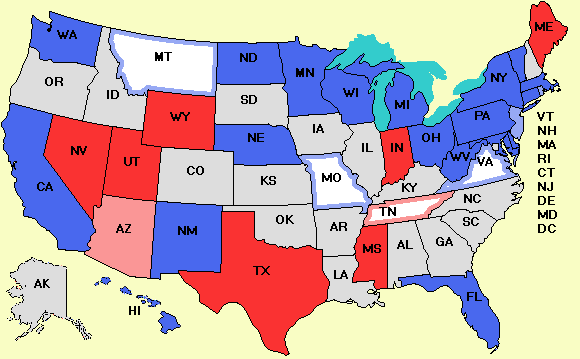
New Senate: 51 Democrats 49 Republicans
|
|


| Oct. 12 | Pickups: | Missouri, Montana, Ohio, Pennsylvania, Rhode Island, Virginia |  |
 Welcome
 General FAQ
 Polling FAQ
 Votemaster FAQ
 Donations
 All Senate races
 Hot House races
 Poll Graphs
 More election data
 Senate info
 Political websites
 Articles and books
 2004 Election
 EVP track record
 Political humor
 For bloggers
 Animated map
 Contribute a page
News from the Votemaster
Let's take a look at how the pollsters did. Below is a table given the final vote in column 2, followed by the results of 8 pollsters. Each cell consists of the Democratic percentage minus the Repubican percentage. For example, in Arizona, the Democrat - Republican value is -9, meaning the Republican won by 9%. In California, the last poll from Mason-Dixon predicted a Democratic win by 30% (it was actually only 24%).
| State | Vote | Gallup | M-D | Polimetrix | Quinnipiac | Rasmussen | Research 2000 | SurveyUSA | Zogby |
| Arizona | -9 | -8 | -4 | -9 | -13 | -8 | |||
| California | 24 | 30 | 32 | 23 | 29 | ||||
| Connecticut | -10 | -4 | -12 | -8 | -12 | -11 | -12 | ||
| Delaware | 41 | ||||||||
| Florida | 22 | 24 | 26 | 35 | 17 | 18 | 23 | 29 | |
| Hawaii | 24 | ||||||||
| Indiana | -87 | ||||||||
| Maine | -53 | -46 | |||||||
| Maryland | 10 | 15 | 3 | 6 | 5 | 3 | 5 | ||
| Massachusetts | 38 | 40 | 30 | ||||||
| Michigan | 16 | 16 | 15 | 16 | 11 | 10 | 7 | ||
| Minnesota | 20 | 10 | 10 | 18 | 14 | 16 | 8 | ||
| Mississippi | -29 | -37 | |||||||
| Missouri | 3 | 4 | 1 | 0 | -1 | 0 | 6 | 3 | |
| Montana | 1 | 9 | 0 | 2 | 1 | ||||
| Nebraska | 28 | 20 | |||||||
| Nevada | -14 | -17 | -11 | -12 | -14 | -21 | |||
| New Jersey | 8 | 10 | 7 | 6 | 5 | 5 | 6 | 12 | |
| New Mexico | 42 | 24 | 20 | ||||||
| New York | 36 | 35 | 30 | 24 | |||||
| North Dakota | 40 | 22 | |||||||
| Ohio | 12 | 2 | 6 | 18 | 12 | 12 | 12 | 7 | |
| Pennsylvania | 18 | 18 | 13 | 16 | 10 | 13 | 8 | ||
| Rhode Island | 6 | 3 | -1 | 8 | 14 | ||||
| Tennessee | -3 | -3 | -12 | -5 | -4 | -5 | -10 | ||
| Texas | -26 | -36 | -26 | -19 | |||||
| Utah | -31 | -30 | -32 | ||||||
| Vermont | 33 | 32 | 21 | ||||||
| Virginia | 0.2 | -3 | 1 | 0 | 0 | 8 | 1 | ||
| Washington | 17 | 16 | 14 | 11 | 8 | 4 | |||
| West Virginia | 30 | 34 | 33 | ||||||
| Wisconsin | 37 | 45 | 27 | 9 | |||||
| Wyoming | -40 | -41 | -27 |
To see how well a pollster did, we can subtract the actual difference between the candidates from the predicted on. For example, in the table below, if we subtract Mason-Dixon's prediction for Arizona (-8) the actual vote total (-9) we get 1. In other words, Mason-Dixon predicted that the Democrat would do 1% better than he actually did. A perfect pollster would have a column consisting entirely of 0s. Since the margin of error in predicting each candidate's score is about 4%, the margin of error in predicting the difference is about 8%. Thus to a first approximation, any number less than or equal to 8 should be considered a correct prediction. Anything more than 8 is wrong.
| State | Gallup | M-D | Polimetrix | Quinnipiac | Rasmussen | Research 2000 | SurveyUSA | Zogby |
| Arizona | 1 | 5 | 0 | -4 | 1 | |||
| California | 6 | 8 | -1 | 5 | ||||
| Connecticut | 6 | -2 | 2 | 10 | -1 | -2 | ||
| Delaware | ||||||||
| Florida | 2 | 4 | 13 | -5 | -22 | 1 | 7 | |
| Hawaii | ||||||||
| Indiana | ||||||||
| Maine | 7 | |||||||
| Maryland | 5 | -7 | -4 | -5 | -7 | -5 | ||
| Massachusetts | 2 | -8 | ||||||
| Michigan | 0 | -1 | 0 | -16 | -6 | -9 | ||
| Minnesota | -10 | -10 | -2 | -6 | -4 | -12 | ||
| Mississippi | -8 | |||||||
| Missouri | 1 | -2 | -3 | -4 | 1 | 3 | 0 | |
| Montana | 8 | -1 | 1 | 0 | ||||
| Nebraska | -8 | |||||||
| Nevada | -3 | 3 | 2 | 14 | -7 | |||
| New Jersey | 2 | -1 | -2 | -3 | -3 | 2 | 4 | |
| New Mexico | -18 | -22 | ||||||
| New York | -1 | -6 | -12 | |||||
| North Dakota | -18 | |||||||
| Ohio | -10 | -6 | 6 | 0 | 0 | 0 | -5 | |
| Pennsylvania | 0 | -5 | -2 | -8 | -5 | -10 | ||
| Rhode Island | -3 | -7 | 2 | 8 | ||||
| Tennessee | 0 | -9 | -2 | -1 | -2 | -7 | ||
| Texas | -10 | 0 | 7 | |||||
| Utah | 1 | -1 | ||||||
| Vermont | -1 | -33 | ||||||
| Virginia | -3 | 0 | 0 | 0 | 7 | 0 | ||
| Washington | -1 | -3 | -6 | -9 | -13 | |||
| West Virginia | 4 | 3 | ||||||
| Wisconsin | 8 | -10 | -28 | |||||
| Wyoming | -1 | 13 |
I may not be able to get to the computer for a couple of days, but I will try to do this analysis for the House sooner or later.
Projected New House*: 230 Democrats 197 Republicans 8 Ties
See complete House polls.Dem pickups: AZ-05 AZ-08 CA-11 CO-07 CT-05 FL-16 FL-22 IA-01 IA-02 IN-02 IN-08 IN-09 KS-02 KY-03 MN-01 NC-11 NH-01 NH-02 NY-19 NY-20 NY-24 OH-18 PA-04 PA-07 PA-08 PA-10 TX-22 WI-08
GOP pickups:


 See the details of the
Senate and
House races with photos, maps, links, polls, etc.
See the details of the
Senate and
House races with photos, maps, links, polls, etc.
If you like this site, please announce it to news groups and blogs and tell your friends about it. If you have your own blog, please click on "For bloggers" above.
-- The Votemaster
