
Dem
47

GOP
53

As long as we are on the subject of ballot initiatives, how about this? Most states in the West and some others have citizen ballot initiatives in their constitutions. Here is the map of where they exist:
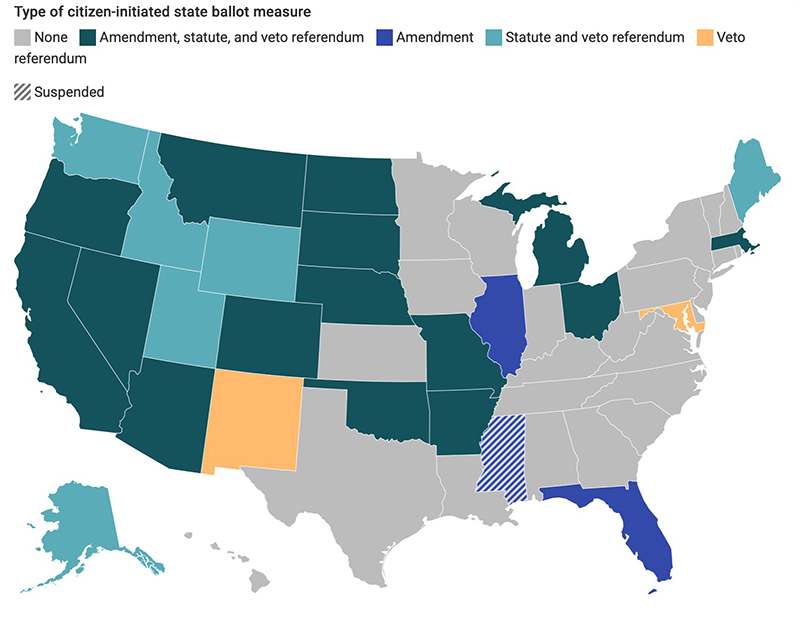
The only states west of the Mississippi River with no referenda are Minnesota, Iowa, Kansas, Louisiana, Texas and Hawaii, although the kinds of ballot measures allowed varies by state.
Citizen-initiated ballot measures were intentionally inserted in the state constitutions because the authors did not trust politicians and wanted to give citizens a way to override state legislatures. In many states, legislators scoff at the idea that ordinary citizens might know more than the state legislators about what is best for the people. In multiple states, legislators are now trying to get pesky citizens to shut up and bow to what their betters decide. In some states, legislators are trying to make it harder to get measures on the ballot and in others the goal is to make it harder to pass them once they have made it. In all cases, the message is: Kindly shut up and do what you are told by us.
In North Dakota, South Dakota and Utah, the state legislators have put measures on the November ballot requiring measures to get 60% instead of 50% to pass. In Missouri, a ballot measure would require a majority in all eight U.S. House districts. A measure with 95% approval statewide would fail if it got 49% in one House district. The not-very-hidden goal is to eliminate statewide referendums on the sly.
In Florida, Gov. Ron DeSantis (R-FL) signed a bill imposing a new raft of rules on initiatives. As a consequence, all 22 citizen initiatives proposed this year failed for one reason or another. For example, groups organizing ballot measures have to pay a fee to have each signature verified. The fees vary by county, but statewide the average is $3.50 per signature. Since about 880,000 signatures are needed to get on the Florida ballot, this means organizers have to pay the state $4-5 million just to have the signatures verified (organizations always collect more than they need since some are always ruled invalid).
Legislators are pleased as punch with all the measures restricting initiatives. President of the Utah Senate Stuart Adams last year said: "We will not let initiatives driven by out-of-state money turn Utah into California." On the other hand, Chris Melody Fields Figueredo, executive director of the Ballot Initiative Strategy Center, said of the state legislators: "They cannot win fairly so they are changing the rules of the game."
The reason initiatives are a pain in the rear for Republican state legislatures is that they were put in power by gerrymandering, and initiatives are an end run around the gerrymander. If gerrymandering were abolished, then state legislatures would much better represent the will of the people, in which case letting them decide might not be so bad. But that is far from where we are now.
In some cases, the voters do something that the lobbyists who own the state legislators don't like and the legislature gets to work to neuter what the voters have foisted upon them. In some cases the lobbyists are corporations, but in other cases the lobbyists are special-interest groups. For example, in 2024, Missouri voters passed a measure guaranteeing the right to an abortion. Anti-abortion groups don't care what the people want because they know they are right. So the legislature has placed an initiative on the November ballot to undo the evil 2024 initiative. In South Dakota, the voters expanded Medicaid. The legislature would prefer that poor people go somewhere else like, say, North Dakota, so they wrote an initiative to contract Medicaid. In many of these battles, the side with the most money wins.
Once in a while, a state official says the quiet part out loud by accident. Missouri state Rep. Ed Lewis (R) admitted that rules are needed to keep highly populated urban and suburban areas from working their will on lightly populated rural areas. In other words, he opposes rule by the majority and prefers rule by the minority, as long as it is his minority. (V)