
Dem
47

GOP
53

At the moment, seven states have altered their House district maps since the 2024 election. The states where the maps moved in a Republican direction are Texas (+5 GOP seats in the best-case scenario for Republicans), Ohio (+2), Missouri (+1) and North Carolina (+1). The states where the maps moved in a Democratic direction are California (+5 Dem seats in the best-case scenario for Democrats), Virginia (+4) and Utah (+1). That's +9 for the Republicans and +10 for the Democrats, which is basically a wash.
Yes, there are some remaining wildcards. The first is that the Virginia map may or may not stand up to legal scrutiny; it's already been the target of an injunction (albeit from a hyperpartisan Republican judge). The second is that Florida may still try to squeeze its maps to create a few more GOP seats. Certainly, that is what Gov. Ron DeSantis (R-FL) wants to do. However, that runs headfirst into the third wildcard, which is that the maps being drawn are based on voting patterns in an election where Donald Trump was on the ballot AND was much more popular than he is now. There is a fair chance that the Texas map will turn into a dummymander, and will hurt Republicans more than it will help them. Because of that risk, members of the Florida legislature might not be keen to do DeSantis' bidding.
(We recognize that there is a fourth potential wildcard, namely the Supreme Court gutting what's left of the Voting Rights Act of 1965, and thus killing off several majority-minority districts in the South. However, that's not a gerrymandering issue, per se, and besides, it does not look like that ruling will arrive in time to impact this year's election cycle.)
The upshot is that, at the moment, it sure looks like the Republicans' efforts to game the system, which started when Donald Trump made a phone call to his good buddy Gov. Greg Abbott (R-TX), have failed. And so, following the setback in Virginia this week, there is a lot of finger-pointing going on. In short, House Republicans blame Donald Trump for starting a fight that he didn't win, and that is certain to cost some of them their jobs. Meanwhile, the White House is furious that House Republicans, particularly those from Virginia, did not do more to try to prevent the Democratic gerrymander, up to and including raiding their campaign war chests to pay for anti-gerrymander ads. If the GOP is to have any hope of fending off a disaster in November, there will need to be very close cooperation between the members of Congress who are up for reelection and the White House, since Trump controls both the bully pulpit and an enormous amount of PAC money. The pi**ing contest over the gerrymandering does not bode well for that cooperation.
On the other side of the aisle, the buzz on the Hill is that the Gerrymandering War, and in particular the Battle of Virginia, is the first signature win for House Minority Leader Hakeem Jeffries (D-NY), and the first real proof that he might just be able to fill the very big shoes that Speaker Emerita Nancy Pelosi (D-CA) left behind. Even Pelosi herself has been singing his praises, declaring that her protégé handled redistricting "fabulously." Certainly, all of this should send a message to Republican politicians and to Democratic voters that the blue team's leadership is learning how to use the levers of power available to the minority party. It also makes clear that Democrats have at least temporarily decided to cast aside Michelle Obama's advice to "go high," and that they are willing to "go low" when they have to. Both lessons may give Republican politicians pause, and may serve to energize Democratic voters.
Meanwhile, allow us to pass along a comparison that has been making the rounds on social media. It's the op-ed that The Washington Post ran after Texas started the Gerrymandering War, and the op-ed the paper ran after Virginia (potentially) finished it:
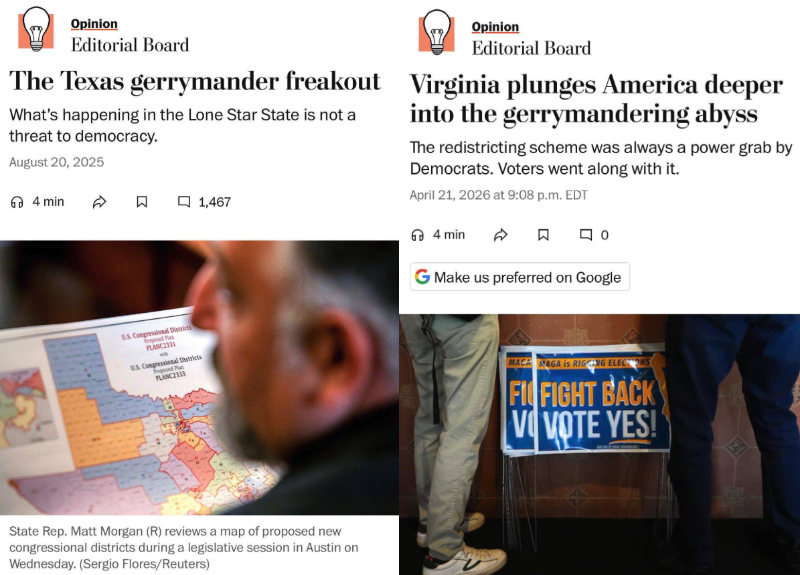
That's your idea of "fair and balanced," Mr. Bezos?
We do not agree with the Post's claim that the Virginia gerrymander was a power grab. That's like saying that it was a power grab when Ukraine counterattacked in Donetsk. We do agree that what happened in Virginia sent the country further down the gerrymandering abyss. And, truth be told, we hope the country goes further still down that abyss. It will not be until the majority of voters, including the low-information ones, perceive that there's a serious problem that the country will get some sort of meaningful fix to this obviously undemocratic practice that has now been going on for two centuries. (Z)