
Dem
47

GOP
53

Authoritarians and would-be authoritarians, like Donald Trump, understand that control of the media is essential to maintaining power. Having newspapers, radio and television stations, and other media sources constantly showing that the administration is corrupt and self-dealing can set the population against the administration. This must be prevented at all costs.
Trump's point man on this is FCC Chair Brendan Carr, who is doing his best to change the rules to make the media more Trump-friendly. One of the things Carr understands very well is that the major TV landscape has two kinds of players. There are the networks, like ABC, CBS, NBC, CNN, Fox, and a few others. And then there are the individual television stations. The networks, by law, don't actually own many television stations. ABC, for example, owns only eight stations, and two of them are in small markets (WTVD in Raleigh-Durham and KFSN in Fresno). Trump perceives the networks, with the exception of Fox, as very liberal and the stations as conservative. To some extent, that is true. There are about 1,500 full-power television stations in the U.S. The biggest owner of stations is Nexstar, with 259 stations. It is quite conservative. Sinclair is second, with 183 stations. It is exceedingly conservative. Gray Television is third with 113. Tegna has 64 and Hearst has 33. Here is a map showing where Nexstar's (current) stations are located:
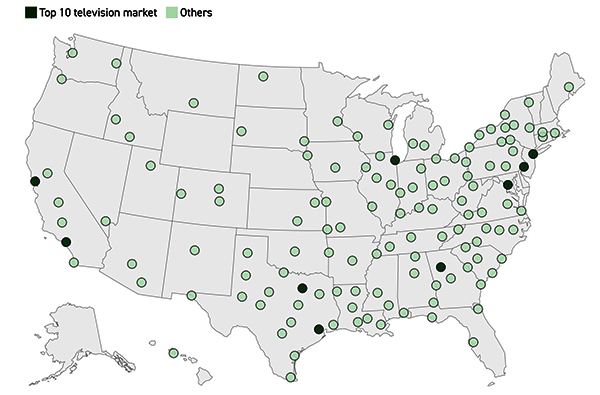
Nexstar is trying to buy Tegna for $6.2 billion, but last week a federal judge temporarily blocked the sale until antitrust issues can be resolved. Carr strongly supports the sale. Normally, when the #1 player in an important industry wants to buy #4, the answer is "no," but given the conservative bent of Nexstar, Trump and Carr will do their best to make the deal happen.
Why does station ownership matter? Most stations have a contract with one of the networks that provide it with content. For example, WJLA in D.C. is owned by Sinclair but has a contract with ABC to provide content. Sinclair also owns KUTV in Salt Lake City, which gets its content from CBS. And it owns WTGS in Savannah, which is a Fox affiliate. Big companies that own many stations often have contracts with different networks for different stations.
All contracts allow stations to preempt the network feed a certain number of hours a week for local content. Sinclair is very aggressive about preempting network content for local (and very conservative) content. Sinclair often sends centrally produced (conservative) content to its stations with a "must run" order.
What Carr wants to do is change the balance of power between the networks and station owners to give the station owners, like Nexstar and Sinclair, more power because he knows they will then preempt "liberal" content for "conservative" content. For example, a local station could decide to not run a network special about climate change and replace it with a "documentary" about heinous crimes committed by undocumented immigrants. One of the things high on Carr's list is to allow conservative companies to merge, to make them bigger and more powerful and reach every household. Another of his pet projects is to change the rules so that local stations can preempt more network content and replace it with "local" content (which includes content generated at Sinclair's headquarters) with no penalties, even if it exceeds the amount stated in the contract. Carr also has other plans, all with the goal of increasing the power of the station owners at the expense of the national networks. Of course, even if a Fox affiliate gets more power to replace Fox content with its own content, it doesn't have to do that. It could run Fox content 24/7 if it wants to.
Carr has also directly interfered with content. In Sept. 2025, ABC host Jimmy Kimmel said some things Carr did not like, so Carr ordered the ABC affiliates to pull Kimmel, which they did. Eventually, public pressure caused them to relent and put Kimmel back on the air. Next time, a station could decide that the potential loss of its broadcast license is more important than loss of the ad revenue from some show Carr wants banned.
None of this is what the FCC was designed to do. When all television was over-the-air, some authority was needed to allocate spectrum to specific station owners and prevent chaos in broadcasting. Carr has completely perverted this to use his power to help favored parties in the broadcast world and punish disfavored parties. He has no intention at all of just being a neutral referee. (V)