
Dem
47

GOP
53

After Nate Silver left FiveThirtyEight, he was replaced by another young statistician, G. Elliott Morris. When ABC News killed FiveThirtyEight altogether, Morris struck out on his own with a blog, Strength in Numbers, that does data-based political analysis. What is with all these weirdos writing blogs about polls and politics? Anyhow, Silver has a bit of competition now. Both are good statisticians and model makers, so it will be interesting to see if their models align in the fall. Morris also partners with Mary Radcliffe and Katie Marriner at another data-driven political website, FiftyPlusOne. Sometimes Morris cross-posts an item to both blogs, but mostly they are different.
Morris is now out with his first random simulation model. If you are a computer simulation nerd and really into Bayesian model stacks, here are the details about how Morris' model works. Silver's model will be out next week. Morris' model is really four models in one:
Morris has built four separate models in the past. Each time he left an employer, he couldn't take his old model with him (for copyright reasons), so he had to start all over again each time. This has the advantage that sometimes he realized he did something wrong in a model and wasn't stuck with it because he was forced to start from scratch each time. It is very common in the software world that some company has a piece of ancient software that works but is flawed. Often they decide that it is too difficult to redo it from scratch so they just keep using it. Much software written for the IBM 360 series in the 1960s (in COBOL) is still being used because the companies have long since lost the source code and don't even know which version of COBOL the software was written in. To accommodate these (many) customers, IBM keeps coming out with new versions of the 360 (the zSeries) that are binary compatible with the original 360, but more than 1000x faster and much cheaper and smaller. Morris turned his misfortune into an advantage by being forced to redo his model repeatedly, but with 20-20 hindsight each time.
Anyhow, here are his simulations of the House and Senate at present:
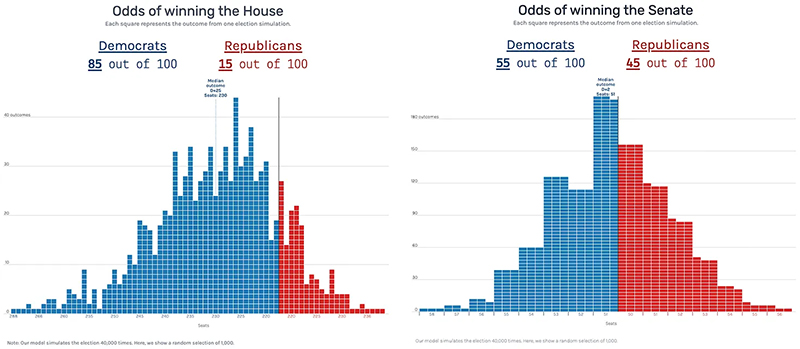
These are the results of 40,000 probability-based simulations. In 85% of the runs, the Democrats controlled the House. In 55% of the runs, they controlled the Senate. The odds of winning both are 50-50, a true tossup. One of the most important factors is the national popular vote (NPV) for Congress. If Democrats win by less than 4%, they are unlikely to win either chamber. In the 4-7% range, they will probably win the House and lose the Senate. If they win the NPV by at least 7 points, they will probably win both. Currently they are roughly at D+8 in the generic House poll, which is a rough predictor of the NPV. Of course, each (Senate) election has its own quirks due to the candidates' campaigns, mistakes, scandals, funding and so on that models can't fully capture. Morris is going to run the model regularly going forward as new Senate polling comes in, the fundamentals (e.g., Donald Trump's approval) change, and the handicappers change their predictions based on all the many factors they consider. The idea is to factor as much available information as possible into the models. The tricky part is to figure out how to weight each piece. (V)