
Dem
51

Ties
1
GOP
48

Yesterday we had an item on why the polls for the Wisconsin gubernatorial election were so far off. As noted yesterday, one of the polls was completely fake, just made up. But there were other polls by legitimate pollsters, that also showed progressive Democrat Francesca Hong way, way ahead. G. Elliott Morris wanted to find out why the legitimate polls were so far off, so he made a deal with pollster State Navigate. The deal was they would give him all their internal data to analyze to find out what they did wrong (something they very much wanted to know). In return, instead of asking for money, he wanted permission to publish his report on his blog, which it granted and he did. Here it is, but be warned it is quite technical.
First, a bit of background. After the 2000 election fiasco in Florida, Congress passed the HAVA (Help America Vote Act). Among its other provisions, it requires states to maintain a proper database of voters, informally called the voter list. What is in the voter list varies by state, but often contains the voter's name, address, date and place of birth, race, gender (identity), precinct, party affiliation, telephone number, e-mail address, Social Security number, driver's license number, voter number, father's name, mother's name, maiden name, political donations, elections voted in, and sometimes more. All states sell their voter lists. Sometimes any legitimate entity can buy them (e.g., political campaigns, pollsters, etc.), sometimes anyone can buy them but only for specific purposes set out in law, sometimes there are more restrictions, and sometimes there are no restrictions at all. Here is a map showing how different states deal with these lists:
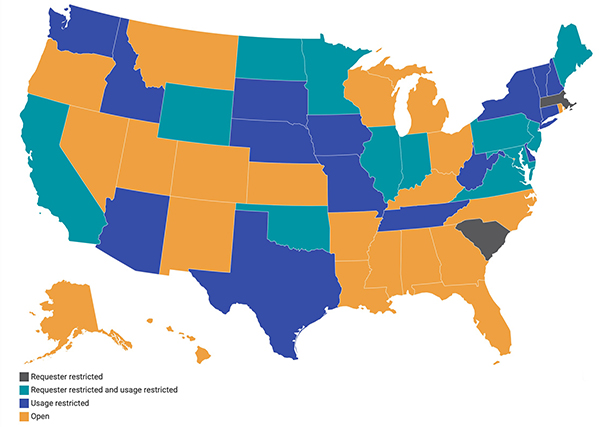
Prices vary from free (e.g., Florida) to $12,500 (Wisconsin). Most states charge less than $1,000.
The first thing Morris learned was how the poll was done. Pollsters rarely use random-digit dialing anymore because nobody answers the phone for unknown callers anymore. What State Navigate did was bite the bullet and buy the Wisconsin voter list. This gave it a list of every registered voter in the state. Then it made a random sample of the actual registered voters and contacted enough of them to get a statistically significant number to agree to take the survey. It did a survey in July and then contacted the same voters in August. This is very significant because then they knew how many individual voters changed their mind in that month, which gave them useful information about trends.
The first good thing about working with a voter list is you know for sure that everyone is a registered voter in the state being polled. With any other method of collecting respondents, you have to trust them when they say they are a registered voter. The sample State Navigate got didn't conform to their model of the electorate. It never does, though, so they corrected it in many ways, based on the voter list data and their own demographic questions at the end. If they wanted a sample with 22% Catholics and they got a sample with 19% Catholics, they counted each Catholic as 22/19 = 1.158 people. Likewise for all the other demographic characteristics they cared (and asked) about. With these corrections, they got a sample that matched what they thought the electorate would be—that is, the right number of Catholics, college graduates, progressives, old people, poor people, Black people, rural voters, and so on for every category.
Based on the raw data, the corrections, the polling results, and the election results, Morris determined that there were three sources of error, from largest to smallest:
So there you have the anatomy of a polling fail. Morris' feedback to State Navigate was to be leery of a sample that contradicts the voter list too much. He also advised doing a sensitivity analysis. That consists changing some parameters up and down and seeing what it does to the results. If small changes in some parameters (e.g., the number of 18-29 year olds in the assumed electorate) changes the results a lot, be very wary. If small changes to all the parameters don't change the result much, you can be more confident in the results. All in all, an interesting study. (V)