Trump Reinstates Colonialism
During the 19th century, the European powers carved up much of the world into colonies for the purpose of extracting
their natural resources and sometimes enslaving the local population to produce agricultural products. In the 20th
century, the colonies got wise and most of them rebelled and became independent nations. Donald Trump seems to be enamored
with the idea of making colonialism great again and has claimed Venezuela's oil as America's. He
thinks
its large supply of oil will lower gas prices.
Guess what? It won't and, even if it did, it would take many years and many many tens of billions of dollars of investment.
There are multiple things wrong with this plan. But before explaining why it won't work, let's take a look at the
question of whether it even matters if the plan might work. Trump's problem is that gas prices are too high now
and he wants them down before Nov. 3. Actually he wants them down earlier, since early voting begins in September in
10 states.
Voters in those states are probably not going to say "Problem solved" with a promise that will be
impossible to fulfill for years at best and never at worst. Trump is hoping that enough voters are
gullible enough to believe him. After all, he won the 2024 election by promising to lower prices on
Day 1. There is no promise so absurd that 30% of the country won't swallow it whole, it seems.
He could promise "a chicken in every garage and a car in every pot" and his supporters would cheer
him on.
The proposed deal would give the U.S. control of 65 billion barrels of Venezuela's 303-billion-barrel proven reserves.
However, it is important to note that
"proven reserves"
is an industry term for the amount of oil in the ground that can be economically extracted at current prices. If
oil prices go up, proven reserves usually go up, too. If oil prices go down, some of the oil won't be profitable to
extract, so the proven reserves go down. The industry term for how much oil is actually in the ground is
OIP.
The deal would create a private joint venture of the U.S. government and a private Venezuelan company. The U.S.
government
will own
55% of the company. Donald Trump is the greatest socialist in American history—you know, the bit about government
ownership of the means of production. Karl Marx is smiling somewhere.
Sorry, President Marx, but this (white) elephant won't fly for so many reasons. Let's take a look:
- Regime Change: The current leader of Venezuela is Delcy Rodriguez. She didn't get the job
by winning an election or pulling off a coup. The U.S. installed her in the top job after capturing Nicolás
Maduro. She is effectively Trump's puppet. Latin America has a long history of unpopular regimes propped up by the U.S.
and other Western powers. Eventually, the people get tired of them and get rid of them. In fact, many of them
expect
the regime to do what it has always done: dole out favors to the wealthy while millions of Venezuelans live in poverty.
Many people are angry with Rodriguez for handing over Venezuela's only resource to Trump and getting nothing in return.
Rafael Ramírez, a Hugo Chávez loyalist in exile, accused Rodriguez of "opening the doors to a new form of U.S.
colonialism." Here is a photo of the protests that are starting already:
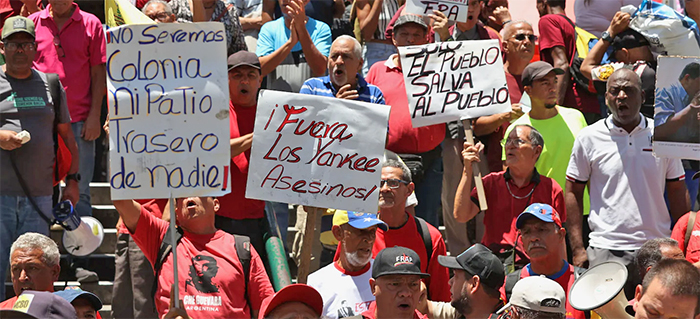
The signs say: "We will not be anyone's colony or anyone's backyard," "Out with the murderous Yankees," and "Only the people
save the people." What could possibly go wrong with Trump's plan? Revolutions do happen from time to time in that neck of the woods and
the next Venezuelan leader might not be so keen on the deal. Also, the next Democratic president of the U.S. might not be either.
- Renationalization: Venezuela has a history of nationalizing foreign oil interests in its
country. In 1976, President Carlos Andrés Pérez took control of most oil operations in the country and
created a local company, PDVSA, to run the business. U.S. companies received some compensation, but less than they
thought their assets were worth. In 2007, President Hugo Chávez took control of most of the rest of the oil
projects from ExxonMobil and ConocoPhillips. They were very unhappy about this and sued the country. Any company
investing big bucks in Venezuela again has to consider the very real possibility that a future Venezuelan government
will once again nationalize their facilities at some point. Investing now is a billion-dollar gamble, particularly
in a world moving toward renewables.
- Massive Investment: Due to government mismanagement, the petroleum infrastructure in
Venezuela is a shambles. It will have to be rebuilt largely from scratch and the parts that are suitable will have to be
upscaled to handle greater production. We are talking here about tens of billions of dollars in a very risky
environment. Do oil companies really want to bet the farm on a very shaky endeavor (rather than, for example, trying to
become the dominant forces in the solar energy business)? Maybe if the U.S. government guarantees their investment they
might do it. That would leave a future (Democratic) administration holding the bag if things go south in South America.
We haven't yet figured out how the Trump family will profit personally from the deal, but we doubt Trump has forgotten about
the possibility altogether.
- Wrong Oil: Oil is not oil, just like rocks are not rocks. There are many kinds of oil in
the ground. Venezuelan crude does not flow, and is more like tar than like gasoline. It is very difficult and expensive
to refine. It is also very high in sulfur and heavy metals, which makes it especially polluting compared to Texan or
Saudi Arabian oil. Removing the impurities is possible but makes the refining process difficult and expensive. The oil
is also very corrosive (due to high acidity), which damages refinery equipment and makes maintenance of the refinery especially
expensive. Finally, the oil is not suitable for gasoline or jet fuel unless heavily blended with lighter oil. It is good
for making asphalt for roads and for heavy fuel oil. The market does not
value
Venezuelan oil highly.
- Refining Capacity: Refining high-sulfur Venezuelan heavy crude requires specialized
refineries. The U.S. does have some in Texas and Mississippi, but they are about 30 years old. They will need to be
upgraded to become modern and new ones will have to be built from the ground up since other refineries can't handle
heavy crude. Building a single new refinery costs $5-20 billion, with the high-end more likely for large-scale
production from high-sulfur heavy crude.
It typically takes 4-10 years from the go-ahead decision to the moment the first barrel of output flows.
Extra complex refineries, like the ones needed for heavy crude, tend to be on the upper end.
- Green New Deal: If a young Democrat is elected president in 2028, he (or conceivably, but
less likely, she) is probably going to actively reverse everything Trump has done to promote the fossil fuel industry (with
one footnote). Solar and wind power will be the president's top priority. There will probably be big subsidies for
renewable energy, making it more than competitive with fossil fuels. Are oil companies going to invest tens of billions of
dollars in extraction technology in Venezuela and upgraded and new refineries in America when there is a roughly 50-50
chance that in 2 years the president will be actively trying to make their entire industry obsolete? It wouldn't be the
first time a CEO couldn't see beyond the next quarter, but some of them may see the risk here. The one footnote that could
give the industry a short reprieve is a 50-50 Senate on Jan. 3, 2029. Then the Democrats could beg Sen. Lisa Murkowski
(R-AK) to become Sen. Lisa Murkowski (I-AK) and caucus with them. They could offer her the choice of chairing any
committee she chose. Her price might well be not killing off the oil industry. Democrats would take that deal since
getting control of the Senate could enable many of their priorities (protecting democracy, elections, abortion, Supreme Court
reform, blocking bad judicial nominations, gun violence, LGBTQ+ rights, etc.) at the expense of just one priority.
We have been surprised by how most media outlets have simply parroted Trump's description of what a great project
this is and how America will profit greatly from it. We have seen remarkably few comments from major outlets pointing
out all the potential pitfalls, as described above. Maybe we are seeing monsters when there is in fact only smooth
sailing ahead. But we doubt it. And see our fourth item today as a possible explanation.
All in all, it is by no means certain that anything will come of Trump's plans, but for some voters, all they hear
is: "Trump is going to lower gas prices." They couldn't tell high-sulfur Venezuelan heavy crude from West Texas light
sweet oil if you gave them a barrel of each, but they "know" that gas will soon be $2.50/Gal. again. That's all they need
to "know." (V)
This item appeared on www.electoral-vote.com. Read it Monday through Friday for political and election news,
Saturday for answers to reader's questions, and Sunday for letters from readers.
www.electoral-vote.com
State polls
All Senate candidates


