
Dem
47

GOP
53

Virginia legislators were none too happy when red states began redrawing their congressional maps to favor Republicans. Currently the Virginia delegation to the U.S. House is 6D, 5R. Here is the delegation:
| District | PVI | Incumbent |
| VA-01 | R+3 | Rob Wittman (R) |
| VA-02 | EVEN | Jen Kiggans (R) |
| VA-03 | D+18 | Bobby Scott (D) |
| VA-04 | D+17 | Jennifer McClellan (D) |
| VA-05 | R+6 | John McGuire (R) |
| VA-06 | R+12 | Ben Cline (R) |
| VA-07 | D+2 | Eugene Vindman (D) |
| VA-08 | D+26 | Don Beyer (D) |
| VA-09 | R+22 | Morgan Griffith (R) |
| VA-10 | D+6 | Suhas Subramanyam (D) |
| VA-11 | D+18 | James Walkinshaw (D) |
Clearly, the seats of Rob Wittman, Jen Kiggans and John McGuire are easy pickings. Ben Cline's district could be made competitive so that in a blue wave, he would go under. If that happened, the delegation would become 10D, 1R, with Morgan Griffiths' district in the rural southwest part of the state being the only remaining district to be represented by a Republican.
The Democratic-controlled state legislature liked this idea very much and has now published the map it thinks could lead to this. Here it is:
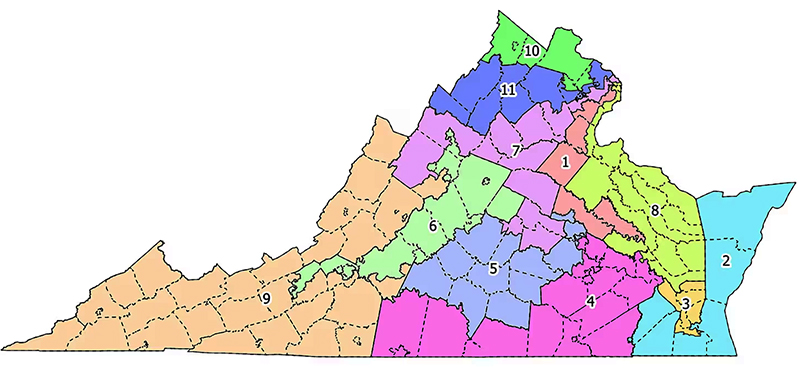
Some of the gerrymandering is subtle, but some is pretty blatant. In particular, the tan counties in southwest Virginia (Griffith's district) are pretty red, except parts of Montgomery County (which is blue due to Virginia Tech in Blacksburg) and carefully selected parts of Roanoke and Bedford Counties. These are the green bits poking into Griffith's territory that make Cline's seat competitive.
A county judge ruled that Virginia can't redistrict, but it will ultimately be up to the Virginia Supreme Court to decide. The legislature does appear to have met all the constitutional requirements for drawing the map. If the state Supreme Court agrees, there will be a referendum on April 21, much like the one in California last year. The referendum will not approve this specific map. It will simply empower the legislature to draw a new map. The legislators thought it would be polite to tell the voters in advance what the map will look like, but they didn't have to do this.
If this goes through, Florida is almost certain to redraw its map as well. That could cancel out the Virginia map and then some. The net result of all this exercise in cartography could be a net gain of around 3-5 seats for the Republicans. However, one really big unknown is when the Supreme Court will gut the last bit of the Voting Rights Act. That will set off a feeding frenzy in which a dozen or so southern states will try to eliminate all their majority-minority districts. That could be a huge win for the Republicans. If the Court waits until June to render a decision, there will not be time for all the states to redraw the maps in time for the 2026 elections, but it certainly will be in time for 2028. Of course, the Court knows this, and since it truly wants to do whatever the RNC and Donald Trump want it to do, it might issue its decision in the next month or two to make it possible for the Republicans to yet save the House in 2026.
In neighboring Maryland, the state House has passed a new map as well. It is the mother of all gerrymanders, but hey, that's the way it goes these days. The president of the Maryland state Senate, Bill Ferguson, doesn't want to bring it up for a vote. Maybe he is just embarrassed because it is so awful. However, Wes Moore went on CNN yesterday and told Dana Bash that Ferguson has an obligation to hold a vote because that is what Marylanders want. If he finally does, the blue team will probably pick up one more seat.
One other point is worth making. Voters from both parties hate this stuff. If another dozen states each try to grab one more seat for the Republicans in 2026 or 2028, cartography could suddenly become a hot political issue and it would favor the Democrats, who would promise legislation to get rid of gerrymandering. One way would be to have independent commissions draw the maps, but more radical options are also possible, like having all House candidates run statewide and using proportional representation. That way, if a party gets [X] percent of the House vote statewide, it also gets [X] percent of the seats. Congress could mandate this by just passing a law. (V)