
Dem
47

GOP
53

America is gradually adopting a weird mix of a presidential system and a parliamentary system with the worst features of both and the best features of neither. More and more, all that matters in races, especially for the Senate, is that little (D) or (R) after the candidate's name. In most states, people are voting for the party and the actual candidate doesn't matter. It takes a truly horrible candidate to upset the applecart (Yes, Herschel Walker, we mean you). For the Senate, this has real implications that Democrats need to come to grips with.
There are 25 states that voted for Donald Trump three times. They have 50 senators. All 50 of them are Republicans, as in 50-0—a shutout. There are 19 states that voted against Trump three times. They have 38 senators. 37 of them are Democrats. The only exception is Sen. Susan Collins (R-ME) and there is a good chance she will be history come Jan. 3, 2027, for another shutout. There are six states that split and didn't go the same way all three times in 2016, 2020, and 2024. They have 12 senators. Ten of these are Democrats and two are Republicans. Here is the map:
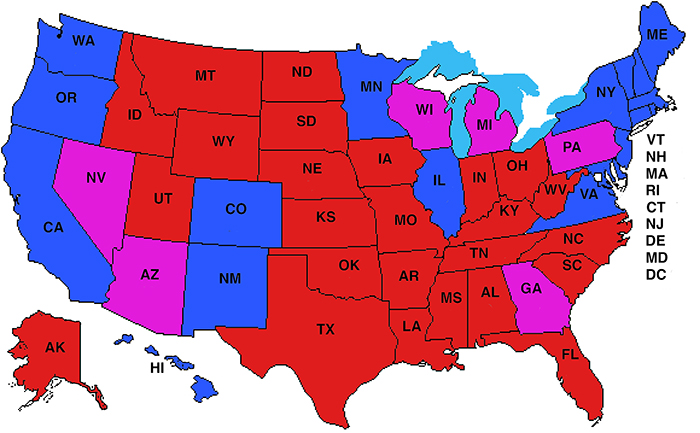
For the Democrats, even if they knock off Collins and eventually pick up the two Republican Senate seats in the swing states, namely the ones occupied by Sens. Ron Johnson (R-WI) and Dave McCormick (R-PA), that gets them to 38 + 12 = 50, best case. With a Democratic vice president, they then barely have control of the Senate, but counting on having all the Senate seats in all the swing states is hardly an enduring majority. To have permanent control of the Senate, they need to win Senate seats in Triple-Trump states, and do it consistently.
Their best shot is turning North Carolina purple. Roy Cooper has a good chance of winning in 2026 and the Democrats might be able to knock off Sen. Ted Budd (R-NC) in 2028 if they can find a good candidate for the Senate and a stellar candidate for president. Then the map would be 24 red states (48 Republican senators), 19 blue states (38 Democratic senators) and 7 swing states with 14 Democratic senators. Still, counting on having all the swing state senators all the time is not a very good bet.
Fundamentally, the Senate is a gerrymander of the entire country.
To get permanent control of the Senate, Democrats have to do much better. Their options include:
First, what about turning swing states blue? Virginia used to be a deep red state. Now it is a light-blue state. It elects Republican governors once in a while, especially when the Democratic candidate is a sleazeball, but now the Democrats hold the trifecta there, all the statewide partisan elected officers are Democrats, and both senators are Democrats. It flipped completely. Democrats could possibly convert all six purple states in the map above to blue states and maybe even North Carolina as well. Then there would be 25 red states and 25 blue states. That would hardly be enduring control, but it would be a lot better than starting in a hole.
Second, it is not impossible for Democrats to thrive in red states with the right candidate. On Jan. 3, 2017, when the 115th Senate convened, there were eight Democrats from red states. They were Sherrod Brown (D-OH), Joe Donnelly (D-IN), Heidi Heitkamp (D-ND), Doug Jones (D-AL), Joe Manchin (D-WV), Claire McCaskill (D-MO), Bill Nelson (D-FL) and Jon Tester (D-MT). All of them were blue dogs and most were populists, but that's what it takes to win in red states. It is not impossible but it takes some separation from the national party and a strong focus on winning white working-class men (e.g., being pro-union, talking a lot about jobs and wages, and staying as far as possible from culture-war issues). In practice, this is going to mean being pro-gun, anti-abortion, and anti-transgirls in girls sports. But they can be pro-union, pro-$15/minimum-wage, pro-same-sex-marriage, pro-Medicare-for-all, pro-environment, and pro Democratic judges. For a candidate in Iowa or Ohio who says "I'd rather be right than be a senator," well, he or she is probably going to be right but won't be a senator and the Democrats won't have a lasting Senate majority.
As to adding blue states to the union, D.C. is a no-brainer and Puerto Rico is next. Puerto Rico is not reliably blue, but Donald Trump may have done enough to offend Latinos that it is blue enough. Four more Democratic senators would really come in handy sometimes. "The chair recognizes Sen. Bad Bunny (D-PR)?"
Splitting a state is more far out, but California is the obvious candidate. The culture of Northern California is sufficiently different from that of Southern California that two states would make sense. After all, there are two Carolinas and two Dakotas. If the split was 20 million in each state, they would rank fourth and fifth, after Texas, Florida, and New York. Might this set up a "splitting war," like the redistricting war? Probably not. Texans tend to identify as Texans, not Northern Texans or Southern Texans. They also love it that Texas is the biggest of the lower 48 and would be loathe to give that up. If Florida split north-south, there is no guarantee that South Florida would always elect Republican senators.
As an aside, there is also one more structural change that would help the Democrats: expand the House. This wouldn't affect the Senate, but would affect the Electoral College. When the size of the House was set to 435 in 1929, each member represented 280,000 people. Now that is 760,000. Suppose the number of members in the House were raised to 1,000—still much smaller than China's 2,980-member National Peoples' Congress and only somewhat larger than the E.U.'s 720-member parliament. Then California would go from 52 House members to 120 House members and from 54 electoral votes to 122 electoral votes. Wyoming would get two House members and four electoral votes. Then the ratio of California:Wyoming in electoral votes would go from the current 54:3 (18.0) to 122:4 (30.5), which is closer to the population ratio of 69:1. Such a change would dilute the electoral power of the thinly populated red states, although it would not affect the Senate. Needless to say, the smaller states would not like this, although they would benefit from better service from their representatives, which would be the Democrats' argument. On the other hand, ambitious state representatives and state senators looking for a promotion might be wildly enthusiastic about it and this could influence public opinion. Changing the size of the House does not need a constitutional amendment, just a new federal law.
All in all, if Democrats want to establish permanent control of the Senate, they have their work cut out for them, but they also have options. (V)