
Dem
47

GOP
53

We often talk about "low-information voters" or "marginal voters" or some other euphemism without giving a precise definition. Now someone has quantified that and asked how they feel now. A new Verasight poll done for G. Elliott Morris asked respondents two questions in addition to the main payload: (1) Which party controls the Senate? and (2) Which party controls the House? Getting both right qualifies you as a high-knowledge voter. Getting one of them right gets you labeled a medium-knowledge voter. Blowing both qualifies you as a low-knowledge voter. Obviously, there are other possible tests, but about 75% of the respondents knew the correct answers to both questions and 25% didn't, so it does differentiate the top 75% from the bottom 25% in some sense.
Here are the results of the poll:
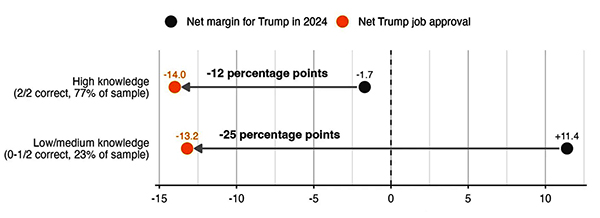
As you can see, the low-and-medium-knowledge voters were strongly pro-Donald Trump in the 2024 election whereas the high-knowledge voters had a slight preference for Kamala Harris. Now both have soured on him, but the high-knowledge voters have dropped by 12 points vs. 25 points for the low-knowledge voters. The latter are not really Republicans. They were unhappy with prices so they blamed Joe Biden and voted for the guy who said he would lower prices. He didn't do it and they are very angry with him. On many issues (trade, foreign policy, immigration, health care, etc.) there isn't much difference between the two groups,
Morris' conclusion from this study (and others) is that the low-knowledge voters weren't really anti-Democrat or anti-Harris. They were anti-incumbent. They still are, which does not bode well for the Republicans in November.
Low-knowledge voters skew lower-income, lower-education, younger, and less politically engaged. They tend to spend a larger fraction of their income on groceries. Someone making $100K might barely notice if his or her grocery bill went up $100/month, but someone making $35K is likely to notice it very sharply.
Another point from the survey is that low-knowledge voters are very elastic (in the economic sense). They are not die-hard conservatives like, say, evangelicals or gun fanatics. They are not tied to either party and are inclined to throw the bums out whenever they are unhappy, no matter who the bums are. Last time it was the Democrats. This time it could be the Republicans. The survey shows this in other ways. The high-knowledge voters have strong feelings about Trump; the low-knowledge voters don't. Their opinion of him can change due to current conditions.
The low-knowledge voters didn't have much knowledge of what Trump planned to do if elected. They are not ideological and don't actually care much about policy. What they knew is that they were unhappy and since Joe Biden was president, it was his fault. Now they are unhappy and Donald Trump is president. Anti-incumbent is the key here. (V)