
Dem
47

GOP
53

Partisanship is now almost total. In 23 states, all the statewide elected officers are Republicans. Here is a table showing the states and the offices. In South Carolina, the comptroller is not elected but is appointed by the governor. In this case, Brian Gaines (D) is a registered Democrat but he was appointed by Gov. Henry McMaster (R-SC), so he is probably not a very good Democrat:
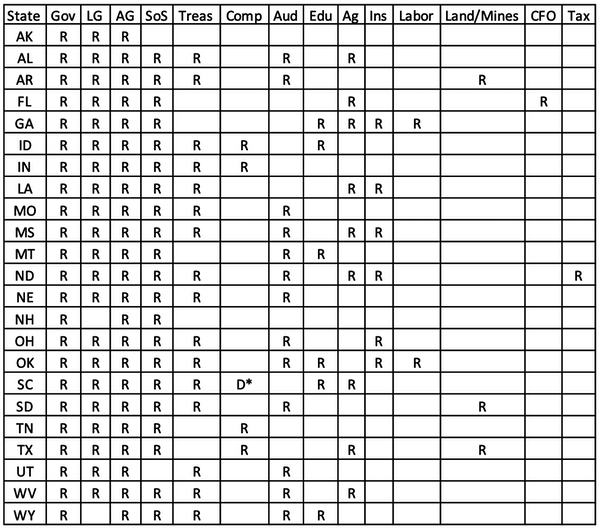
Up and down the line, if the governor is a Republican, so is the lieutenant governor, the AG, the SoS and treasurer (if any) and all the other statewide elected officers.
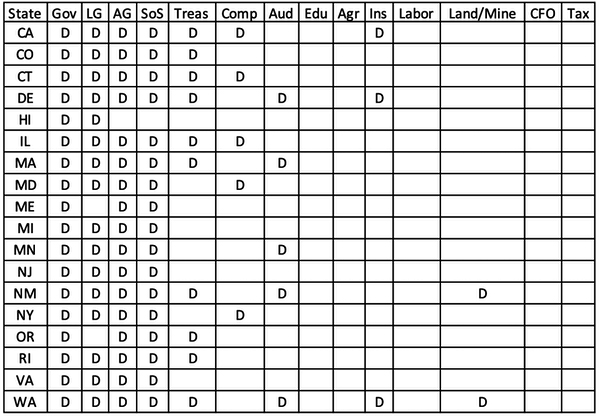
In the blue states, the same is true, but in reverse. If the governor is a Democrat, so are all the other officers. Here is that list:
There are nine states left over. In four of them, Republicans predominate. In two of them, Democrats predominate. Only in Arizona, North Carolina, and Nevada is control mixed. Of course, all three are ferocious presidential battleground states. Here they are:
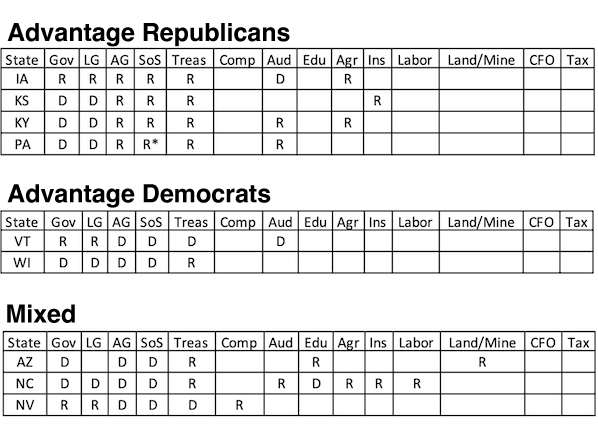
Is this likely to get better or worse? Probably worse. The state auditor of Iowa, Rob Sand (D), is running for governor. If he loses and a Republican is elected auditor, then Iowa will go all red. Gov. Andy Beshear (D-KY) is term-limited and will probably be replaced by a Republican. In Kansas, Gov. Laura Kelly (D-KS) is an oddity in a sea of red. Vermont is really a true blue state, and Gov. Phil Scott (R-VT) is a fish out of water. He is personally very popular and is barely a Republican. When he finally retires, the state will go all blue. Within a few years, the only mixed states may be Arizona, North Carolina, Pennsylvania, and Wisconsin. (V)