
Dem
47

GOP
53

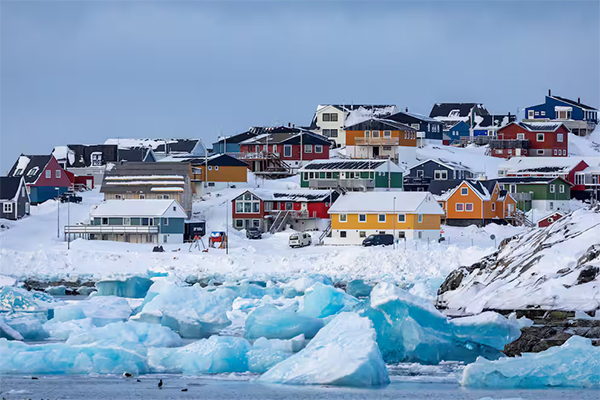
And it is not due to global warming. After capturing Nicolás Maduro with no loss of American life (but the loss of 75 Venezuelan and Cuban lives), Donald Trump has gotten cocky and thinks taking Greenland by force will be child's play. After all, only 57,000 people live there and Denmark, with which it is associated, is not going to attempt to fight off the U.S. military. Does Nuuk, the capital, with only 19,000 people, look hard to take?
When asked about taking Greenland by force, Trump has repeatedly refused to take that option off the table. In fact, Stephen Miller even took a break from deporting immigrants and upped the ante, telling CNN's Jake Tapper: "We live in a world in which you can talk all you want about international niceties and everything else, but we live in a world, in the real world, Jake, that is governed by strength, that is governed by force, that is governed by power." In other words, imperialism is back in fashion and might makes right. Maybe Miller is angling for a new job: (Appointed) Governor of Greenland.
He also pointed out, truthfully, that Denmark's claim to Greenland is a bit shaky. Erik the Red settled it in 985 A.D. and claimed it for Norway. He did this without consulting the Paleo-Eskimos living there at the time, probably because he did not speak Paleo-Eskimo. He named it "Greenland" to attract settlers. Think of it as an early "Florida land scam." When Denmark took over Norway in 1380, it acquired Norway's claim to Greenland. The settlers all died off, but in 1721, Denmark sent some more settlers there and it became a Danish colony. Most Greenlanders support Namminersulivinneq (independence), and do not want to be governed by anyone except themselves.
Sen. Chris Murphy (D-CT) and other Democrats are worried that with the easy win in Venezuela and Miller's increasingly violent rhetoric, Trump may be dead serious about taking Greenland by military force. They are taking the threat so seriously that Sen. Ruben Gallego (D-AZ) has introduced an amendment to the must-pass Defense Appropriations bill forbidding the use of government funds for invading Greenland without congressional approval.
If Trump invades Greenland, that will spell the end of NATO, something Trump doesn't like anyway. NATO members are obligated to come to the defense of any NATO country (such as Denmark) that is invaded. So technically, NATO Secretary General Mark Rutte would ask the U.S. to help defend a part of Denmark from an invasion by the U.S. Rutte is a skilled diplomat, but that is a steep glacier to climb.
Denmark and most European countries are deathly afraid that Trump is serious this time and will destroy NATO to get his way. They are seeking a meeting with Secretary of State Marco Rubio to try to get him to talk Trump out of this. Rubio has tried to lower the heat somewhat by suggesting that Trump wants to buy Greenland rather than conquer it. Of course, no one speaks for Trump except Trump.
Assuming Rubio and cooler heads can convince Trump that the America Firsters who hate forever wars would be furious with him if he started two foreign wars in the same month, Trump has options other than military conquest. He could encourage Greenland to hold a referendum on independence and then get Elon Musk to spend €20 million to advertise Ja til uafhængighed. Once independent, Trump could offer Greenland a sweetheart deal: become a state or sign a Compact of Free Association, like the U.S. has with Micronesia and other Pacific islands. Under it, the U.S. would provide essential services and protection in return for the U.S. being able to set up military bases where it wished.
If Trump could get the E.U. on board with this deal, it would be much easier, and the U.S. does have a card to play here: Ukraine. In return for E.U. support for the Greenland deal, the U.S. could agree to support Ukraine in some way—for example, more weapons, security guarantees, etc. It could be attractive since Europeans care much more about Ukraine than Greenland and if Greenland voluntarily agrees, it is less offensive.
If none of this comes to pass and the U.S. takes Greenland by force, it would destroy all cooperation with (former) allies. No one would give the U.S. any intelligence. If the U.S. were attacked by terrorists in the future, no one would help track them down. If there was a future need for a "coalition of the willing" (as there was in Iraq), no one would be willing. Many countries would cozy up to China, which is looking increasingly less scary than the U.S. It would be a five-alarm foreign policy disaster. (V)