
Dem
47

GOP
53

Congress is ever so slowly and hesitantly beginning to remember that it is mentioned in the Constitution and plays a small, but interesting, role in government. It has been a year, though, so Republican senators are a bit rusty on how this "government" machine runs. Do you just pour oil into it and then it works, or what?
To start with, Senate Majority Leader John Thune (R-SD) collected a bunch of Republicans running in competitive races this fall and held a highly staged photo-op at the southern border:
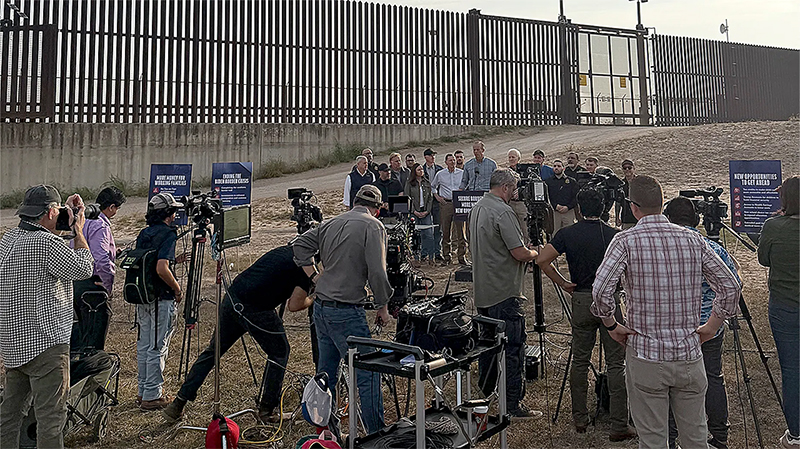
This is apparently his way of launching the Senate campaigns of his colleagues. To us, it seems like an odd choice to focus on securing the border, since the voters are concerned about affordability. Wouldn't it have been better to hold it at a supermarket and find some product, like milk, that has gotten cheaper since last year and focus on it? At least that would send the message that Republicans care about prices.
Other than this kind of grandstanding, the Senate is gradually discovering what it is supposed to do: pass laws. Sen. Tim Kaine (D-VA) wrote a resolution that would ban the armed forces from taking military action in Venezuela that has not been authorized by Congress. On Thursday of last week, a motion to bring the resolution to the floor for a debate passed 52-47, with five Republican senators supporting it (Susan Collins, ME; Josh Hawley, MO; Lisa Murkowski, AK; Rand Paul, KY; and Todd Young, IN). When it came up for a final vote, Hawley and Young flipped sides, after heavy lobbying from the White House. That put J.D. Vance in the position of casting the tiebreaking vote to kill the resolution, which he did. However, if things get worse on the Venezuela front, a similar measure could very well pass, since the administration has no margin for error. As an added bonus, from the vantage point of anyone who dislikes Vance, he has claimed to be a non-interventionist, and he just cast a very big vote for intervention. That will not make his life easier if and when he runs for president—another John Kerry-style example of Vance being for something, until he's against it.
Donald Trump was not amused by this act of rebellion. On his social media site, which is the official sponsor of the White Man's Burden, he posted: "Republicans should be ashamed of the Senators that just voted with Democrats in attempting to take away our Powers to fight and defend the United States of America." Except for heading off a few crazypants appointments, this was the first time in Trump v2.0 that the Senate has acted like anything other than an obedient lapdog. It is very likely that the senators are sensing that Trump's popularity is waning and he will not be able to protect them in November, so they had better start striking out on their own. Paul was the most outspoken of the group. He said: "But make no mistake, bombing another nation's capital and removing their leader is an act of war, plain and simple. No provision in the Constitution provides such power to the presidency."
Paul wasn't the only one who had some choice comments for Trump. Retiring Sen. Thom Tillis (R-NC), who is now free to speak his mind, had some thoughts on Greenland: "I want good advice for this president, because I want this president to have a good legacy. And this nonsense on what's going on with Greenland is a distraction from the good work he's doing, and the amateurs who said it was a good idea should lose their jobs." (English translation: Stephen Miller should be fired immediately.) Sen. Roger Wicker (R-MS) met with the Danish ambassador and afterwards said it was Denmark's right not to sell Greenland. Having Republican senators openly saying things Trump does not want to hear is new. Is this a fluke or will this be the start of a new era? We'll soon see.
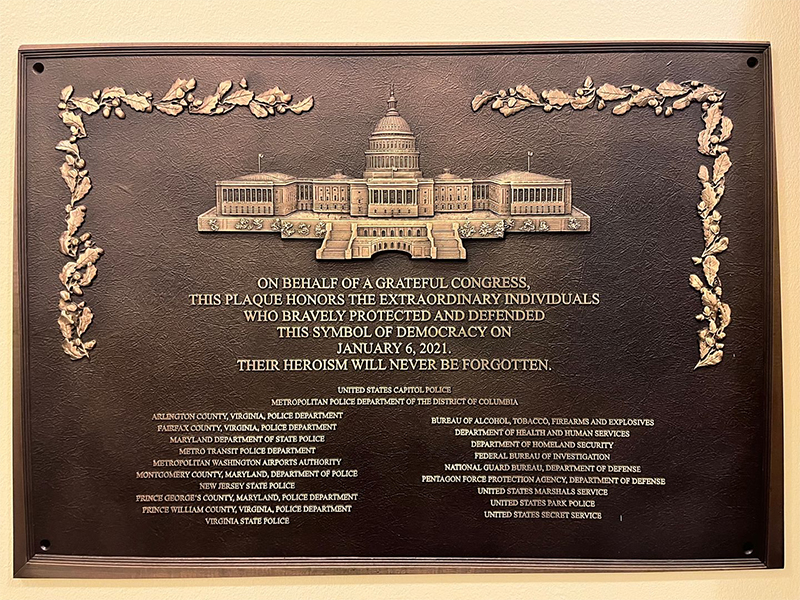
And there are more signs of life coming from the Senate. On March 2, 2022, Congress ordered a plaque made honoring the Capitol police for defending their lives from a violent mob egged on by Trump. By law, it must be displayed in the Capitol building. However, it has been kept in storage because Donald Trump doesn't like it because it reminds people of what actually happened that day, not his imaginary version of events. Now the Senate voted to take it out and display it. This is a direct affront to Trump. Here it is:
Meanwhile, over in the House, Trump was getting some more negative feedback. Also last Thursday, the House voted on a bill to restore the ACA credits, something the Democrats want and were willing to shut down the government over. All Democrats and 17 Republicans voted for it, so it passed the House 230-196 and will now go to the Senate, where passage seems unlikely. Perhaps the Senate will concoct its own health care bill, but so far there is no agreement on what should be in it and the clock is ticking. By the end of January, most people who need to choose what health plan they want will already have done so. Still, for the House to do something that Trump does not want is also a sign, however small.
As with the Senate, there are also other signs. While we were on hiatus, Trump issued the first two vetoes of his second term. One bill expanded Miccosukee Tribe lands in Florida, the other would make a water pipeline in Colorado more affordable for residents. They both passed both chambers on a unanimous voice vote, but Trump wasn't happy with them, because... reasons. He claimed it was the high cost of the two drop-in-the-bucket projects, but the general suspicion is that he was poking Gov. Ron DeSantis (R-FL) and Rep. Lauren Boebert (R-CO) in their eyes. The House tried to override the vetoes, and failed, but Trump lost 35 Republicans on the Colorado bill and 24 on the Florida bill.
And finally, there is also an example of bi-chamber (is that a word?) pushback. Trump hates Voice of America (VoA), the international radio network that broadcasts American programming around the world. Officially, his reason is that it costs too much money. The real reason is that he thinks it broadcasts left-wing, woke propaganda. We suspect he might be getting VoA confused, maybe with the sometimes-lefty NPR, maybe with the now-defunct, definitely lefty, Air America Network. It's also possible that the problem with VoA is that Vladimir Putin hates it, and has persuaded (ordered?) Trump to hate it.
The members of Congress, on both sides of the aisle, recognize that VoA is one of the greatest bargains going. It promotes American ideas abroad, and at a bargain price. We wouldn't exactly say it's a propaganda operation, but we wouldn't exactly say it's not a propaganda operation, either. Anyhow, Congress has put together a bipartisan bill to fund VoA at something fairly close to current levels. The total outlay, $643 million, is four times the $153 million Trump wants to spend (and he wants to spend that money to shut the network down).
The VoA bill has already passed the House, 341-79, as part of a minibus package, and is expected to pass the Senate. At that point, it is not clear if Trump will swallow hard and accept it or issue another veto, in which case we'll see if the third attempt at an override is the charm. Whatever happens, it sure looks like the President's iron grip is slipping. (V & Z)