
Dem
47

GOP
53

When Donald Trump doesn't like someone, he has one standard playbook that he uses over and over: punish his enemy financially. Sometimes it is a lawsuit that costs his enemy money to defend against, sometimes it is something different, but money is almost always part of it. Right now, Trump is focused on acquiring Greenland—buying it if possible, otherwise conquering it. He is getting a lot of pushback from European countries, so once again he is reaching for his weapon of choice, this time manifesting itself in tariffs. He has decreed that eight European countries will face a 10% tariff on their exports to the U.S. starting Feb. 1. It will climb to 25% on June 1 if the U.S. does not own Greenland by then.
Back when the Constitution was in force, only Congress could impose tariffs, except in very limited situations. Now the president can just do it on a whim without a peep from the so-called "Legislative Branch." The targeted countries are Denmark, Finland, France, Germany, the Netherlands, Norway, Sweden and the United Kingdom. These are the countries that have sent or will soon send troops to Greenland to defend the island. However, the Supreme Court is considering a case in which it might decide that indeed, the power to levy tariffs belongs to the Legislative Branch, not the Executive Branch.
After Trump announced the tariffs Saturday, there were immediate protests outside the American consulate in Nuuk. They yelled "Yankee go home!" and other things and chanted: "Kalaallit Nunaat," which means "Land of the Greenlanders." There were also large protests against the U.S. in Copenhagen and other cities in Denmark. Here is the protest in Nuuk:
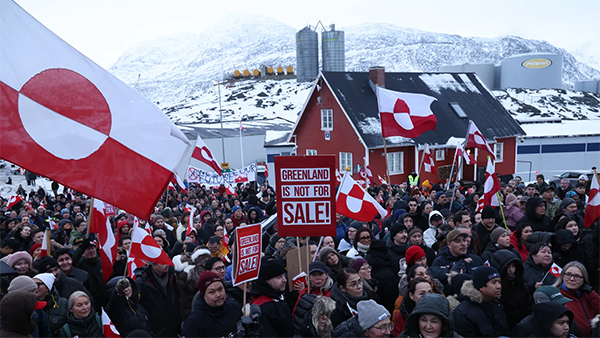
Trump will travel to the World Economic Forum in Davos tomorrow, where he will likely encounter some of the leaders of these countries and get an earful. He will undoubtedly tell them: "You have no cards. You have to obey me." They are likely to point out that they actually have quite a few cards. One of them is the China card. French President Emmanuel Macron visited China a few weeks ago. Irish Prime Minister Micheál Martin went there last week. British P.M. Keir Starmer is going later this month. German Chancellor Friedrich Merz is going in February. Others will surely follow. All of them are seeking individual or collective trade deals so instead of being dependent on the U.S. for their exports, they will do business with China, who they are coming to see as a more reliable partner.
Another card the European countries have is South America. On Saturday, the E.U. formally signed a trade agreement with Mercosur, a bloc of a dozen South American countries. It is the South American analog to the E.U. Here is E.U. Commission President Ursula von der Leyen at the signing ceremony:

The treaty will open an almost-free-trade zone with 700 million people. The initial focus will be on exporting European industrial products to South America in exchange for cheap food, but it could expand later. And the U.S. has nothing to say about it. In fact, in an increasing amount of world trade, the U.S. will be left out.
Although Trump hasn't threatened Canada with a new round of tariffs, Canadian Prime Minister Mark Carney can read the writing on the wall and has already visited China and made a deal with Chinese President Xi Jinping. Among other things, China will slash its tariff on Canadian canola oil and Canada will reduce its tariff on Chinese electric cars. Carney has been actively working on diversifying Canadian trade away from the U.S. Carney said that Canada's relationship with China has been more "predictable" in recent months and he found Chinese officials realistic and respectful.
The new tariffs have already had a tangible effect. Trump had previously bullied the E.U. into agreeing to a tariff regime in which U.S. products sold in Europe would have 0% tariffs but European products sold in the U.S. would be subject to a 15% tariff. Von der Leyen felt this was the best deal she could get. The European Parliament was set to ratify the treaty. Now the treaty is on hold indefinitely. Swedish MEP Karin Karlsboro, the trade coordinator for one of the parties in the E.U. governing coalition, said: "I see no possibility for the European Parliament to give the green light to move forward with the tariff agreement when we take a decision on Wednesday. Instead, the E.U. must prepare to respond to President Trump's tariff attacks, including those targeting Sweden."
If Trump responds to the pause in ratification, the E.U. could use its "trade bazooka," the Anti-Coercion Instrument. This would let the E.U. use weapons like restrictions on investments and even putting limits on intellectual property protections. Emmanuel Macron is in favor of using the bazooka, but other European leaders aren't there yet. If Trump keeps responding, a full-blown trade war is not out of the question, even though it would hurt both sides. Keep in mind that most leaders, in contrast to Trump, do not start trade wars unless they intend to stay the course. So, if the Europeans do pull the trigger on the bazooka, the Rubicon will have been crossed, and things are all-but-guaranteed to get very ugly. (V)