
Dem
47

GOP
53

Today, we hear from B.C. in Walpole, ME:
In the mid-1950s, my father bought a Penguin, a dinghy with a single sail and simple rigging. A solo sailor could handle it; a pilot plus a crew of one could race it; and on summer days with light breezes, our family of six sailed together: I sat aft with Dad; my mother and older sister sat on either side of the centerboard trunk, with baby sister on one lap and little brother on the other.
But there were clues that this was not my father's first boat. In my boyhood, the back of my closet held naval uniforms that I knew must have been Dad's. He had Brazilian coins on his dresser. He got mail from the U.S. Coast Guard Academy. To view a solar eclipse one summer, he produced a sextant. We'd never seen it before. Only as an adult, did I learn that during World War II, he had made port from New York to Scotland, Brazil to the Bay of Fundy, New Orleans to New Guinea.
After Pearl Harbor, anticipating being drafted, my father volunteered for the Merchant Marine. What was he thinking? Did he know the Merchant Marine had the highest casualty rate of any branch of the service? Had my dad, who grew up in Memphis, TN, ever actually seen the ocean before he enlisted?
Yet the efficient War Department turned that landlubber into a ship's officer—in just ninety days!
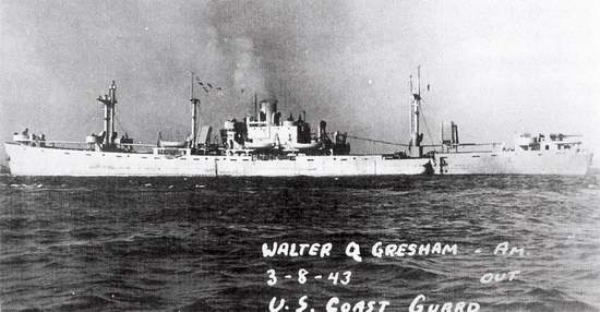
Enjoying entirely at U.S. government expense his first voyage on the open ocean, my father sailed aboard the Walter Q. Gresham on its maiden voyage. Leaving from Pass Christian, MS, the Gresham sailed to Cuba to pick up a load of sugar, and then to New York City to pick up the rest of the crew and tons of powdered milk. She then joined Convoy HX-229 as ship number 21 of 42, headed for England.
A bit before that, on the other side of the Atlantic, Hans-Hartwig Trojer, a young German a bit older than Dad, had volunteered for his country's unterseeboot service. After training, Captain Trojer participated in five North Atlantic patrols between May 1942 and September 1943, sinking 22 enemy ships.
During the third week of March, 1943, Captain Trojer's Type VII-C U-221 and ten other German submarines comprising Wolfpack Dränger located Dad's convoy and began systematically attacking it, ultimately sinking half of its 42 vessels.
When the convoy came under attack, my dad and his brave shipmates leapt into action: Being mostly between the ages of 17 and 21, they formed a pool and took bets on the day and the hour the Gresham would get her torpedo.
At 2:55 pm on the 18th of March, the U-221 fired two torpedoes at the Gresham. Both hit. The first blew off the ship's screw, leaving her helpless. The second, striking the port side just aft of cargo hold number 5, was the kill shot: The Gresham and its 9,000 ton cargo sank in 15 minutes. Of the crew of 70 men, 42 survived.
My father survived and went on to have me, among others, but it was a close call: As they were leaving their rapidly sinking mothership, one of the davits on his lifeboat jammed and the boat flipped over.
The next part of the story should be: "Tumbling from the lifeboat, the sailors fell into the North Atlantic." Which is approximately what happened, but with a complication. The second torpedo had opened a gaping hole in the side of the ship near the location of their lifeboat. When the seawater hit the cargo, the milk powder reconstituted, mixed with the sugar, and was sucked back out by the swell. My father and his shipmates fell from their lifeboat into the Largest Milkshake Man Has Ever Made.
Convoy ships were not allowed to stop for any reason. After 3 hours in a small boat in March in the North Atlantic, Dad and his shipmates saw a ship. A Canadian vessel picked up their lifeboat and took the crew to Scotland.
Six months later, in September 1943, British aircraft spotted Captain Trojer's U-221 and bombarded her; she sank with all hands on board.
Today, we remember the sinking of the Walter Q. Gresham and the rescue of my father. I have taken my wife to what used to be the Rexall Drug Store on Main Street here in Damariscotta, ME. Now part of a Reny's store, it still has the original soda fountain and the World War II- era booth, stools, and counter. We are sitting in the booth, and we have just ordered large milkshakes.
Ten days after this photograph was taken, the Gresham was torpedoed on her maiden voyage:
Thanks, B.C. (Z)