
Dem
47

GOP
53

Or so it seemed. OK, he's old, but not that old. But he certainly made it all about himself. Let's start with the run-up to the holiday itself. On June 24, a fake Great American State Fair opened on the National Mall. If you have never been to a state fair, suffice it to say that they are kitschy but, if you go with the right mindset, fun. Each state has its own local or regional traditions, including Cajun-infused boiled peanuts (Alabama), 130-pound cabbages (Alaska), butter cows (Iowa), gator on a stick (Louisiana), elephant ears (Ohio), deep-fried beer (Texas) and Navajo tacos (Utah). Some features, like Ferris wheels and funnel cakes, are universal. Regular attendees know all this and compare this year to last year. This hastily planned and poorly executed fair had none of this local charm and was a huge flop. Almost nobody visited it. And quite a few of the states didn't do more than create an empty booth with no one from the state there to talk to visitors. Here are some photos of the fair. Note the giant crowds everywhere. Almost as big as Trump's giant inauguration crowds:
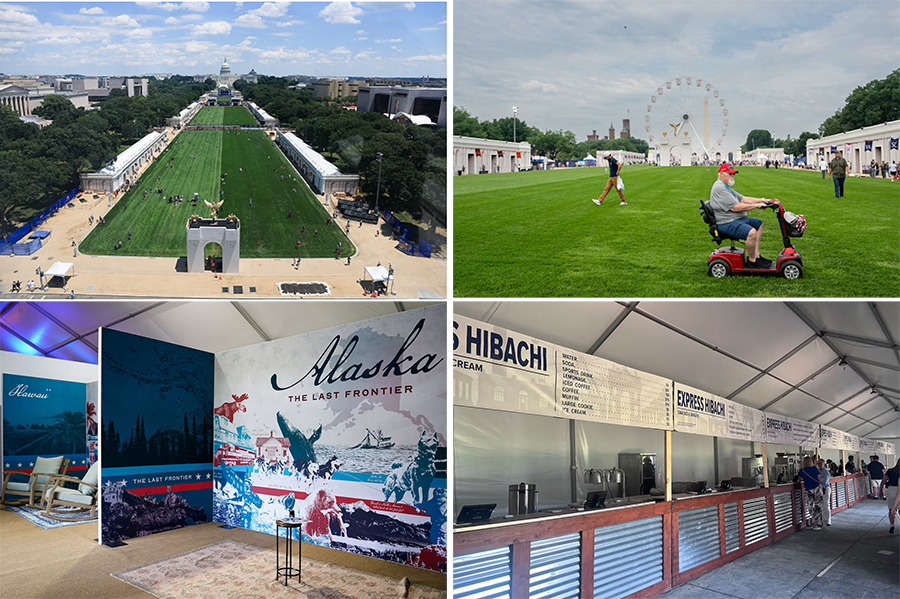
The food stalls (lower right) were empty because the power failed and they had to be closed for hours. Even a semi-competent administration could manage to get reliable electric power to work in the middle of D.C. Maybe this is a metaphor for something. Also note the tacky plywood model of the Arc de Trump in the upper left photo.
If you like games and puzzles, reader J.G. in San Diego, CA sent us an image that someone on social media put together. It's "Where's Waldo," Great American State Fair edition:
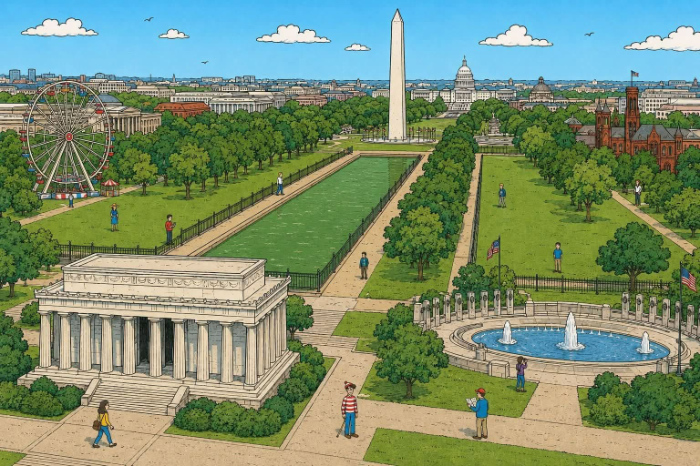
Did you find him?
What was the holiday yesterday about? Despite endless hoopla among all ages, a new Cato Institute/Morning Consult poll shows that only a bare majority (53%) of American adults think it was about the 250th anniversary of the signing of the Declaration of Independence. If you want to be picky, though, the Declaration was actually mostly signed on Aug. 2, 1776. Almost a quarter of the poll respondents (23%) didn't have a clue what was being celebrated. Among 18-29 year olds—the people most recently in school—it was even worse:
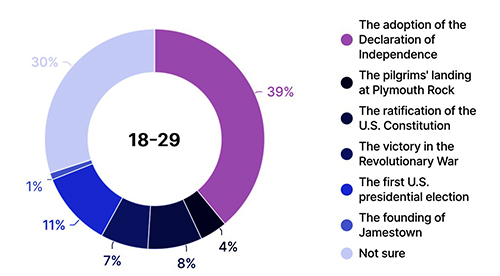
Only 39% got it "right" (i.e., what they were taught in school). Among Boomers, 72% got it right. On the other hand, large majorities of Democrats (81%), independents (64%), and Republicans (86%) have a favorable view of the nation's founding. Nevertheless, 36% thought the nation was founded to protect slavery (which is not true because slavery was perfectly legal under British law at that time, so there was no need to secede to preserve it). Among Black Americans, 51% believe declaring independence was to preserve slavery. Given these numbers, there is obviously a great deal of overlap here. There must be many people who believe: (1) the country was founded to preserve slavery and (2) look favorably upon this. The poll also has plenty of additional fodder for those who think Americans are quite ignorant of their history, but keep in mind that Cato is a libertarian group. Morning Consult ran the poll, so it is surely legitimate, but Cato picked the questions to ask.
Donald Trump was born on Flag Day (June 14), it's true, but somehow mistakenly confused that holiday with
Saturday's. On Friday, he went to Mount Rushmore in South Dakota to honor Washington, Jefferson, T. Roosevelt,
and Lincoln
talk
about himself and the mortal threats from the political left. He also said there was a resurgence of communism
(obliquely referring to the three DSA candidates who won primaries in NYC and two who won in Colorado). He blamed this
on "newcomers" (immigrants—who can't vote). He also condemned Marxist lies (e.g., telling children that we live on
stolen land, an equally oblique reference to
United States v. Sioux Nation of Indians
in which the Marxist Supreme Court ruled 8-1 precisely that and that the U.S. owed the tribe $88 million for the land stolen from them).
In case anyone missed the symbolism of his going to South Dakota, where none of the key events of 1776 took
place, he did put this (AI-generated) image out on his social media site for rockheads:
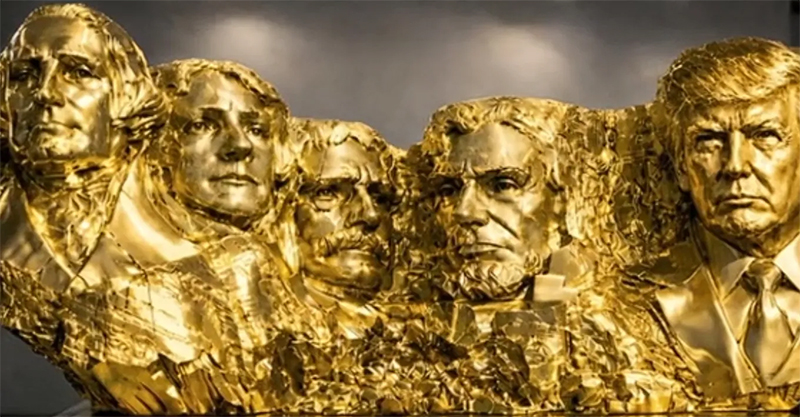
Note that his image is the biggest of all. A man can dream, can't he? In case you missed the big picture, one of the key themes of Trump v2.0 is putting his stamp of everything he can, including the East Wing of the White House, the Arc de Trump, limited edition passports that read "Welcome, but be good" (which is strange for a document allowing you to visit other countries), and U.S. money.
Trump's speech at Mount Rushmore is appropriate for an event celebrating the Declaration of Independence—in a way. Both the Declaration and his speech were full of grievances. His include:
In general, he has many more that didn't make it into this particular speech but often do. They are all pretty vague but include wokeness, DEI, the claim that white people (especially white men) are victims, media bias, the "rigged" 2020 election he actually lost, and the "deep state." Jefferson's document is much more specific and contains 27 precise grievances against King George III. A few of them can be summarized as follow.
Not a lot of overlap here, but some of Jefferson's grievances do seem vaguely familiar.
Trump repeatedly invoked the words "patriot" and "patriotism" in connection with Independence Day. However, he has a modified definition from the one in the dictionary, which is "a person who loves, supports, and defends their country and its interests with devotion." His is "a person who loves, supports, and defends Donald Trump and his interests with devotion." To him, anyone who does not blindly support him is "unpatriotic," or worse, an "enemy of the state." Trump constantly compares himself to great leaders in American history and banners on federal buildings reflect this, for example:
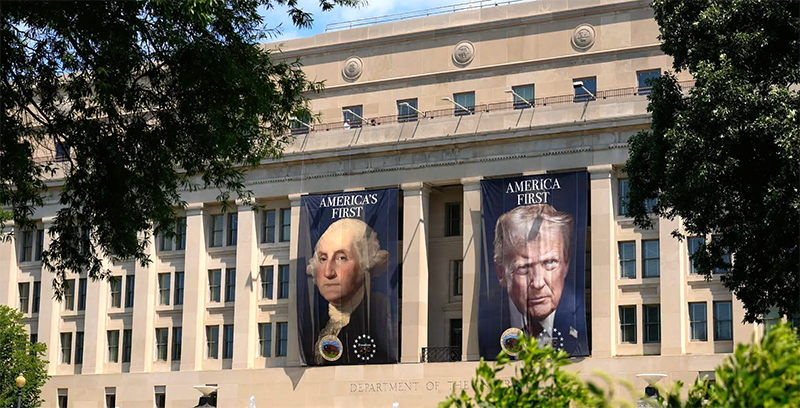
Chad Williams, a historian at Boston University, said: "His version of patriotism is rooted in his narcissism. It's self-aggrandizing on the one hand, but it's also deeply ahistorical, and I think this entire commemoration has been reflective of this." Trump is trying to make the whole event—no, all of American history—about himself.
When Congress created the America250 Commission a decade ago to celebrate the 250th anniversary and appropriated $150 million for it to work with, it was definitely not intending the event to be about the then-president, but about the country and its history, warts and all. When the rubber began to approach the road, Trump refused to disburse the money. Instead Trump created his own commission, Freedom250, to compete with the official one. One of Freedom250's events was the disastrous State Fair (see above). It also made a bunch of videos featuring rich white men, God and Trump. Freedom250 is run by Keith Krach (pronounced "crock"), an ambitious tech entrepreneur who sold one of his companies for $4 billion. His much-younger second wife said he was abusive and once kicked her to the ground from behind and called her a "fu**ing brainwashed Democrat." She also accused him of kicking one of their children, who screamed in pain. She later filed for divorce. Clearly the man to bring the country together—after all, he donated $50,000 to Trump's 2024 inaugural committee. Sen. Alex Padilla (D-CA) wanted to know who was funding Freedom250 and what the quid pro quo was. He did not get an answer.
A parade in D.C. planned for Friday was canceled due to the extreme heat. So were events in Philadelphia; Fairfax, VA; Laurel, MD, and other cities. The thunderstorms caused by the heat led to thousands of people losing power.
The capstone of the festivities was Trump's speech on the National Mall, which happened Saturday at 11:15 p.m. due to delays on account of violent stormy weather. He praised the founding fathers and called several veterans onto the stage and thanked them for their service. He also praised America's military might—not for World War I or World War II, but for sinking Iran's (minuscule) navy. Other than that, his speech, which had a religious tone (God is mentioned six times), was part political rally, part discourse on flags, and part national pep talk. One highlight was: "As our Declaration of Independence tells us, we are all made in the image of one almighty God, and a communist will never say that, that's for sure."
The Declaration is not a religious document, although it does contain the famous sentence: "We hold these truths to be self-evident, that all men are created equal, that they are endowed by their Creator with certain unalienable Rights, that among these are Life, Liberty and the pursuit of Happiness." This is a reflection of Thomas Jefferson's deist views. He believed that a Supreme Being created the universe but does not listen to prayers or interfere in human affairs. Jefferson did not believe in miracles, the Trinity, or Jesus' divinity. He saw God as the Great Clockmaker: He made the universe, wound it up, and then went off to take care of other matters.
After Trump spoke, there was an immense 40-minute fireworks display—truly impressive, as it was mixed with lightning. In NYC, the Brooklyn Bridge celebrated by catching fire, but fortunately no one was injured. Landing aircraft in other cities "made contact" with local fireworks. Again, no one was hurt but the folks on board were probably quite surprised.
Not all the weekend's events were, uh, inclusive. On Saturday, hundreds of masked men wearing clothes bearing the logo of the white supremacist Patriot Front marched around the Capitol and surrounding neighborhoods. The group has argued for turning the United States into a white ethno-state. When asked about this, Secretary of the Interior Doug Burgum said he did not agree with the group on anything, but they were within their constitutional rights to free speech to march peacefully as they did.
Not all the exhibits and events were in D.C. Back in the 1790s, when Philadelphia was the national capital, George Washington lived in a house there with his family and nine slaves. The house was close to the events of July 4, 1776. There was an exhibit on the site about slavery, focusing on Washington's nine personal slaves. Trump ordered it replaced by a new one that whitewashes slavery. The city sued to keep the original exhibit. After a court battle, the U.S. Court of Appeals for the Third Circuit ruled that Trump had the authority to determine what was in the exhibit and the whitewashed version was on exhibition yesterday. (V)