
Dem
47

GOP
53

It is hard for us to understand how someone with skeletons as numerous and as large in their closet as Graham Platner has could think they could run for an extremely high-profile public office and not have them come out and haunt him. But he threw caution to the wind, was lucky they didn't come out until after the primary, then was unlucky that afterward they followed him home. The jig was clearly up, and yesterday, Platner bowed to reality and dropped out of the race.
Platner made his announcement via a video. He starts out by announcing that he is out. Then he immediately blames the establishment for his travails. Not his repeated horrible behavior toward women, not his disgusting postings to social media, not his Nazi tattoo. The whole thing was someone else's fault, not his. Nothing like taking responsibility for your actions.
Inasmuch as Platner could have dug in and refused to withdraw, he felt he had some leverage and could use that to force the Democrats to switch to his chosen successor. They were having none of it. The executive director of the Maine Democratic Party, Devon Murphy-Anderson, tweeted: "The integrity of this process is just as important as the outcome, and we are committed to ensuring that Democrats across our state can have confidence in both. Unfortunately, Graham Platner's team has repeatedly reached out to us in an attempt to put their thumb on the scale of what this process looks like." She made it abundantly clear that he would have no role whatsoever in selecting the new candidate.
Picking a new candidate will be tricky. The Party needs someone inches from Platner politically but a million billion zillion miles from him personally. One of the things the Republicans are going to do is say the new candidate is "just like Platner." If challenged by reporters to explain, they will say the replacement is another socialist, but they will hope that voters also think the new candidate is also a rapist. If Platner comes within a country mile of the selection process, that will be the kiss of death for the candidate. And country miles are really big in Maine.
Further, Democrats are going to be very leery of a process that looks like an anointment. The Brits are OK with allowing, like, 12 people to choose new prime ministers, but Americans, not so much. The blue team just put that to the test with Kamala Harris, and look how that turned out. So, there's gotta be a mini-primary/convention/caucus/whatever, even if most rank-and-file voters don't actually get to cast ballots. There were 215,000 votes cast in the recent Democratic gubernatorial primary. Having all 215,000 Democrats showing up in a big empty field (say, the state fair in D.C.) and raising their hands for their respective choice is not a good idea. Some other process will be needed.
Murphy-Anderson is not really the person in charge. She is more the operations person, the one who carries out party decisions. The chairman of the Maine Democratic Party is a progressive 72-year-old lawyer from Leeds, ME (Pop. 2,285), Charles Dingman. We hope he is ready for his 15 minutes of fame, because it is going to be wild and woolly. Here he is along with Murphy-Anderson. Dingman is on the left.
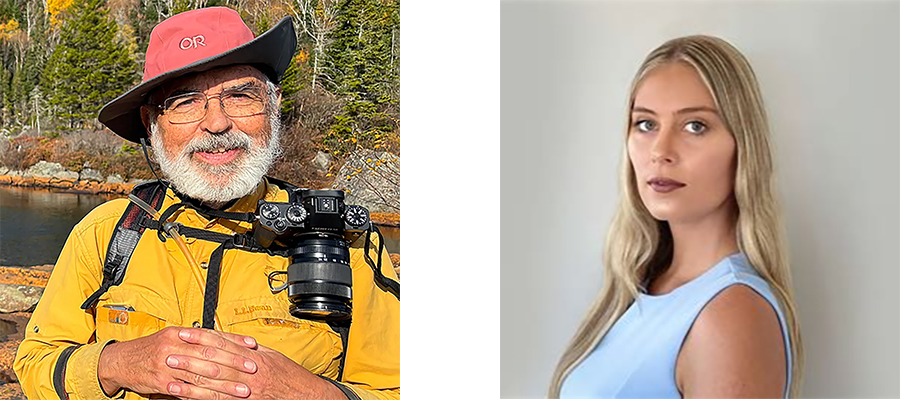
People who know Dingman say he is very liberal, very kind, and a consensus builder. He is a small-town lawyer, not a politician. Nevertheless, he was a delegate to the Democratic National Convention for Sen. Bernie Sanders (I-VT) in 2016 and 2020. He is expected to really try to make the process transparent.
Dingman was on vacation when all hell broke out and hastily headed back to Maine to lead an emergency meeting of the Maine Democratic Party's central committee. Late last night, the committee approved a plan for choosing the new nominee. First, the county-level committees will meet and choose delegates to a mini-convention. A total of 500 delegates will be elected in this way. If each county gets the same number, then 500/16 = 31.25. Guess that would require a little rounding. Alternatively, they could (and probably will) weight things by population. In that case, the lion's share of the delegates would go to Cumberland and York Counties, which together form the southwestern corner of Maine.
How the county committees will pick their delegates is not yet decided, but very important. Since Dingman knows how crucial it is to make the process open and transparent, he will have to figure this out fast. Maybe allow any registered Democrat in the county to fill out an online form giving his or her background (education, occupation, birthplace, length of residence in Maine, etc.) plus a pitch of not more than, say, 300 words, as to why they should be chosen. Maybe allow a photo to be uploaded. Then every Democrat in the state will have a voice.
Thereafter, the 500 county-level delegates, and the 100 already-existing state-level delegates, would meet and choose the new nominee. The Maine Democrats have not decided exactly what that convention will look like, or when or where it will be held (though it has to be completed by July 27). It is even less clear if there will be some sort of campaigning (e.g., town halls or a televised debate) or if there will be a good way for voters to convey their views to the delegates who will represent them at the convention.
In addition, the Maine Democrats haven't yet wrestled with the other side of the equation, namely the candidates. People interested in running will have to file to run with the Maine Division of Elections in the usual way and be vetted on age, citizenship and residency, the only constitutional requirements for the Senate. But what if 80 people file, including some people with a special interest in rodent reproduction? This is all about to be on Dingman's plate. To keep things manageable, he and his colleagues could say, for example, that anyone who currently holds or previously held, elective office in Maine as a Democrat and people who hold or held any nonpartisan office in Maine are eligible. Outsiders who file petitions with at least, say, 500 signatures of registered Maine Democrats are also eligible. That would keep most people from signing up on a lark, though it probably wouldn't stop all the Republicans who want to throw a monkey wrench in the gears. How many people named Dan Sullivan live in Maine?
The candidate who comes out on top will have to unify Maine Democrats and attract independents. Some die-hard Platner fans may be hard to convince, especially young men who don't think a mere allegation of rape is disqualifying. After all, Platner vigorously denies it. If the process ends up with someone as working class as Platner and as left-wing as Platner, they may be mollified somewhat.
Already, three candidates have thrown their hats into the ring. The first is former state Senate President Troy Jackson (D), who is blue-collar (a former logger), pretty lefty (at least now; he was once more socially conservative), and has run for office many times and is less likely to have undiscovered skeletons in his closet. However, he is not as charismatic as Platner, and is also older (57 vs. 42). Rep. Ro Khanna (D-CA) has already switched from being Platner's biggest fan to being Jackson's biggest fan. Unfortunately, Khanna's district is about 2,700 miles from Maine. However, if some members of Congress from closer states, say, Vermont and Massachusetts, make their preferences known, that could really help Jackson.
The second declared candidate is Dan Kleban (D). He also has a blue-collar résumé, as he is founder and owner of a brewery. He's a bit closer to Platner than Jackson is when it comes to charisma and age (48). And he's definitely closer to Platner when it comes to lack of experience, because Kleban also doesn't have any, except for a Senate run this year that he ended very early in the process. Kleban's problem, when it comes to Platner's base, is that he's hemmed and hawed on Israel/Hamas, and also that when he dropped out of the Senate race, he endorsed Gov. Janet Mills (D-ME). The populists and progressives aren't going to like those things. And his problem, when it comes to moderates, is the lack of vetting. We suspect most Maine Democrats, knowing they are most definitely on their last chance, are going to be very leery of going down this same road.
The third official candidate, at least at the moment, is 29-year-old social worker Paige Loud (D). She is a citizen of the Cherokee Nation, which probably matters more in, say, Oklahoma than it does in Maine. She ran a progressive campaign for the U.S. House in Rep. Jared Golden's (D-ME) soon-to-be-vacated district, and came in fourth, at least in part because she was a very poor match for that electorate.
Time, of course, is of the essence here. So, any person who's going to try to make a run at it will surely make their intentions known in the next couple of days. The Maine Democratic Party would be very pleased if they only have to consider a small number of candidates. The more candidates there are, the more that people will get attached to a particular favorite, and the more chance that some of those voters who don't get "their" candidate will be angry, and maybe skip November's election.
There is already one data point. As Platner decided whether or not to fall on his sword, his campaign commissioned a flash poll to see where voters were at. With the rape allegation out there, Platner was trailing Sen. Susan Collins (R-ME) by 5 points, 42% to 47%. The pollster (PPP) also polled five other candidates. Jackson led Collins, 49% to 44%. Secretary of State Shenna Bellows (D-ME) and 2026 gubernatorial candidate Nirav Shah were both tied with Collins. Mills trailed Collins by 11 points, 37% to 48%, while progressive activist (and failed Senate candidate) Jordan Wood trailed Collins by 9 points, 38% to 47%.
Could this disaster have been foretold? Well, yes, and Politico's Jonathan Martin did the foretelling. On Oct. 22, 2025, he wrote a column with the headline: "Democrats Keep Falling for Political Fantasies. When Will They Learn?" It was about the Democrats' brand-new heartthrob, an oysterman named Graham Platner. Tough guy, progressive, working class, the whole nine yards. Just like Sen. John Fetterman (D?-PA). What could possibly go wrong? Martin argued that having experienced party leaders, like Sen. Chuck Schumer (D-NY), do the picking tends to avoid having this kind of disaster with unvetted candidates. Schumer's pick in Maine, Gov. Janet Mills (D-ME), was a poor choice because she is too old and her heart wasn't in it, but Schumer's pick in North Carolina, Roy Cooper, is running away with it despite being old and moderate. His picks in Ohio (Sherrod Brown) and Alaska (Mary Peltola) are doing pretty well, given the redness of their states. Hopefully (but unlikely) Democrats will learn the lesson that the Senate is not an entry-level job and picking candidates who have been through the wringer at least once is a good idea. But this runs head-first into the view of some progressives that all politicians suck and what the Democrats need are "real" people from outside the system. But that can lead to Fettermans (Fettermen?) and Platners. Politics ain't beanbag.
Republicans smell an opportunity here. Even before the Democrats have decided on their candidate, Republicans have
put together
a budget of $8 million to take that person down. Of course, since the GOP doesn't know who the candidate will be, they
will have to produce multiple ads, each one targeting one of the likely candidates, so the ads are ready to go unless
the Democrats go with a dark horse moose. All of this said, anonymous members of Collins' campaign were
honest enough
to admit that it would have been easier for them if Platner had remained the candidate.
The Maine fracas has already spread beyond Maine, all the way to Michigan. There, Rep. Haley Stevens (D-MI) has dinged her progressive primary opponent for the Senate nomination, Abdul El-Sayed, for not calling on Platner to exit the race, as she has. Stevens said: "Voters in Maine deserve a choice for U.S. Senate that doesn't force them to make a moral compromise between sexual violence or corporate servitude." Any candidate or officeholder who was keeping his or her Platner powder dry, for whatever reason, is pretty much stuck with that choice now. It doesn't mean a whole lot to call for someone to drop out after they have already done so. That Stevens condemned an alleged rapist and El-Sayed did not could help her with Michigan women.
We're going to run our own, not terribly scientific, flash poll today. We've put together a list of every candidate whose name we've heard mentioned. Click here to rank up to three candidates you think would be the strongest choice(s) for the Democrats. Please get your vote in by 9:00 p.m. PT; we'll have the results tomorrow. (V & Z)