
Dem
47

GOP
53

With the elections now 3½ months away (how time flies), The New York Times asked six election experts to give their best guesses on how they will go. The experts are:
Each one gave a prediction of how many seats each party would have in each chamber of Congress in November. Here are the predictions:
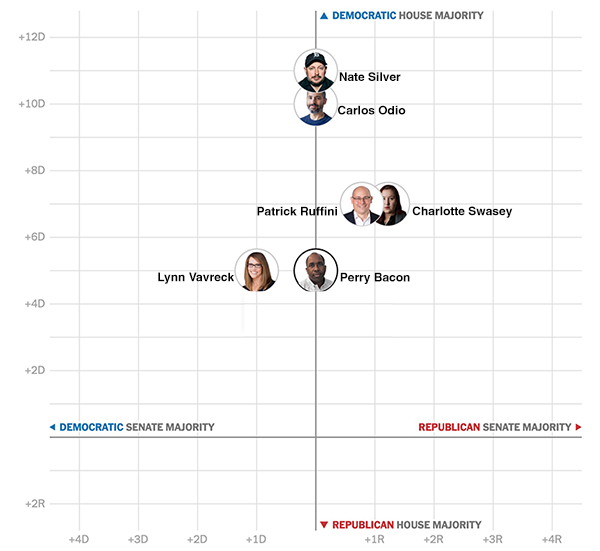
They all predict a House majority for the Democrats, in the range of 5-11 seats. This small number is because due to gerrymandering, there are almost no closely divided districts now. How big the Democratic majority is matters a lot, even though it takes only 218 votes to pass bills or impeach government officials. If the new size of The Squad is larger than the Democrats' margin, the Democrats could have a Freedom Caucus problem, with a tiny minority of the caucus holding the rest hostage.
Two of them gave the Republicans the Senate, one gave the Democrats the Senate, and three expect a tie. In the latter case, Sen. Lisa Murkowski (R-AK) will suddenly have a lot of power. She could also switch to being an independent to avoid Donald Trump threatening her with a primary in 2028.
Bacon says that polarization and partisanship rule. He doesn't think Democrats can win statewide in red states. For House races in competitive districts, the generic ballot is a good indicator and that is currently D+6. He is surprised that Ohio became so red while Michigan and Pennsylvania did not, so he doubts Sherrod Brown will get his old job back in Ohio.
Odio is not sure that all the marginal young voters who went for Trump in 2024 are going to show up for the Democrats. To get a Senate majority, Democrats need them in red states and they might not vote. Winning two red-state Senate seats would require a small miracle, in his view. He thinks a race to watch is TX-15, which is 75% Latino. If Latinos vote in 2026 as they did in 2018, Texas could shift to the left and Tejano singer Bobby Pulido could unseat Rep. Monica De La Cruz (R-TX) and the gerrymander could become a dummymander. But he is not so certain of this yet.
Ruffini thinks the new maps will definitely help the Republicans but not insulate them from a loss of the House. He is also watching gas prices closely. He thinks if it is below $3.50, the Republicans will do better than expected. The national average is now $3.97. He is keeping an eye on the Democratic primary in Michigan. If Abdul El-Sayed wins the primary and wins the general election, it will be proof that progressives can win in swing states. If he wins the primary and loses the general election, it will show that the left flew too close to the sun and possibly cost the Democrats the majority and the ability to block Trump's cabinet and judicial appointments. Boy, will there ever be recriminations if that happens.
Silver thinks that the Democrats' D+6 edge in the generic ballot could grow as pollsters switch from registered voters to likely voters (because Democratic enthusiasm is through the roof and most Democrats will show up and vote). He is also concerned about Maine. If Graham Platner decides to go home and pout that the Democrats stole his nomination from him, that could be just enough for Sen. Susan Collins (R-ME) to eke out a win. He is also keeping an eye on gas prices.
Swasey thinks a Democratic House is a done deal, but she thinks they will fall just short in the Senate. But she notes that polling is very patchy so far. She is also watching the Kansas gubernatorial primaries, which are a microcosm of the country.
Vavreck sees Trump's approval rating as key. If many Republicans have had it with him, they may stay home, and that could give the Democrats the Senate as well as the House. She is also paying attention to whether Gov. Josh Shapiro (D-PA) can flip four House seats (see below). If he can, he will get a boost for 2028. (V)