
Dem
47

GOP
53

Nate Silver is still around. He founded FiveThirtyEight, worked for The New York Times, then for ABC, and now has his own blog, Silver Bulletin. He writes about politics and sports. With the Democratic Socialists of America (DSA) in the news a lot lately, he did some digging into who the DSA members are and wrote a column about his findings.
He took a look at the Cooperative Election Study, which is a database of 400,000 voters, allowing small subgroups to be studied. By now everyone knows that high educational attainment generally correlates with high income and voting for liberal Democrats. But Silver found an oddity in the data. There is a group with high educational attainment (at least a bachelors degree), but moderately low income. The problem is that the U.S. cranks out more college graduates annually than the economy can absorb, while there is (unfulfilled) demand for plumbers. The consequence is that some people with a college degree or more are basically downwardly mobile and are working in jobs that don't need a college degree and don't pay well. He made this table showing the relation of education, income, and voting for 2016-2024 presidential voting:
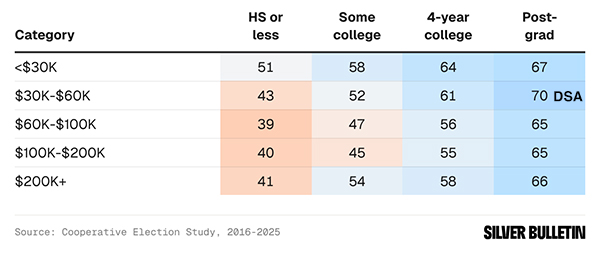
Based on this data, which is the most Democratic group in America? It is the people with a postgraduate degree making $30-$60K. These are the people who have a Ph.D. from studying the philosophy of some Belgian philosopher no one else has ever heard of, and are not working as a professional philosopher, and are not making as much money as they expected. They think something is rotten in America. This is where the DSA membership comes from. A study by the DSA of its membership showed that most of its members were working as teachers, nonprofit workers, social workers or government employees. They were not working class at all, and 85% were white, which is not even representative of the Democratic Party, let alone the country.
By way of contrast, the most Republican boxes in the table above are the three lower left ones, people with little education but making a lot of money. These are small business owners, contractors, real estate developers, used car dealers, etc.
When broken down by race, the table above for only white voters is basically the same, but for Black voters it is very different. It is much more uniform. The only two boxes below 83% are the lower left one (69%) and the one to its right (78%). Rich, undereducated Black people are the only ones with any interest at all in what the Republicans are selling, and even then, not much.
DSA members are largely disillusioned highly educated white progressives who are disappointed by their economic reality. But the DSA is for the "omnicause." If you want better wages for working-class people, you also have to support abortion on demand, be for immigration, embrace gay and trans rights, and oppose Israel. It is a package deal. Silver suspects that if the DSA dropped the cultural stuff and just focused on the economic issues, like a much higher minimum wage, stronger unions, and guaranteed health care, it would do better.
The data also show that the people who describe themselves as extremely or very liberal are also in the DSA box of people with postgraduate degrees making $30-$60K. The DSA box has similar priorities as all voters on many issues, but sharply diverges on a few of them. Here are the numbers:
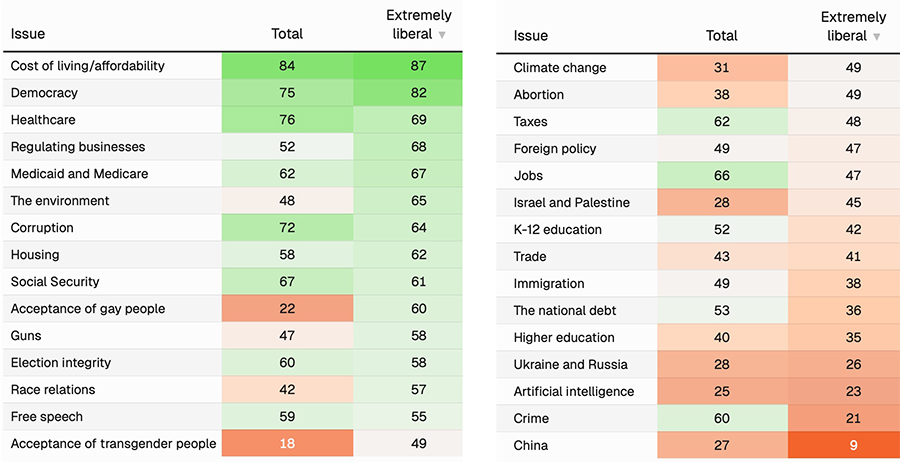
As you can see, on affordability, democracy, and healthcare, the extremely/very liberal voters are pretty much in line with all voters as the top issues. However, there are a few places where they sharply diverge, especially gay people, trans people, climate change, Israel, crime and China. These are likely the issues that are keeping the DSA from becoming a major political force. Noah Smith recently argued that the socialist left and the woke left are very different movements. The DSA is actually more the woke left (focused on cultural issues) than the traditional socialist left (focused on economic issues).The European Social Democratic parties are much more working class than the DSA and are not populated by people with postgraduate degrees. They are largely focused on traditional socialism, meaning improving life for working-class people, with only minor attention to cultural issues, if any at all. For example, here is the platform of the British Labour Party. The eight issues listed are the economy, secure borders, national security, economic growth, clean energy, crime, education and healthcare. Cultural issues? Not so much. If the DSA would drop the cultural stuff and focus on making life better for actual working-class people (rather than supporting the policy preferences of disillusioned underemployed people with postgraduate degrees), it might actually become a competitive party, as the Labour Party is. (V)