
Dem
47

GOP
53

Some Democrats are crying in their beer white wine about Maine Senate candidate Graham Platner because he was
not the ideal boyfriend in the past. Other candidates also have problems of various kinds. Democrats are very sensitive
to flaws in candidates, whereas Republicans are not. Think: Mehmet Oz, Ken Paxton, and Herschel Walker. They just look
at the name, see the (R) after it, and know how to vote.
A new survey shows that the controversies swirling around Platner and Paxton aside, an overwhelming majority of voters understand that you often have to go with the lesser of two evils, and that nearly always means voting for your party's candidate, however flawed. If that holds, it will have effects in Maine and Texas. Here are the results of the question asking if you often have to pick the lesser of two evils:
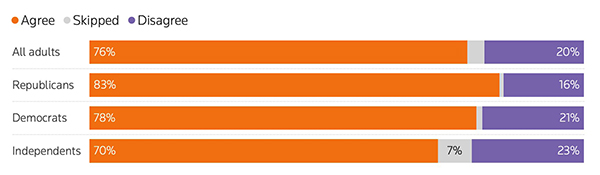
Republicans see the problem more acutely than Democrats, possibly because they tend to nominate more seriously flawed candidates than the Democrats. Another question got more specific. Democrats were asked if they support "Democrat Graham Platner, who had a chest tattoo associated with Nazi Germany" and 55% said yes, 17% said no, and 29% were uncertain. Republicans were asked if they support "Republican Ken Paxton of Texas, who was indicted for securities fraud" and 57% said yes, 17% said no, and 26% were uncertain. So basically, a majority of partisans stick with their own tribe. No matter how flawed their candidate is, he or she is better than the other one.
A lot hinges on how true independents vote. Many people who are registered as independent, or who decline to state, lean strongly to one side or the other. Nevertheless, there are a small number of true independents and their votes can be decisive in close races. How they vote can depend on many factors including the economy, candidate quality and their opinion of the sitting president. (V)