
Dem
47

GOP
53

Republican senators are starting to stand up to Donald Trump on a few issues. One of the big ones is the "SAVE America Act," which makes it more difficult to vote in a variety of ways. Trump really, really wants this bill but Republican senators do not. Passing it would require abolishing the filibuster (which Trump wants), but it is doubtful that there are 51 Republican votes for the bill in the Senate at all, even if the filibuster is abolished.
Different Republicans have different objections to the bill. One thing they don't like is the federal database of eligible voters it would create. Many Republican senators are strong supporters of states' rights and don't want the feds mucking around with elections, which the Constitution says are to be run by the states.
A second objection is political, although few senators will talk about it. The bill requires voters to present proof of citizenship to register to vote, even after an in-state move. Driver's licenses do not prove citizenship, just residency (except in five northern states). That proof could be a passport or a current ID that matches the name on the voter's birth certificate. Most other documentation is disallowed. The "problem" is that people living in rural areas in interior red states rarely travel internationally and many do not have a passport. In contrast, urban, coastal voters are more likely to have a passport. Also, the vast majority of women in red states who get married change their name, so a current ID will not match their birth certificates. In blue states, many women who get married do not change their name. Consequently, in practice, this provision would probably disproportionately hurt Republicans. The senators understand this but Trump does not.
Trump thought he could pressure the Senate into passing the Act by announcing yesterday morning that he was going to refuse to sign the bipartisan housing bill that passed the House 358-32 and passed the Senate 85-5. Trump may not know this, but if he takes no action on the bill for 10 days, it automatically becomes law. If he vetoes it (which would be a gift to the Democrats), Congress can override it with a two-thirds vote in each chamber. Given the initial vote, the votes for overriding a veto are almost certainly there.
After the announcement, Trump stormed into the GOP Senate lunch to try to bully the senators. He vented at the senators for an hour. They vented right back, especially Sen. Bill Cassidy (R-LA), who stood up and loudly explained why he and three other Republican senators voted for a resolution ordering Trump to end the war in Iran. Much yelling occurred. Sen. Ted Cruz (R-TX) called the meeting "spirited," "frank," and "candid." Sen. Roger Marshall (R-KS), a physician, described the meeting as "very much like a hospital board meeting, when a bunch of doctors are yelling at each other." Another senator said that Cassidy's anger was "out of body." It didn't work. Sen. Kevin Cramer (R-ND) said nobody changed their mind. The senators reminded Trump that they have taken votes on the SAVE Act five times this year and the votes simply are not there.
On the other hand, the Republican senators wanted to make sure Trump knew that despite Cassidy's outburst they were still world-class cowards. So in the evening, they walked back their earlier resolution to order Trump to either end the war in Iran or get Congress to authorize it. Cassidy switched sides and Sen. Rand Paul (R-KY) voted present. The vote was 47-50-1. The second vote changes nothing since Trump was not going to obey the first one, even if the House approved it, too. The main thing the second vote showed is that the Republican senators are like beaten dogs who cower and beg when their master raises his eyebrows.
Meanwhile, over in the House, Speaker Mike Johnson (R-LA) is plotting a third reconciliation bill that would include the SAVE America Act in it. He announced this to placate Trump, who has probably forgotten that the last time he tried this, Senate parliamentarian Elizabeth MacDonough made the Senate remove the SAVE Act stuff because reconciliation bills operate under special rules and only budget items are allowed. Trump wants Senate Majority Leader John Thune (R-SD) to fire MacDonough, but Thune has steadfastly refused because he knows if he replaces her with some flunky, next time the Democrats get the trifecta, they will replace his flunky with their flunky.
A second area where Congress is starting to stand up is a secret $500 million investment in the Trump family crypto company made by a group led by Sheikh Tahnoon bin Zayed al Nahyan, brother of the ruler of the United Arab Emirates. Four months after the investment, the U.A.E. got authorization to buy the best American AI chips, something the Biden administration had banned due to the U.A.E.'s close relationship with China. Coincidences do happen, of course. Here is Trump in the U.A.E. with Tahnoon:
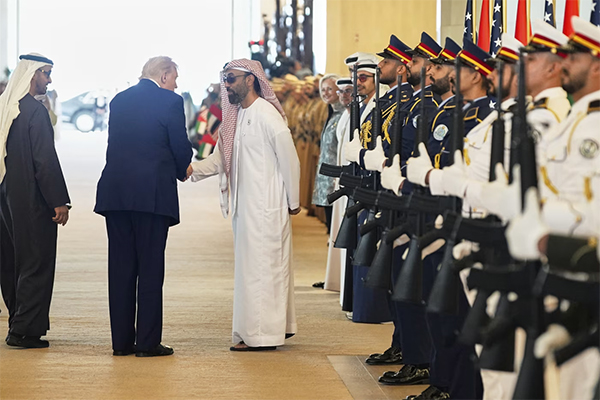
The deal sold 49% of World Liberty Financial, a company formed by Trump's sons and supernegotiator Steve Witkoff, who got $31 million, to the Emirati group. So even if the crypto business collapses completely, Trump has made a few hundred million off it so far. Democrats smell something fishy here and wrote letters demanding an investigation to the heads of the Senate Investigations, Banking, Homeland Security, Judiciary and Finance Committees asking for action. The letters were signed by the ranking members of these committees, Sens. Richard Blumenthal (D-CT), Elizabeth Warren (D-MA), Gary Peters (D-MI), Dick Durbin (D-IL), and Ron Wyden (D-OR), respectively.
On Tuesday, Democrats on the Senate Banking Committee listed a series of administration actions following the deal that benefited the U.A.E., including sale of 15% of TikTok's U.S. operations to MGX, a company led by Tahnoon, and the pardon of Changpeng Zhao, the founder of Binance, which is partly owned by MGX. The Democrats called the Emiratis buying 49% of a worthless company for $500 million, followed by Trump giving the U.A.E. a number of valuable things the Emiratis wanted, corruption and self-dealing. If the Democrats capture either chamber of Congress, this is sure to be investigated. This kind of garden-variety corruption—a foreign leader giving the president a lot of money and then the president doing things that the foreign leader wants but which are against the interests of the United States—is something even ordinary voters understand.
However, pushing back is something that happens both ways. While Congress is starting to stand up to Trump, Trump is continuing to push back on Congress. Back when Elon Musk was running the country, he gutted the world's largest provider of foreign aid, USAID. Trump later wanted to finish the job and kill it completely, but Congress created it and only Congress can kill it. Trump asked Congress and it refused.
Worse yet, it has passed legislation to fund some USAID activities, including $9.4 billion to prevent and treat HIV, malaria, and tuberculosis and $5 billion in humanitarian aid. Congress also required regular detailed reports on the spending. Trump signed the bill and is "delaying" spending the funds the government is required by law to spend. Administration officials are also refusing to answer queries from Congress about the matter. The president refusing to spend money appropriated by Congress is called impoundment. In Train v. City of New York, the Supreme Court ruled that it is unconstitutional.
In practice, there is not much Congress can do about this now, but impoundment could rate an article in future impeachment proceedings by the next House. It continues to be clear that Trump regards Congress as an annoying nuisance that he can ignore with impunity. (V)