
Dem
47

GOP
53

A former teacher named Dan Sullivan decided he wanted to run for the Senate this year and filed the paperwork. The director of the Alaska Division of Elections, Carol Beecher, refused to put him on the ballot because she said he was not running in good faith. That is probably true, but is it a valid reason to keep someone off the ballot? Sullivan didn't think so and sued.
On Friday, Superior Court Judge Thomas Matthews overturned Beecher's ruling. He said there are only three qualifications for running for the Senate in Alaska: (1) the candidate must be 30 years old, (2) the candidate must be a U.S. citizen, and (3) the candidate must be a resident of Alaska. Teacher Dan meets all three requirements, so the state can't ban him from the ballot because there is no legal or constitutional requirement of running in good faith. Every year there are dozens of "perennial candidates" who don't expect to win and aren't trying. Should they be banned? Who would decide what is a good-faith run? Matthews' decision can be appealed to the state Supreme Court.
Teacher Dan is not home free yet. There is still the matter of how he is listed on the ballot. He wants to be listed as "Dan Sullivan." Beecher could insist (against all precedent) that he be listed by his legal name, "Daniel J. Sullivan," but then she would have to list Sen. Dan Sullivan (R-AK) as "Daniel S. Sullivan." That would be just as confusing, because it is doubtful many Alaskans know the senator's middle name is "Scott." Party affiliations are listed, but Teacher Dan was clever enough to register as a Republican. Office titles and occupations are not listed on Alaska ballots, just the name and party. Here is part of the 2022 Alaska primary ballot:
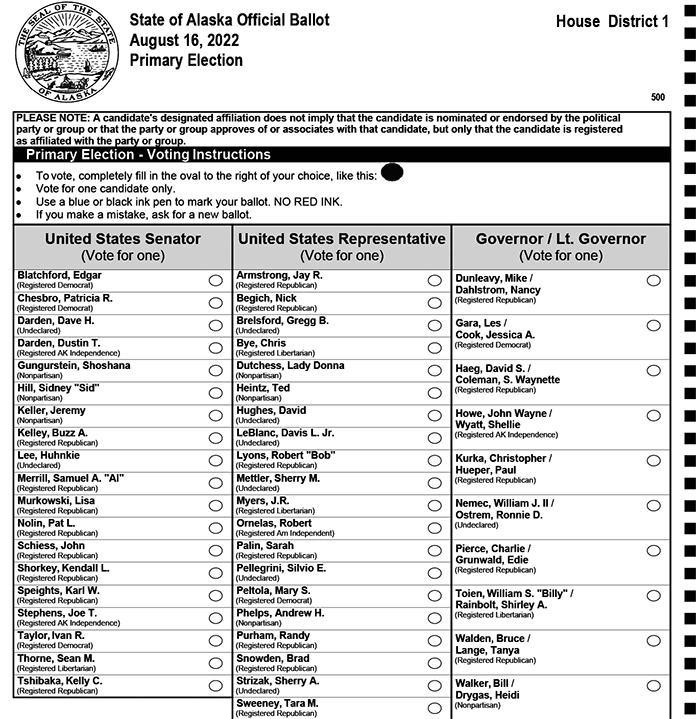
Unless the state Supreme Court overturns Matthews' decision, there will be two Dan Sullivans on the primary ballot. But remember, the way it works in Alaska is that the top four candidates, irrespective of party, advance to a ranked choice general election in November. It is entirely possible that Sen. Sullivan, teacher Sullivan, Democrat Mary Peltola, and some random other person make it to the general election, in which case many Republicans will rank one of the Dans as #1 and the other one as #2. But there is still a danger that more than half of the voters get it wrong and the senator is forced out in round 1 or 2. The final round could conceivably be teacher Dan vs. Peltola, and the teacher could be elected to the Senate. Stranger things have happened. (V)