The (Political) War in Iran
For months now we had been planning that on March 2, we would lead with the start of the primary season tomorrow,
especially the two hotly contested Senate primaries in Texas that could determine control of the Senate next January.
But you know what they say about the best laid plans of rodents and humans... So first, Iran Part II, to which there are
likely to be sequels for a bit, then on to the primaries.
Donald Trump has announced that Iran's Supreme Leader, Ayatollah Ali Khamenei, is dead. At this point, if Trump were
to announce that this year April is going to follow March, we would consult three calendars before even considering the
possibility. But three days into the war and Khamenei hasn't appeared in a video holding today's newspaper, so maybe it
is true. The leading leftist Israeli newspaper, Haaretz, which is a fierce critic of Benjamin Netanyahu, ran a
headline
yesterday reading: "Iran's Supreme Leader Ayatollah Ali Khamenei Killed, State Media Confirms," so it is probably true.
Haaretz isn't toting Bibi's water, that's for sure, so Khamenei has probably really gone off to collect his 72 virgins.
If Trump were smart, he would end the war now with only
three Americans killed,
claim that the goal (regime change) has been achieved, and crow about it until Nov. 3. However, this does not appear to
be his plan. In fact, he probably doesn't have any plan at all. As we pointed out yesterday at length, starting a war
with no plan for ending it is generally not a good idea.
The political repercussions of this are probably going to be huge. Only we don't know what they will be yet.
Everything depends on how this ends. A quick American victory with only a handful of American casualties and regime
change with Reza Pahlavi firmly installed as the new Shah in an interim government that will hold elections is Trump's
dream scenario. That could help Republicans in the midterms by boosting Trump's approval rating. We aren't quite there
yet, to say the least. A victory by the old regime led by a different and even angrier ayatollah, with many American
deaths, will have the opposite effect. An ongoing war with Americans being killed every day and economic chaos
everywhere would not help Trump. World War III would definitely not help. What political effects can we already dimly
see?
- Why?: We still are not sure why Trump started this war. Sooner or later—probably
sooner, if American casualties mount—some voters are going to want to know why their son or daughter died. If it
was to get the Epstein files off the front page, that will not be popular. What about Trump feeling his oats after an
easy win in Venezuela? Nah. To stop Iran from going nuclear? That would be popular, except Trump claimed that he did
that in June, so what was this round about? Maybe Trump thought he could bomb Iran into becoming a friendly democracy.
In the history of the world, that has never happened without boots on the ground. Hope springs eternal. Simple
opportunism
won't be a crowd-pleaser either. Openly saying: "I was expecting an easy win and I thought that would goose my approval
rating so as to help Republicans in November" might be the actual truth, but God help Trump if there are many American
casualties and he says that out loud.
Maybe follow the money?
A real possible explanation might be found by seeing who benefits from this war. Israel and Benjamin Netanyahu
certainly, but Trump doesn't really care about Netanyahu all that much, although the Mossad probably is supplying
valuable intelligence for the war. However, Trump cares a lot about Saudi Arabia, which gave First Son-in-Law Jared Kushner $2 billion to
play with, and which sees Iran as its mortal enemy. The Saudis would definitely like to see Iran bombed back to any time from 622 A.D. to
20,000 B.C. Saudi Crown Prince Mohammed bin Salman has been
lobbying
Trump for weeks to strike Iran.
And what about the U.A.E., which is only 70 miles from Iran and completely defenseless? Iran could level Dubai in an
hour if it wanted to. If Iran is reduced to a smoldering pile of rubble, that problem goes away. Thinking about this
makes the U.A.E.'s "donation" to the Trump family by buying $2 billion in worthless crypto seem like a very wise
investment.
And then there is Qatar, which is 120 miles from Iran, across the Persian Gulf. It gave Trump a $400 million gilded
flying plaything and would love to see Iran get a one-way trip back to the stone age. Just imagine, for a measly
$4.4 billion, you can rent the entire U.S. military machine. That has to be the bargain of the millennium. If Trump
started a war in which Americans get killed because his Arab buddies gave him big bribes presents, and America
Firsters figure this out, Katie bar the door. He'd better figure out something to tell them that sounds better than any
of these.
Trump may have accidently stumbled onto the greatest grift of all time for use after the midterms when he doesn't care about his approval
rating. If a country or consortium of countries has a regional enemy they would like to annihilate, they can buy some $TRUMP
coins and then the full power of the U.S. military wipes out that country, with the U.S. taxpayer picking up the actual tab.
There could be a price list, say, countries with fewer than 50 million people for $5 billion. More than that costs $10 billion.
The U.S. Army as mercenaries for hire.
- No Forever Wars: Make no mistake. This is a war of choice. Trump made a
campaign promise
to end "forever wars" that is no longer operative. Many America First voters pulled the lever for him specifically on
account of that promise. They are not likely to be amused by any explanation, especially not a half-baked one that makes
even Karoline Leavitt giggle when explaining it to the media.
The key word here is "forever." If it is over in a month and all the troops are home safely, all will probably be forgiven.
However, if it starts to look like it really will go on forever, Trump's approval rating will take a massive hit. At some
point, Trump may be in a bind. Stop the war and look weak or keep going and make Tucker Carlson furious. The joke on
Saturday Night Live was that Trump is keeping his promise. He promised no more forever wars (note plural), so
he gets one for free. We wouldn't be too surprised to see the real Trump try that line, if he gets desperate.
- Congress: A third political problem is Congress, which has the power, you know, to
declare wars. It didn't declare this one and some members don't especially want this war and will want it increasingly
less if it goes south. It is a bit early for a big "Mission Accomplished" banner. Rep. Thomas Massie (R-KY) is not a
one-trick pony who cares only about the Epstein files. He and his new buddy Rep. Ro Khanna (D-CA) have once again teamed up and
introduced a
war powers resolution.
It orders the president to terminate all hostilities against Iran (because Congress has not authorized them). Who said
bipartisanship is as dead as the dodo?
A second Republican, Rep. Warren Davidson (R-OH), supports Massie. He tweeted: "War requires Congressional
authorization. These are actions short of war, but no case has been made." With the current Congress at 218R, 214D, if
all Democrats support the resolution, the vote will be 216R, 216D and fail. But if one more Republican jumps ship, it
will pass. The House will not be in session until Wednesday, so developments in the next 2 days could influence some
votes. If Congress formally orders Trump to cut it out and he doesn't, that is certainly grounds for impeachment on Jan.
3, 2027 if Democrats capture the House. Defying the explicit will of Congress about starting a war is easy for Americans to understand.
- Ukraine: The U.S. is burning through its missile
stockpile at a furious rate. That means
fewer missiles for Ukraine, even if the E.U. is willing to pay for them. Raytheon and Lockheed Martin can make Patriots
and Tomahawks only so fast and they can't even start until Congress passes a supplementary appropriations bill paying
for them. On the other hand, Russia, which used to think of itself as a world power, has been getting armaments from Iran.
That supply chain is now dead in the water because Iran needs every weapon it has for its own war. Having both Ukraine
and Russia run out of weapons might actually be a good thing, but it does reinforce the current stalemate. Still, the
war in Iran definitely affects the war in Ukraine, with all the political ramifications of that.
- Affordability: Yup, that makes an appearance here, too. Iran is claiming it has
effectively closed the
Strait of Hormuz,
through which one-fifth of the world's oil and liquified gas flows. An
animation
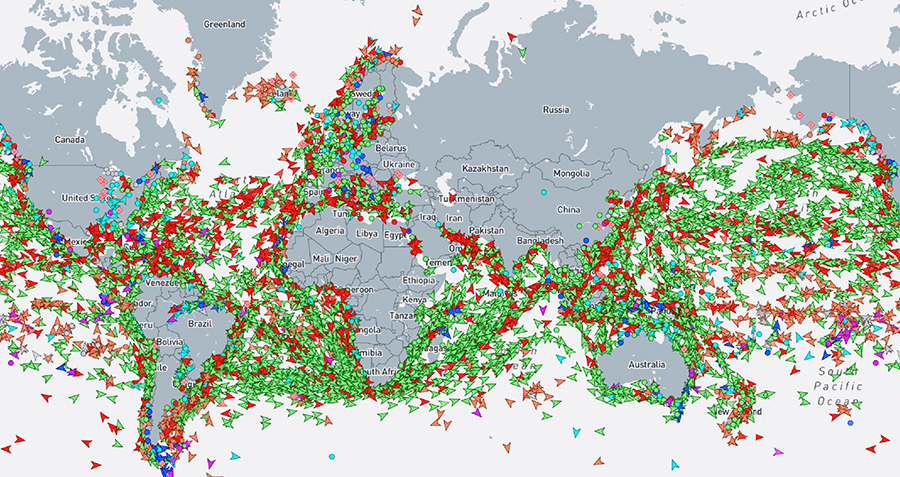
of real-time ship traffic on the New York Times website shows that the claim appears to be true. There are a lot
of ships out there, as the image below, from
marinetraffic.com,
shows. That site is to ships as
flightradar24.com
is to airplanes, only the objects being tracked don't move as fast:
Needless to say, any long-term disruption of maritime commerce, especially in energy, will cause prices to rise and
markets to become volatile. If it goes on long enough, that could lead to a recession, inflation (especially gas prices)
or maybe both at once. Voters don't like that.
If Iran's new leaders decide that disrupting the world economy is a good strategy, it could hit oil fields and oil
infrastructure in the Gulf countries to reduce total oil output. It is also possible that Iran's own oil infrastructure
is damaged one way or another, also reducing world output.
- The Stock Market: Trump and other administration officials keep saying the economy is
great because the stock market is so high. Even AG Pam Bondi said that during her recent congressional testimony. But if
the war in Iran goes on for a while and oil supplies are disrupted and recession looms, the bears may chase away the
bulls and the stock market could crater. That would have two effects. First, people would notice that their 401(k)
statements are gloomy. This is direct and personal. Second, Trump's argument that the economy is good because the stock
market is good goes away. The last thing Trump wants in November is a cratering stock market along with higher inflation
and probably higher unemployment. That would be a disaster for the midterms and also for Trump's ego since he seems to
measure his own worth in terms of where the Dow Jones index is.
We are going live long before U.S. markets open, so we don't know how they will do today.
However, European markets are already open and they are
down.
The markets are very jittery and every little nugget of news moves billions of dollars in or out.
- The Shutdown: With all the news about war and oil supplies, you might have forgotten that
part of the government, DHS, is shut down for lack of funding. That shutdown is likely to continue because the war has
sucked up all the oxygen. Are House members discussing how to fund DHS and what conditions Democrats will demand as the
price? No. Nobody is talking about DHS at all. All the focus is on the war and a possible vote on a resolution to force
Trump to withdraw all troops from the area. DHS just isn't a priority right now. You would think that with 432 current members
of the House, it ought to be possible to find five Republicans and five Democrats to talk about DHS, but that is not how
Congress works. In fact, Congress does not work at all. That is the problem.
Suppose the U.S. bombs the hell out of Iran for a month but the Iranians refuse to surrender. What then?
Trump's main options then would be to send tens of thousands of American soldiers to Iran, largely without the backing
of many allies, few of whom trust Trump now, or else to go nuclear. The effect of a ground invasion, which Trump has said he
would never do, would be to drive his approval rating below the Bush line (32% approval) and hand the Democrats the
House and maybe even the Senate. A nuclear attack would consume the whole world in a fireball. It is possible that every
general he asked to pull the trigger would resign rather than do it. Trump's "thought" process simply assumed that with
enough bombing, Iran would eventually give up. But what if it won't?
The first poll on the Iran war is in.
Reuters/Ipsos
has 27% of Americans supporting the war in Iran, 43% not supporting it, and 29% not exactly sure what or where Iran is.
Approval of the war by Democrats, independents, and Republicans is 7%, 19%, and 55% respectively. Keep an eye on the
approval rate of independents. That could be the key to the midterms. (V)
This item appeared on www.electoral-vote.com. Read it Monday through Friday for political and election news,
Saturday for answers to reader's questions, and Sunday for letters from readers.
www.electoral-vote.com
State polls
All Senate candidates


