
Dem
47

GOP
53

There were lots of interesting primary results yesterday, which gave some—but not a lot—of clarity. Let's run down the biggies out of Texas, North Carolina, and Arkansas:
U.S. Senate, Texas (R): This seat is the big story of the night, and on the GOP side, things turned out almost exactly as expected, as Sen. John Cornyn and state AG Ken Paxton finished in a near dead-heat, 41.9% to 40.9%, with neither coming close to the threshold needed to avoid a runoff. So, the two of them will be facing off again on May 26.
As we have noted several times, the conventional wisdom is that voters know the incumbent, and if they don't vote for him or her, they want to throw the bums out. If so, then most of the 13% of voters who went for Wesley Hunt will migrate to Paxton, and Cornyn will be in trouble. To save Cornyn, the GOP is going to have to keep spending lavishly in the Lone Star State, to the tune of seven or eight figures a week (the current spending level) for another 12 weeks or so. Even if Cornyn pulls it out, that's millions and millions and millions of dollars that won't be available for the general election, or for other tight races.
U.S. Senate, Texas (D): The polling for this one was all over the place, with most pollsters giving a huge lead to either Rep. Jasmine Crockett or to state Rep. James Talarico. As it turns out, the last major poll of the race, from YouGov, was the most accurate. They had the final tally 53% for Talarico to 40% for Crockett, and when the votes were counted, it was 53% for Talarico and 46% for Crockett. That's still not great, and most of the other polls were a lot further off. The lesson: Texas is going to be tough to poll this year.
Take a look at these three maps of Texas:
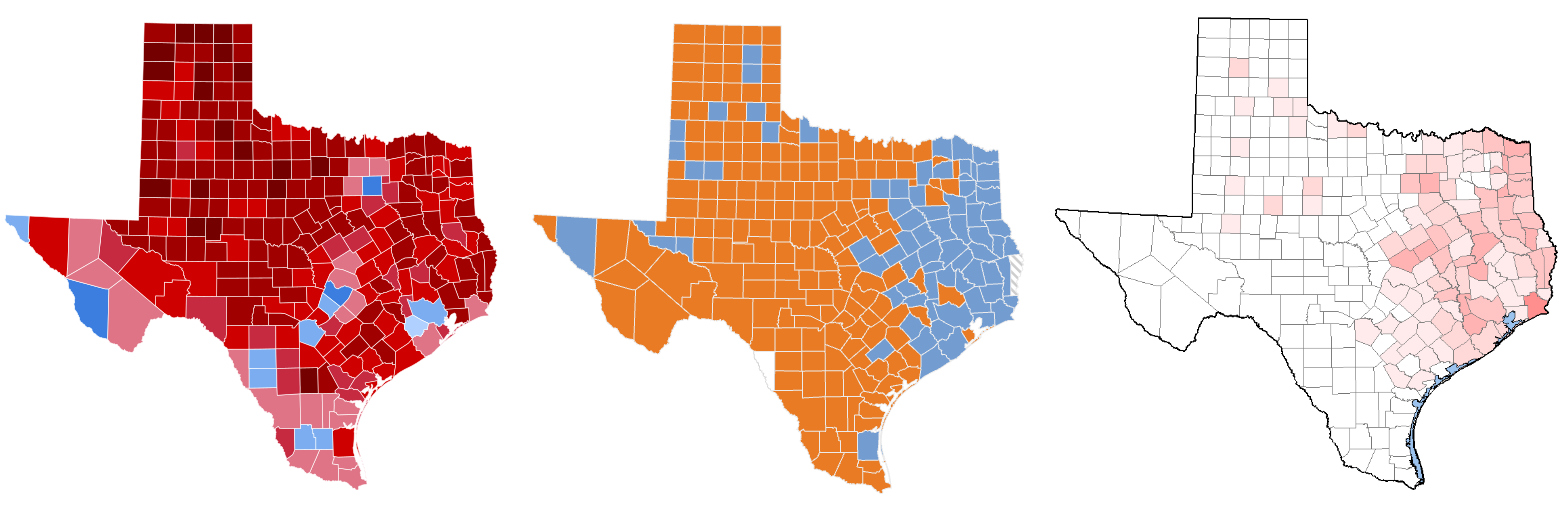
Map #1 shows the 2024 presidential vote by county, with red being Trump counties and blue being Harris counties. Map #2 shows yesterday's Democratic primary results, with orange being Talarico counties and blue being Crockett counties. Map #3 shows the Black population of each county, with redder meaning Blacker.
If you pair map #1 and #2, the story they tell is a story of ratfu**king; a bunch of Trumpy voters chose Democratic ballots and voted for Crockett to try to stick the Democrats with the worst candidate. If this is the correct story, it's at least a little bit of bad news for Democrats, because it means that some of the "enthusiasm" that showed up in early voting is just ratfu**king. If you pair #2 and #3, by contrast, the story they tell is a story of identity politics. If this is the correct story, it's better news for the Democrats, and it means Talarico just needs to make sure to find a way to connect with Black voters. Since he speaks the language of evangelical Christianity, and since many Black Southerners are evangelical Christians, that is doable.
We do not know which story is the true one. Could be both. The only thing that is certain is that the Democratic Party got the candidate that it thinks is more electable. What he does with the opportunity will be one of the big stories of 2026.
Governor, Texas: There was little drama here, as both of yesterday's winners were overwhelming favorites. Gov. Greg Abbott (R) is now officially the nominee for a fourth term, having crushed his challengers with 82% of the vote. He will face off against state Rep. Gina Hinojosa (D), who crushed HER challengers with a slightly more modest 60% of the vote. There were just a shade over 2 million votes on each side of the contest, so the question of whether the record number of Democratic ballots cast was a product of Democratic enthusiasm, or just Republican ratfu**ing, will loom rather large over this contest, just as with the Senate seat.
TX-02: This is the seat of Rep. Dan Crenshaw (R). Soon, we will write that it WAS the seat of Rep. Dan Crenshaw (R). That is because he earned the booby prize for first sitting member to be primaried this cycle. The Representative, who was once a rising star in the GOP, toted the MAGA water 95% of the time. But that other 5% was too much; he was the only House incumbent running for reelection in Texas who did not get Donald Trump's endorsement, while the backstabbing Sen. Ted Cruz (R-TX) actively campaigned for Crenshaw's opponent. The result is that state Rep. Steve Toth (R) easily beat Crenshaw, 56% to 40.5%, and will surely be the next representative for this R+12 district.
TX-15: This red-leaning district is currently represented by Rep. Monica De La Cruz (R). The Democrats think they can win it back with the right candidate, and they got their preferred choice yesterday in Bobby Pulido, as he dispatched the more lefty Ada Cuellar, 68% to 32%. Pulido is not only Latino (something of a must in this heavily Latino district), he's also a Tejano music star. Imagine Snoop Dogg running for Congress from South Los Angeles, and you begin to get the idea. That said, Pulido also has a problematic history when it comes to social media postings; De La Cruz is likely to mention the ones that could be read as misogynist, at least once or twice.
TX-18: This race came about because of two major 2025 storylines. The first was the Texas mid-decade redistricting. The second was the death of Rep. Sylvester Turner (D). Due to the former, Rep. Al Green (D) jumped over to this district. Due to the latter, special-election winner Christian Menefee (D) is currently representing this district in the House. Green is legendary, but part of the old guard. Menefee is young and hungry, and part of the new guard. Yesterday, Texas Democrats favored the new guard by just a shade, as Menefee took 46% of the vote to 44.5% for Green. That means a runoff, though, and if there's any Texas representative who knows a thing about GOTV operations, it's Al Green. So, this could definitely go either way in May.
TX-23: Republicans in this red district were left to choose between two real prizes. Rep. Tony Gonzales (R) looks to have had an affair with his former staffer, who then committed suicide. Brandon Herrera is a gun fanatic to the point of being reckless; he thinks that every house, right next to the broom and the mop, should have an AK-47. They'll head to a runoff, as Herrera claimed 43.4% of the vote, to 41.7% for Gonzales.
TX-33: This was another district that saw some jumping due to the new district map. Rep. Julie Johnson (D) decided that she would like to remain in the House, and that TX-33 was the best chance to do that (her current district, TX-32, is about to get pretty red). Meanwhile, former representative Colin Allred, after he got out of the U.S. Senate race, decided that this district was his ticket back to Washington. This one is going to produce another runoff, albeit with the edge going to Allred, as he collected 44.8% of the vote yesterday to 33.7% for Johnson.
U.S. Senate, North Carolina: There was no suspense here. On the Republican side, Michael Whatley is boring and bland, but he used to run the RNC, and so he had the full backing of his party. He took 65% of the vote. On the Democratic side, Roy Cooper is a shade less boring, and he's won statewide six times. He took 92% of the vote. There were a little over 800,000 votes in the Democratic primary, as compared to a little over 600,000 in the Republican primary. Make of that what you will; this seat, of course, is a must-win for the blue team if they wish to have any hope of retaking the Senate.
NC-01: At R+1, this is one of two districts in the Tar Heel State that can be considered "swingy." The seat is currently held by Rep. Don Davis (D), who barely defeated retired Army colonel Laurie Buckhout in 2024. The district is now redder thanks to mid-decade redistricting, and Davis will face Buckhout again, as he was unchallenged yesterday while she won her primary with 39% of the vote.
NC-04: This D+23 district will remain in Democratic hands in the next Congress. But will those hands be the hands of the incumbent, Rep. Valerie Foushee, or her more lefty challenger, Nida Allam? With 95%+ reporting, Foushee has a slim lead, 49.2% to 48.2%. It's not quite over yet, but Foushee is certainly on the cusp of keeping her job. And note that North Carolina, unlike many Southern states, does not require an absolute majority for victory. A plurality is enough, as long as it's a plurality of greater than 30%.
NC-11: At R+5, this is the other swingy North Carolina district. Rep. Chuck Edwards (R) took 70% of the vote in his primary to win the right to run for reelection against Jamie Ager (D), who took 65% of the vote in his. Ager, a fourth-generation farmer, is basically North Carolina's answer to Graham Platner. Should be interesting to watch.
AR-04: We feel like we should at least mention Arkansas, since it also had a primary yesterday. The problem is that the state itself is R+15, such that Gov. Sarah Huckabee Sanders (R) and Sen. Tom Cotton (R), who were both officially renominated yesterday, are going to cruise to reelection. The four house districts are R+8 to R+23, and all four have incumbents who are also going to cruise to reelection.
The fact that Arkansas politics is rarely competitive anymore is indicated by the fact that the majority of the statewide and federal races were uncontested on both sides of the aisle, and the races that WERE contested, save one, were decided by 50 points or more (for example, Cotton beat both of his foolish challengers by more than 70 points). The one and only legitimately competitive race was for the right to be the Democratic nominee in AR-04, where James Russell outpolled Steven O'Donnell, 53% to 47%. Russell appears to be a perfectly respectable candidate who might be a real threat in a purple district, but who will get absolutely leveled by Bruce Westerman in this R+20 district. That said, Russell gave us something to write about for Arkansas. So, in a sense, he's already a winner.
And there you have it. Next week is Mississippi, which is like Arkansas in that it has no competitive races (although one of the House districts, though not competitive, is blue). Also next week, and probably of greater interest, is the special election to pick a replacement for Marjorie Taylor Greene. (Z)