What Is the Republicans' Absolute Worst Case in the Senate Elections?
Just as a thought experiment, we decided to consider what the truly worst-case scenario would be for the Republicans in
the Senate in November. To get the worst case, we would probably need all (or most) of these things:
- Gas is above $5/gal.
- Inflation has come roaring back.
- There is a deep recession with high unemployment.
- Donald Trump's approval rating is below the Bush line (32%).
- American troops are bogged down in a forever ground war in Iran.
- MAGA is having an open civil war.
Needless to say, some of these things are individually unlikely and the combination of all (or most) of them is
beyond unlikely. Still, there is a difference between winning Iowa (maybe) and winning Wyoming (not gonna happen). Here
is our list of states that the GOP could lose under the worst-case conditions, numbered from most vulnerable (1) to
least vulnerable (9). We cannot conceive of any plausible scenario in which any of the other red states are lost:
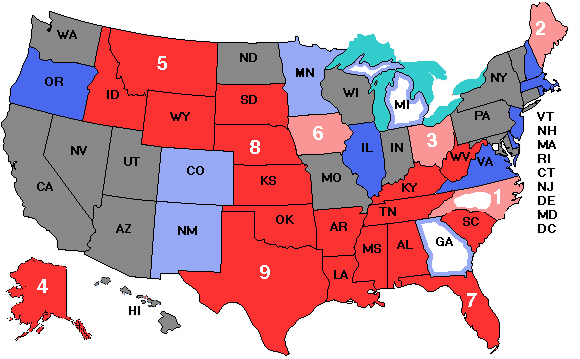
- North Carolina: This is probably the most vulnerable red state. It is an open-seat
election with a well-known and popular former governor, Roy Cooper, running against a Republican apparatchik, Michael
Whatley, that no one has ever heard of. Republicans will spend a fortune here, but negative ads against Cooper won't
work because people know him well and he has been vetted so many times in the past, there are not likely to be any
skeletons in his closet. Positive ads for Whatley will be tough because he has never done anything important or useful
for the people of North Carolina and as a newbie politician, he could fumble the ball. Also, the current North Carolina
governor, lieutenant governor, AG, and SoS are all Democrats, so Democrats can win in the Tar Heel State.
- Maine: Sen. Susan Collins (R-ME) should be really concerned this time. Maine is a blue
state and her personal popularity goes only so far in these very polarized times. The Democrats are having a nasty
primary and each of the contestants has some problems. For Gov. Janet Mills (D-ME) it is her age (78). For Graham
Platner, it is lack of any relevant experience, a Nazi tattoo on his chest (now covered), and many intemperate things he has posted to
social media over the years. Still, in a big blue wave, either of them could probably beat Collins (73).
- Ohio: Former three-term senator Sherrod Brown (D) is trying for a comeback against
appointed senator Jon Husted (R-OH). Appointed senators don't have a great track record and Brown is both a good fit for
Ohio and better known than his opponent. It is rare for a challenger to be better known (and probably better liked
personally) than an incumbent senator, but that is the case here. Trump will not be on the ticket in 2026, as he was in
2024, when Brown was defeated.
- Alaska: Alaska has a PVI of R+8 and Sen. Dan Sullivan (R-AK) has won two Senate races in
the Last Frontier. On the other hand, Mary Peltola has won statewide before (for the House), so she is well known and a
proven winner. Alaska is a cheap state to advertise in and she will have plenty of money from out of state. It would
take a serious blue wave for Peltola to win, but it is not impossible if there is one.
- Montana: Due to the decision by Sen. Steve Daines (R-MT) to retire and some fancy
footwork, the Republican candidate will be U.S. Attorney Kurt Alme, who is totally unknown in the state. If the
Democrats are smart, they won't support their own nominee at all, but will support independent Seth Bodnar, a West Point
graduate who fought with the famed 101st Airborne Division (the Screaming Eagles) and was later president of the
University of Montana. If he wins, he will probably caucus with the Democrats. His
campaign website
seems more compatible with Democratic positions than with Republican ones and
the website has a button to donate using ActBlue. Closet Republicans don't usually do that.
- Iowa: At a town hall, when Sen. Joni Ernst (R-IA) was asked about health care, she said
"We all are going to die." She was quickly dubbed "Joni Hearse" and dropped out, so it is an open-seat race. Iowa is red
but not that red (R+6) and it used to be a swing state. Rep. Ashley Hinson (R-IA) is the likely Republican nominee, but
she is known in only a quarter of the state. The Democrats have two strong candidates, state Rep. Josh Turek and state
Sen. Zach Wahls. Polling has Hinson ahead of both Turek and Wahls by 3 points, but in a big blue wave, 3 points is not
insurmountable.
- Florida: Florida used to be the mother of all swing states, but now it is red, although
not that red (R+5). This will probably be a steeper climb for the Democrats than Iowa despite the slightly better PVI
because the Republican, Sen. Ashley Moody (R-FL), is an incumbent. But, like Husted in Ohio, she was appointed to the
Senate (when Marco Rubio resigned to become secretary of state). As noted above, appointed senators don't have that great a track
record. The Democratic bench in Florida was pretty bare until Alexander Vindman jumped in. He was the whistleblower who
helped trigger Donald Trump's first impeachment, as a result of Trump trying to blackmail Volodymyr Zelenskyy into
investigating Hunter Biden. Democrats are going to shower him with money. His brother is Rep. Eugene Vindman (D-VA).
- Nebraska: Sen. Pete Ricketts (R-NE) was appointed in 2023 after Ben Sasse resigned, but
Ricketts won the special election in 2024 and is now seeking a full term. Democrats have decided not to field a
candidate at all, but are backing independent Dan Osborn, who ran against Sen. Deb Fischer (R-NE) and lost by 7 points.
He is more experienced now and will have plenty of backing. He is a Navy veteran and former union leader. He has the
same working-class vibe as Graham Platner in Maine. Nebraska is very red (R+13), but Osborn did better than expected
last time and Trump is not on the ballot this time. Also, Ricketts is very wealthy and his father, Joe Ricketts, is an
actual billionaire, so an anti-billionaire campaign could catch on. Last time Osborn faced someone (Fischer) who is
merely upper middle class. This time an anti-billionaire campaign could work.
- Texas: This one is tough and depends on who the Republican nominee is. We expect Trump to
endorse John Cornyn. If Ken Paxton stays in the race, Republicans will have to spend another $100 million to get Cornyn
over the finish line first. Trump could try to entice Paxton to drop out, but the only position he might accept is
attorney general. Given how MAGA Paxton is, Trump just might fire Pam Bondi and appoint Paxton. Against Cornyn, James
Talarico really doesn't have much of a chance. Against Paxton, he does. The only reason we even put Texas in this list
is that there is a chance that Paxton is the GOP nominee.
In a normal, but good, year, Democrats could flip North Carolina and Maine. Going deeper into the list will require a
substantial blue wave. In the absolute worst-case scenario for the Republicans, the Democrats could hold all their own
states and flip nine states, to give them 56 seats. But don't bet on it. (V)
This item appeared on www.electoral-vote.com. Read it Monday through Friday for political and election news,
Saturday for answers to reader's questions, and Sunday for letters from readers.
www.electoral-vote.com
State polls
All Senate candidates


