
Dem
47

GOP
53

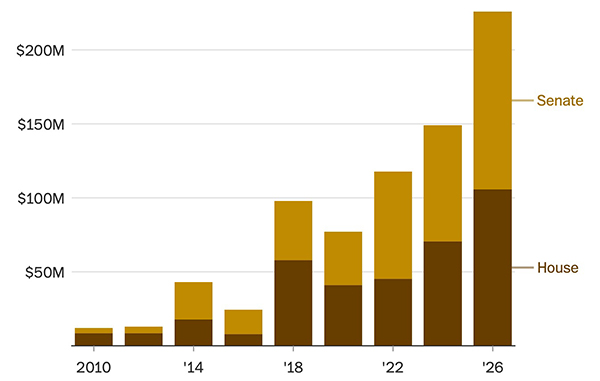
Outside spending on elections has gone through the roof. It has passed $225 million for the primaries so far, and we have had only five of them so far. Just wait until the general election starts.
Even worse, special interest groups are now trying to hide their spending by funneling it through other groups with names that don't reveal whose money it was or what they want. For example, AIPAC, which supports Israel, ran ads in an Illinois House Democratic primary attacking Daniel Biss (who is Jewish) by funneling it through a shell group called Elect Chicago Women. The ads were intended to help a woman candidate whose position on Israel they preferred. Biss won anyway. Money distorts politics terribly, but it is not always decisive.
The groups that are doing this have plenty of lawyers and make sure what they are doing is technically legal, even if the intent is to deceive the voters. The amount being spent by outside groups keeps growing and the deception keeps getting worse. Here is the spending in congressional races since 2010.
In the Illinois House elections last week, three groups poured boatloads of money into the races. They were AIPAC, the crypto "industry," and groups supporting AI that don't want it regulated. In some cases, the spending converged. Former congresswoman Melissa Bean got money from all three and won her primary by 3,500 votes. When asked about all the outside spending for her, she said: "I was just really proud to get a lot of broad base support from just every wing of Democrat," a somewhat awkward phrasing, but the point is she liked all the money. However, there were other races with AIPAC money fighting against crypto money, with mixed results.
A group called Fairshake supports the crypto "industry." It wants politicians to give "blockchain innovators the ability to develop their networks under a clearer regulatory and legal framework." They didn't mention that the only area where blockchain is the best solution is crime, especially kidnappers collecting their ransom anonymously. For everything else, there are better solutions not using blockchain. Basically, blockchain is a big transaction log. Computers are very good at keeping transaction logs. Mastercard processes 400 million transactions a day and has no problem doing so.
What blockchain adds to the mix is doing it secretly, so no one can find out who transferred money where. That is the magic ingredient that criminals want. Normal businesses very much want an accurate record of who transferred how much to whom and when. They don't want it to be anonymous. The other group that supports blockchain are the people and companies in the crypto "industry" who are convincing ordinary people to buy a product that is, at its heart, a Ponzi scheme, where the underlying product has no intrinsic value. Crypto is sometimes compared to stocks, but the comparison is false. Buying a share of stock gives you a claim to a certain percentage of a company's profit in the form of its dividends (or possibly future dividends for a young company). Crypto doesn't pay dividends or interest. It is a bet that someone else is willing to pay more than you did for your coin. (V)