
Dem
47

GOP
53

On his podcast, Ezra Klein interviewed global energy expert Jason Bordoff about what would happen if the Strait of Hormuz stayed closed for a long time, keeping 20% of the world's oil and gas (20 million barrels/day) from the market. Here is a summary of what Bordoff had to say.
To start with, it is a very asymmetric situation, in which a weak country, like Iran, can keep the Strait closed with cheap drones. And there is nothing that multiple countries with huge powerful navies can do about it, at least short of occupying the country, finding all the drones and drone factories and destroying them. All it takes is for one tanker to be destroyed by a drone and the insurance companies will cancel coverage and without insurance, no oil company will put a $100-million tanker at risk.
Meanwhile, the oil and gas producers are running out of space to store their products and will soon have to shut down production, which could take weeks or months to restart once the Strait is safe. Currently, many industries around the world are running on inventory. In some cases, it takes 2-3 weeks or more for a tanker to get to its destination. That means that some tankers that passed through the Strait on Feb. 27 may still be underway or in the process of unloading their cargo. But at a certain point, all pre-Feb. 28 inventory will be used up. Then the shortfall of 20 million barrels a day will hit.
The effect is nonlinear. It is not the case that a 20% shortfall means a 20% price increase. Countries and companies that can afford it will bid the price up to get what they need. Oil at $150 or $200 per barrel or more is realistic in a long-term shutdown of the Strait. The equilibrium price is the one that eliminates demand (in the sense economists mean it) for 20 million barrels a day. That could be quite high. At a microeconomic level, how much would the price of gas have to go up before someone would decide not to go to work? Would someone who needs, say, 40 gallons/mo. to commute to work, stop going to work at $6/gal.? At $8/gal.? At $10/gal.? For people with public transportation options, there is a point at which they would switch, but many people don't have that option.
At a macroeconomic level, at what price point would electricity producers decide to shut down and not produce any electricity for millions of not-so-happy customers? It is probably pretty high, so each power company will just keep raising its bids to get enough, and that "auction" could drive prices to unheard-of levels. Ditto, entire countries bidding against each other. China is not going to shut down its industry and will pay whatever it has to in order to keep the lights on. The nonlinearity comes in because demand is extremely inelastic and none of the customers want to do with less oil or gas.
A factor that is rarely discussed is that oil and natural gas are the feedstocks for many products besides gasoline. Think: diesel, jet fuel, fertilizer, petrochemicals, even some pharmaceuticals. If jet fuel goes up too much, airlines will simply cancel their least-profitable flights, which may cut off many smaller cities and will certainly affect commerce in many ways. Remember, the airlines transport a lot of cargo, including perishable food and medicine, not just people.
Although the U.S. is a net exporter of oil, that doesn't make it immune to a long-time worldwide shortage. If an oil company has a long-term contract to deliver some product to another country, it will be very hesitant to break the contract and use its oil domestically. Not only would it get sued, but in the long run it would lose business permanently as foreign buyers would not see it as a reliable supplier. Additionally, the effects of a shortage would not be uniform. Oil companies and their stockholders would make out like bandits, but consumers and some industries would be hit very hard. From a GDP standpoint, having consumers and industry pay $[X] billion/day more and having the oil companies getting $[X] billion/day more revenue (with no extra work) is neutral, but from a political standpoint, it is not neutral at all.
Classic capitalism says that if the price of something goes up, companies will produce more of it and new companies will spring up to produce it. That is not true of oil because huge investments are needed to bring oil wells online and environmental regulations can make the process take years. Also, oil is not found everywhere. Japan can't suddenly become self-sufficient in oil because there is almost no oil in the ground there. The only country with excess capacity that could ramp up production quickly is Saudi Arabia, but it exports most of its oil via the Strait of Hormuz. It does have a pipeline to the Red Sea port of Yanbu, but that has a capacity of only 7 million barrels/day. And to get to Yanbu, tankers would have to pass through the Bab al-Mandab Strait, which is only 10 miles wide and bordered by Djibouti on the west and Yemen on the east.
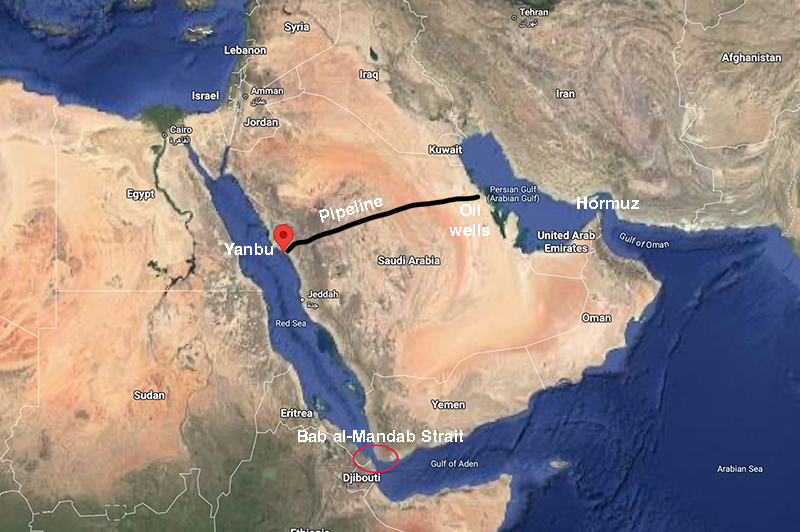
The largest ethnic group in Djibouti is the Somalis, a group that Trump dumps on daily. The U.S. does have a military base in Djibouti and USAID provided a lot of medical and other help to the country until Elon Musk and his DOGEys didn't see any point to providing aid to countries whose name they couldn't pronounce. Saudi Arabia has been bombing the hell out of Yemen for 12 years. Trading the Strait of Hormuz for the Bab al-Mandab Strait is probably not a winner.
If the U.S. would just get rid of the sanctions, Russia could up its oil exports easily. Then it could help Iran more and conquer Ukraine. Also not the best idea.
China imports about half its oil through the Strait of Hormuz, but it still gets a lot of its electric power from (domestic) coal. It is electrifying at a dizzying pace. Currently half the cars sold in China are electric (vs. 6% in Q4 2025 for the U.S.). China also has a stranglehold on the green-energy world, from magnets to solar panels to rare earths. Joe Biden's Inflation Reduction Act was a small step toward making the U.S. more competitive, but Trump killed it all off. He sees the U.S. as a future petrostate, like Saudi Arabia.
All in all, a long-term shutdown of the Strait of Hormuz would probably lead to a worldwide depression and inflation at the same time. The folks selling those Donald Trump "I Did That" stickers for gas pumps will make a killing, though. (V)