
Dem
47

GOP
53

Iran has said it has mined the Strait of Hormuz. We don't know if that is true, but it is certainly possible. Sea mines are cheap, easy to deploy and effective. There are three basic types. Floating mines just drift with the current. Fixed mines are tethered to an anchor on the sea bed. Limpet mines are attached by magnets to a ship's hull by divers and detonated by a timer or a radio signal. They are not as sexy as an F-35 but can cause massive damage, even to a modern aircraft carrier, and certainly to a tanker.
If Iran has indeed mined the shipping channels, before shipping can begin—and after an agreement with Iran to open the Strait—minesweepers would have to clear the channels. The U.S. Navy used to have hundreds of minesweepers, but is now down to a handful and none are near Iran now. The Navy is betting on a different kind of ship, the littoral combat ship with mine countermeasures. These ships attempt to detect and destroy mines at a distance, but they have never really been tested against actual enemy mines and might not work for 100% of them. Working for 95% of them doesn't do the job here with $100-million tankers and billion-dollar warships at stake. Here are three of them in the Pacific Ocean in 2019:
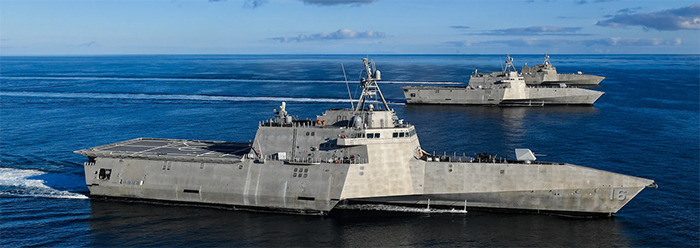
Currently, no littoral combat ships are in the Middle East and it would take some time to get any there. Allies (?) might be able to help. European navies have traditionally had better minesweeping capability than the U.S., but they haven't had to use that capability for years. The U.K. has minesweeping drones, but they have never been tested in actual combat.
If it turns out that there are mines and the U.S. is at a loss to clear them, that could tell potential adversaries, like China, Russia and North Korea, that the U.S. is woefully unprepared for mine warfare. They could place mines at chokepoints or along their coasts and try to remember where they put them. For example, if China is planning to take Taiwan by force, it could place mines in strategic places to keep the U.S. Navy at bay.
Trump has said that one possible end game in Iran is just to take his marbles and go home, leaving other countries to clean up after him. He thinks that the U.S. won't be hurt by the closure of the Strait because the U.S. doesn't get any oil through it (although it does get a lot of fertilizer that way). But if the world price of oil goes to $100/barrel and stays there, U.S. oil companies are going to charge $100/barrel, even if they can make a good profit at $60/barrel. Why shouldn't they?
But mines aren't the only problem. Marco Rubio has warned Europe that Iran could place tolls on ships passing the Strait of Hormuz. The Strait is an international waterway and not the property of Iran, so such tolls are illegal. But what if Iran simply says: "Trump ignores international law, so why should we obey it?" and tells ships that refuse to pay the toll that they will be attacked? These tolls could become a major source of income to Iran, which would strengthen the regime. Also, Iran could demand they be paid in yuan, in an attempt to weaken the dollar as the world's reserve currency. (V)