
Dem
47

GOP
53

Big industries buying donating to politicians is nothing new, but there has been a recent change in where the
big money is coming from. Historically, companies in the banking, oil, media, telecom, pharmaceutical and
transportation industries were the biggest donors because government regulations heavily affected their businesses.
Consequently, owning a couple of congressmen was a good business decision.
Recently, two giant—and extremely unpopular—sectors have been added to the mix: crypto and AI. This puts candidates in a real bind. If they accept money from crypto and AI interests and carry their water, it turns off the voters. But if they refuse the money, it will probably go to a less scrupulous opponent.
Fairshake, a pro-crypto super PAC, has $171 million in its bank account as of the end of February. In 2024, Fairshake spent $40 million to defeat then-Sen. Sherrod Brown, a crypto opponent who sees crypto as a scam and favors tight regulation of the "industry." And Fairshake is not the only super PAC supporting pro-crypto candidates.
Leading the Future is a pro-AI super PAC that has initial commitments of $200 million. It wants to elect candidates who are gung ho on AI and defeat those who want to regulate it.
However, the voters don't like either crypto or AI. A 45% plurality of Americans say that crypto is too risky and 44% of Americans say that AI is developing too fast. Two-thirds support the government putting strict regulations on AI. The two are very different. Crypto is essentially a big Ponzi scheme since the underlying asset has no actual value, unlike a stock or bond. It is more like gold, except that gold has a tradition of thousands of years behind it and it also has some industrial value. AI is different. It actually works, and that is the problem. It threatens many jobs. Also, data centers are having a major impact on electricity and water prices. Here are poll results about people's views about crypto:
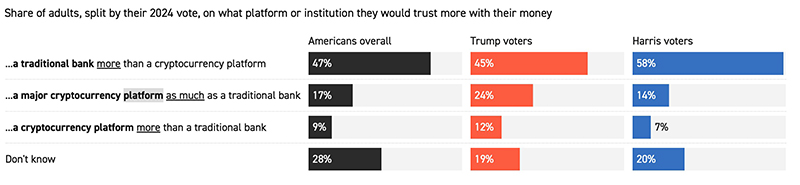
It is interesting that Trump voters are more trusting of crypto than Harris voters. The poll didn't ask why. It could be that Trump voters are comfortable participating in scams because Trump runs so many of them and they are used to it whereas the college-educated Harris voters see it for what it is: a bubble that could burst at any moment.
Now the poll results about AI:

Here again, the Trump voters are more positive on AI, actually evenly split. Harris voters are worried about it. It could be that blue-collar workers understand that AI could take away office jobs but don't realize that AI could also drive a bus. But it is true that, at least initially, more white-collar jobs are threatened by AI than blue-collar jobs.
So what is a candidate to do: take the money and alienate the voters, or refuse the money and have it used against you? We suspect that some candidates will take the money, not talk much about crypto or AI during the campaign, and after being elected, sponsor bills that the donors want. In other words, bamboozle the voters by campaigning for one thing but supporting the opposite after getting elected. Hiding your true intentions (or outright lying to the voters) is a time-honored tradition in politics. (V)