
Dem
47

GOP
53

Future historians may record May 14, 2026, as the day the leader of the United States, the greatest superpower in the history of the world, acknowledged that the country was declining (because of Joe Biden) and its geopolitical rival, China, was ascending and was now at least equal to the U.S. That is all Chinese President Xi Jinping wanted from his meeting with Donald Trump and he got it. Advantage Xi.
From 1945 to 2026, the U.S. ran the world. Yes, Russia was there, too, but was always basically a gas station with nuclear weapons. Its GDP is roughly $2.7 trillion vs. $20.9 trillion for China and $32.4 trillion for the U.S. China hasn't yet reached full parity with the U.S. economically, but in many ways, such as the hundreds of "dark factories" (fully automated factories with no people there so there's no need for lights), China is ahead of the U.S. How did America's decline happen so fast? Future historians will have to write this up, but here is a very rough first cut:
How's that for a summary in eight bullet points? OK, we left some details for future historians, but you get the idea. The meeting with Xi was a disaster for Trump from the get-go. For China, Taiwan was the main issue of the summit, since it sees the island as a breakaway province of China that it wants back. When reporters asked Trump if he discussed Taiwan with Xi, all he had to say was "China is beautiful." Here is a photo of a humiliated Trump and a blasé Xi:
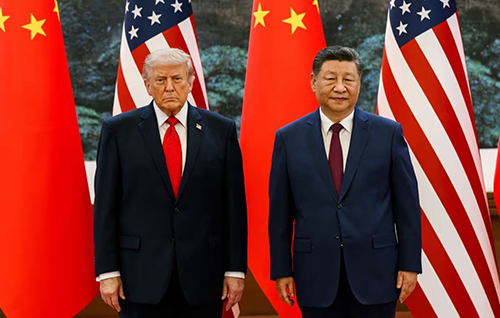
Xi is 5'10"; Trump claims to be 6'3". Maybe Trump forgot to bring the lifts in his shoes or maybe he loaned them to another lift user, his sometimes-buddy Gov. Ron DeSantis (R-FL).
At the end of the meeting, the nominal author of the ghostwritten The Art of the Deal had no major deals to announce. Yes, China "promised" to buy some more Boeing airplanes and U.S. soybeans, but nothing that would slow China's advance in the South China Sea or anywhere else. Not even a trade deal of "AI chips for rare earths." Trump seemed to think he was the U.S. Trade Representative and his job was making business deals. Actually, that is Jamieson Greer's job.
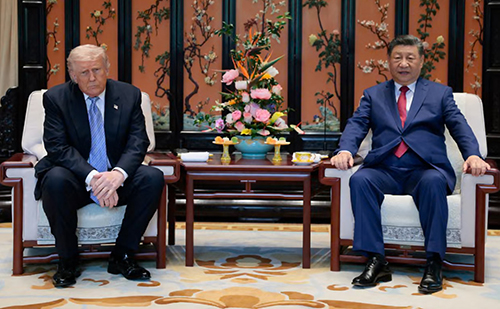
Trump talked about a "G2"—the two great nations, America and China, leaving out the rest of the G7 (Canada, France, Germany, Italy, Japan and the U.K.). Xi, a much better diplomat than Trump, did not use the term because he is hosting Russian President Vladimir Putin later this month and doesn't want to rub it in Putin's face that Russia's GDP puts it between Italy and Brazil, barely in the top ten worldwide. Here are the "G2" leaders at the little negotiating table. Quick quiz: Which one looks confident and in charge and which one looks dejected and hopeless (answer below)?
What Xi did talk about is the Thucydides Trap, in which a rising power threatens an established power, which leads to war. Trump didn't appear to understand that Xi knows Western history better than he does.
After Trump arrived home, he headed directly to a safe space: Fox. There he said he and Xi "settled a lot of different problems that other people wouldn't have been able to solve." However, he didn't mention any solutions or even points of agreement. Among topics where there weren't any agreements are Iran, Taiwan, trade, rare earths and human rights. In short, Trump is a classic bully. He is tough when confronting much weaker opponents, like Venezuela and Cuba (and also Bill Cassidy), but when faced with an opponent roughly equal in power, like China, he cowers under the table like a frightened child. The message to the world should be that if you stand up to Trump, you get a free TACO.
Answer to the quiz above: The one on the left is dejected. The one on the right is confident. He knows he is the boss. (V)