
Dem
47

GOP
53

As Donald Trump's approval rating makes a beeline for the Bush line, the House, and maybe the Senate, are likely to flip in November, especially if Ken Paxton is the Republican nominee in Texas. This would not be at all unusual. In fact, it would continue what has become normal. In the 13 federal elections since 2000, either the House, the Senate, or the White House has changed hands in 11 of them. Only twice in that period has control of all three remained unchanged. If Democrats win the House (or the Senate, though it's hard to see them winning the Senate and NOT the House), the score will increase to 12 changes in 14 elections. In nearly every case, the new winner had a tiny majority that was vulnerable next time around. The country is so closely divided that neither party can get a serious majority on anything ever. If 3-5% of the people who gave a party power don't like what they are doing, it flips next time. Ronald Brownstein talked to people and looked at why this happens.
UCLA political science professor Lynn Vavreck explained it like this: "For most of our lifetime, politics was contested over the New Deal issues—the size and role of government. Those days are so gone. We are not (primarily) fighting over the tax rate anymore. In 2016, Trump raised these identity-inflected issues (and) now we are fighting about who deserves to be an American." This means most voters don't change their votes based on candidate qualities. They are immovable. Thus a tiny slice of the electorate, maybe 10-15%, picks the winner-of-the-year, and these people often are not really interested in politics and don't follow it. They are often dissatisfied with both parties and depending on the year and the candidates, they may vote or not vote.
Also a factor in the constant switching back and forth is presidential overreach. Newly elected presidents got there by making grandiose promises to their bases. They also know they have at most 2 years to get everything done. This leads to a huge partisan effort in year 1 to get some red meat (blue meat?) through Congress. Once it passes, that base becomes fat and lazy but the other side is enraged and determined to throw the bums out at the next election. Presidents are also using XOs far more than in the past—and in highly partisan ways that further enrage the other side.
Here is a chart showing control of the Senate, House, and White House since 1855:
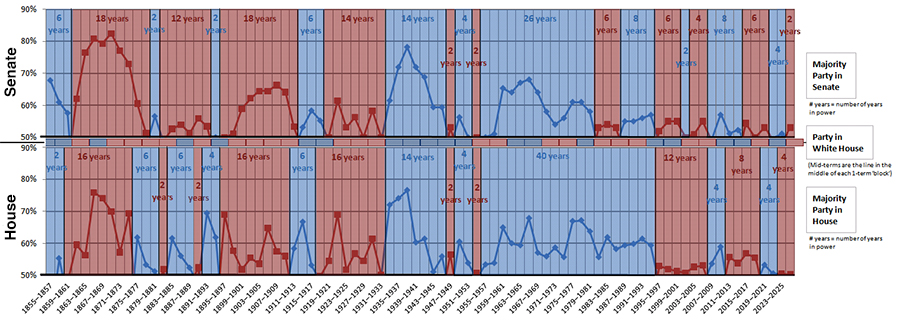
As you can see, from 1855 to 1933, the Republicans were in charge most of the time for long runs of power. Starting with the 1932 elections, Democrats took over for a long run. In the House that lasted until 1994, a 62-year run with only two short interruptions. What has been going on since 2000 is new. It is not the historical norm.
The voters are clearly unhappy. How could this cycle be broken? If one party could raise living standards, that might help, but that would require having power for more than one election cycle. The Grim Reaper might also have a solution. Old people and young people often have different views, especially on cultural issues. If the Reaper could eliminate one of the groups, that might produce a solid majority long enough to effect change.
Prof. Sean Wilentz of Princeton pointed out that historically, sometimes the president handles a crisis so well or so badly that it begins or ends an era. The financial crisis of 2008 could have been a turning point, but neither George W. Bush nor Barack Obama was willing to hold Wall Street and the wealthy accountable, so neither one ushered in a long run for his party. Maybe if the Iran war results in massive inflation and a deep recession at the same time, that could force a permanent realignment. But maybe we'll just muddle through. (V)