
Dem
54

Ties
2
GOP
44

The blue tsunami was deep, as well as wide. Senators and governors had coattails that pulled in a variety of candidates for lower offices. Forty-five states have a lieutenant governor, although most of them have nothing to do all day. In a few states, the lieutenant governor has another function other than waiting for the governor to die. Sometimes that is presiding over the state Senate, sometimes it is doing the work of a secretary of state since there is no actual secretary of state. But on the whole, it is a thankless job other than sometimes being a stepping stone to the governorship. In 26 states, the governor and lieutentant are elected on a joint ticket (like president and vice president), but in 17 states, the LG is elected independently of the governor. In two states, the president of the state Senate also holds the title of lieutentant governor and becomes governor if the governor dies or resigns.
Having a separate election for lieutenant governor means that the governor and lieutenant are sometimes from different parties, with the lieutenant constantly trying to undermine the governor. Sometimes they are from different wings for the same party and are also taking potshots at each other all day. Nine states had an election for LG last week. If you have nothing better to do and want to learn more about them, here is a link.
Here is some evidence of how unimportant the LGs are. As readers probably know, when one party holds the governorship and both chambers of the state legislature, it is called a trifecta (except in unicameral Nebraska, where it is a bifecta). When one party holds the top three executive offices in a state, it is called a triplex. And what might those offices be? They are the governor, attorney general, and secretary of state. Lieutenant governors are so unimportant that there not even a name for a party holding the governorship, lieutenant governorship, and AG position. Enough said about the hapless LGs.
In 44 states, the AG is elected in a partisan election. In four, the AG is a gubernatorial appointee. In Maine the state legislature does the appointing and in Tennessee the state Supreme Court appoints the AG.
The tsunami allowed the Democrats to flip the AG office in five states: Georgia, Kansas, Iowa, Ohio and Texas This means that the new AGs (yes, technically AsG, but please) they will work together with the Democratic governors of those states and file endless lawsuits against the administration, often together with the new and continuing Democratic AGs in the blue states. All in all, 28 states plus D.C. will have Democratic AGs and the lawsuits will fly like 17-year cicadas in the 17th year. Of course the Democratic AGs will also work on "normal" issues like consumer protection, algorithmic price setting, misuse of AI, price gouging and fixing, and more. The AGs can also decide if prosecuting people for violating abortion laws or for violating tax laws has the higher priority. Here is a list of the winning AGs. We'll have an item later this week with more on the implications of the Democrats taking over some of these attorney generalships.
Before getting into the state legislatures, let's take a quick look at other statewide elected offices. Most states typically have six to eight offices, including governor, lieutenant governor, AG, secretary of state, treasurer/auditor/comptroller, school superintendent, and in some states agricultural commissioner, commissioner of public utilities, insurance commissioner, and a few random others, depending on the state. Democrats swept every single statewide executive office on the ballot in Arizona, Georgia, Nevada, Ohio, Texas, and Wisconsin. TEXAS!!! They now hold every state office in all these states except the Ohio auditor, who escaped because he wasn't on the ballot. Here are the offices in these states:
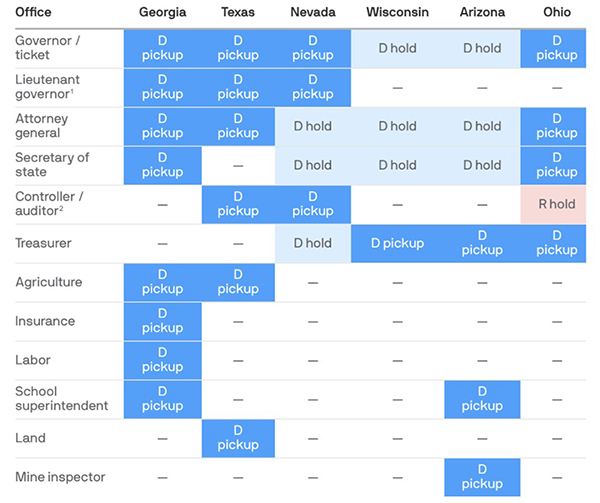
Democrats flipped the secretary of state position in Georgia, Indiana, and Ohio, and those secretaries will run the elections in 2028.
In addition, Democrats did well in elections for seats on public utilities commissions, which gives them power to approve or reject proposed rate changes for electricity, always a hot topic. Democrats also won four seats on the Texas Supreme Court, which is now 5-4 for the Republicans instead of 9-0. The five remaining Republican justices also now have an excellent idea of which way the wind is blowing, which could impact upcoming decisions. The Democrats winning the Texas Senate race and all the statewide offices is going to force the Republicans to spend a lot of money in 2028 in a very expensive state. And, as Elon Musk learned the hard way, spending a lot of money is no guarantee of winning. Or even making it close.
Now onto the state legislatures, where the Democrats also triumphed in many states. The Democrats are set to flip about 12 state legislature chambers, dismantle five Republican trifectas, break 11 Republican supermajorities, and construct 12 of their own supermajorities. In January, Democrats will control 51 of the 99 chambers, up from 39 now. One of the chambers with a new Democratic majority is the Texas House, but Republicans held the Texas Senate. Republicans will drop from 57 to 46 chambers they control. The others were tied or had bipartisan coalitions.
Of course, winning many gubernatorial races and flipping state legislative chambers like pancakes brings up the subject of trifectas. Right now, Republicans have 22 trifectas and the Nebraska bifecta vs. the Democrats' 16. The other 12 states have divided government. Starting in January, Democrats will probably have 22 trifectas to the Republicans' 18. Some state races haven't been called yet, but here are the most likely results for states where something changed:
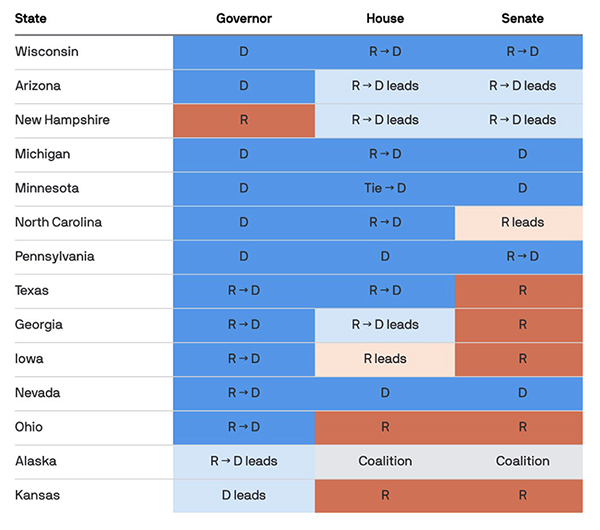
Democrats can use their new trifectas to pass many bills that will directly affect millions of people. They can raise minimum wages, give public workers the right to form unions, mandate paid sick and child care leave, change election laws to make it easier to vote (e.g., more days and hours for early voting, same day registration) and faster to count the votes (by allowing absentee ballots to be counted the day they arrive), expand Medicaid eligibility, increase or decrease sales taxes (and what items are exempt from them), and much more. While the federal government is unlikely to pass many laws helping people in the next two years, if 20 new free urgent-care clinics are opened in a state or a state decides to accept the ACA Medicaid expansion, a Democratic governor can make sure the voters know which party did that. If done right, Democrats may not be able to deliver many goodies at the federal level, but they certainly can in many states starting in January. Not to keep beating a dead horse, but look for a more detailed piece on this subject in the near future.
The executive summary here is this: Republicans spent 16 years building power in state legislatures and the voters erased it all in one frantic night. In this way, the Democrats have finally reversed the single-biggest error Barack Obama made as a party leader, as he allowed the blue team to focus almost exclusively on high-profile and/or federal offices at the expense of downballot state offices. (V)