
Dem
54

Ties
2
GOP
44

You may recall briefly hearing about the rotten boroughs in England in a high school class on European history. The boroughs (analogous to congressional districts) used in England in the 19th century to elect members to the House of Commons were frozen in time for hundreds of years. In many cases, nearly all the peasants around some castle left over the years, leaving the lord of the manor as the only voter, who was nevertheless entitled to an M.P. for that borough. The Reform Act of 1832 got rid of them.
The Electoral College in the U.S. is America's answer to the rotten boroughs. A presidential elector in California represents 740,000 people whereas one in Wyoming represents 196,000 people, meaning that a vote in Wyoming counts 3.8x more heavily than one in California. The Electoral College also means that presidential candidates campaign in only about seven states, ignoring the other 43, except for quick fundraising trips once in a while.
Eliminating the Electoral College would require amending the Constitution, which needs a two-thirds majority in each chamber of Congress and ratification by three-fourths of the state legislatures and the governor's signature. Since passing such an amendment would take political power from underpopulated rural states (which vote Republican) and give it to heavily populated urban states (which mostly vote Democratic, especially these days), there is no way on God's green earth this is ever going to happen.
However, some clever Democratic lawyers thought of a workaround. It is called the National Popular Vote Interstate Compact (NPVIC). It relies on two clauses on the Constitution. Art. II Sec. 1 Clause 2 reads:
Each State shall appoint, in such Manner as the Legislature thereof may direct, a Number of Electors, equal to the whole Number of Senators and Representatives to which the State may be entitled in the Congress: but no Senator or Representative, or Person holding an Office of Trust or Profit under the United States, shall be appointed an Elector.
This means the legislature, by law, can decide how its presidential electors are chosen. It can run an election with slates of electors pledged to a presidential candidate with the statewide winner getting all the electors, but it doesn't have to. Maine and Nebraska don't do this. If Virginia passed a law saying that any Virginia voter who wanted to run for elector could pay a $100 filing fee and get on the ballot, then people would vote for their favorite elector and the top 13 vote getters would be the 13 official electors. Or the legislature could skip the election altogether and appoint the 13 electors itself. This was actually the norm in most states from 1789 to the 1830s. The last state to introduce popular elections for elector was South Carolina in 1860.
Meanwhile, here is Art. I, Sec 10, Clause 3 of the Constitution:
No State shall, without the Consent of Congress, lay any Duty of Tonnage, keep Troops, or Ships of War in time of Peace, enter into any Agreement or Compact with another State, or with a foreign Power, or engage in War, unless actually invaded, or in such imminent Danger as will not admit of delay.
In a somewhat backhanded way, the Constitution says that states may form compacts (agreements) among themselves, subject to congressional approval. For example, states bordering a river could make an agreement how much water each state may take from the river.
What the NPVIC says is that the legislatures in the signatory states have agreed to cast all of their electoral votes for the winner of the national popular vote for president, regardless of who won the state vote. However, it kicks in only when the total number of electoral votes in the member states hits 50% + 1 of the total number of electoral votes (currently 270). Eighteen states and D.C. have signed on. Together they currently have 222 electoral votes, although that can change after each census. States with another 48 electoral votes are needed to activate the Compact. Here is a map showing the signatory states:
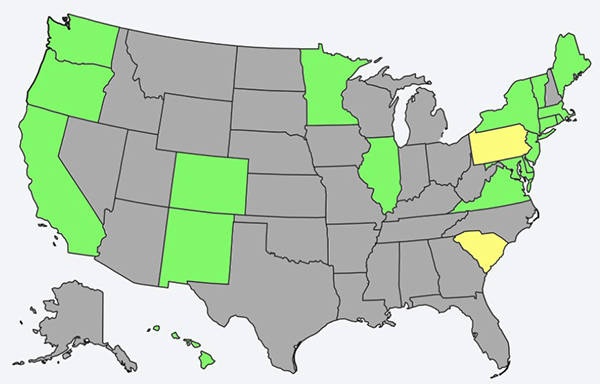
In the map, green means enacted and yellow means pending.
Here's where it gets interesting. Democrats suddenly have the trifecta in new states. Here they are, with the respective numbers of electoral votes: Arizona (11), Michigan (15), Nevada (6), Pennsylvania (19), and Wisconsin (10). Together they have 61 electoral votes. If states with at least 48 EVs sign up, the Compact will be ready to go. So for example, Pennsylvania + Wisconsin + Michigan is 44. Add in either of Arizona or Nevada and bingo, you hit the magic number.
Michigan and Nevada have tried to join before, but the votes weren't there, even though Democrats had the trifecta. But with the 2030 census looming, and a major loss of electoral votes in the blue states virtually certain, they could try again.
Approval of Congress is needed. That's in the text. However, there is nothing there about presidential approval or a possible presidential veto. This means if the Democrats decide to play hardball—and given all the illegal things Donald Trump has done, why wouldn't they?—the 120th Congress could approve the Compact next year.
Of course, the filibuster is an issue, but it is easily dealt with. Senate rules specify that many kinds of votes cannot be filibustered. These are known as carve-outs. They include budget reconciliation, confirmation of judges and justices, fast-track trade agreements, impeachment procedures, debt limit, and many more. New carve-outs can be added by a simple majority vote of the Senate. So if enough new states join the NPVIC in 2027, Congress could add a carve-out and then approve the Compact. Alternatively, the Democrats could force the Republicans to stand in the well of the Senate and read the Bible, Macbeth, or the Dallas phone book for days on end until they physically dropped on the floor and there was a big pile of senators lying there. This approach would bring public attention to the fact that Republicans were actively trying block election of the president by popular vote, something the public supports 56% to 23%. Making the Republicans the "bad guys" here would probably help the Democrats in 2028.
One possible way this could go wrong is that Republicans could appeal to the Supreme Court, which could rule that yup, the president must sign the bill to approve the Compact, even though the Constitution doesn't give the president any role here. If that happened and if the Democrats have the trifecta in 2029, Congress could try again and get the president's signature. Alternatively, it could expand the Supreme Court and/or strip it of the jurisdiction to rule on cases involving interstate compacts. (V)