
Dem
54

Ties
2
GOP
44

This year's elections upended everything. Could the 2028 elections upend everything again—and go the other way? Since the entire House is up in 2028, a massive red tsunami (which is different from a red tide, but almost as dangerous) is definitely possible, with a Republican capturing the White House and Republicans getting 250+ seats in the House. However, if a Democrat is elected president it is exceedingly unlikely that the Democrats will simultaneously lose 40+ seats in the House. In that case, they are more likely to hold most of their own House seats and maybe pick up more.
However, the Senate is a different story. Since only one-third of the Senate is up every cycle, there are limits on how much it can swing in any election year. In particular, could Republicans capture the Senate in 2028 and potentially get a trifecta, or could the Democrats hold the Senate even in the event of a red tsunami? Nate Silver already took a look, but here is our take.
First, here is the final 2022 election map for the Class III senators, all of whom will be up in 2028:
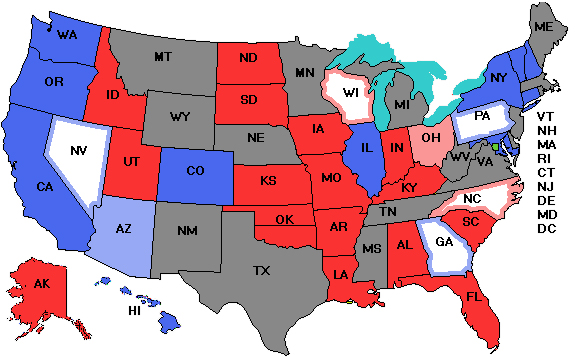
After the 2022 election, there were 14 Democratic senators and 20 Republican senators in the class. There were also special elections for Kamala Harris' seat in California and Jim Inhofe's seat in Oklahoma. They won't be back in 2028. A couple of the winners are no longer in the Senate. Marco Rubio has been replaced by Ashley Moody (R-FL) and J.D. Vance has been replaced by Sherrod Brown (D-OH), so Democrats will be defending 15 seats and Republicans will be defending 19 seats, a small advantage for the Democrats.
Now let's look more closely at the list of Class III senators up in 2028. Here is the list, sorted by party:
| State | Incumbent | Age in 2028 |
| | ||
| Arizona | Mark Kelly (D) | 64 |
| California | Alex Padilla (D) | 55 |
| Colorado | Michael Bennet (D) | 64 |
| Connecticut | Richard Blumenthal (D) | 82 |
| Georgia | Raphael Warnock (D) | 59 |
| Hawaii | Brian Schatz (D) | 56 |
| Illinois | Tammy Duckworth (D) | 60 |
| Maryland | Chris Van Hollen (D) | 69 |
| New Hampshire | Maggie Hassan (D) | 70 |
| Nevada | Catherine Cortez Masto (D) | 64 |
| New York | Chuck Schumer (D) | 78 |
| Ohio | Sherrod Brown (D) | 76 |
| Oregon | Ron Wyden (D) | 79 |
| Pennsylvania | John Fetterman (D) | 59 |
| Vermont | Peter Welch (D) | 79 |
| Washington | Patty Murray (D) | 78 |
| | ||
| Alaska | Lisa Murkowski (R) | 71 |
| Alabama | Katie Britt (R) | 46 |
| Arkansas | John Boozman (R) | 78 |
| Florida | Ashley Moody (R) | 53 |
| Iowa | Chuck Grassley (R) | 95 |
| Idaho | Mike Crapo (R) | 77 |
| Indiana | Todd Young (R) | 56 |
| Kansas | Jerry Moran (R) | 74 |
| Kentucky | Rand Paul (R) | 65 |
| Louisiana | John Kennedy (R) | 77 |
| Missouri | Eric Schmitt (R) | 53 |
| North Carolina | Ted Budd (R) | 57 |
| North Dakota | John Hoeven (R) | 71 |
| Oklahoma | James Lankford (R) | 60 |
| South Carolina | Tim Scott (R) | 63 |
| South Dakota | John Thune (R) | 67 |
| Utah | Mike Lee (R) | 57 |
| Wisconsin | Ron Johnson (R) | 73 |
If every incumbent is reelected, the Democrats will continue their majority of 54-56 seats, depending on who wins Alaska and Mississippi.
Now let us look at possible flips. The most likely reason for a flip is that the incumbent barely won last time and the other side finds a bang-up candidate this time, or else a seat becomes open due to a retirement or death. First, which seats could the Democrats lose? We will start out by going on a limb and making a prediction: Sen. John Fetterman (D-PA) will not be a senator on Jan. 4, 2029. He hates being in the Senate, his party hates him being in the Senate, and Pennsylvania Democrats hate him being in the Senate. If he doesn't retire, he will be primaried and lose the primary. There is no shortage of ambitious Pennsylvania Democrats who are interested in challenging him. An open seat in a swing state is a potential Republican pickup.
Next up is Sen. Mark Kelly (D-AZ). Arizona law allows candidates to run for president and the Senate at the same time, so Kelly can file for both. If he gets the Democratic nomination, he will probably resign his Senate seat in late spring and let Gov. Katie Hobbs (D-AZ) appoint an interim Democratic senator, who will have to run (for a full term) in Nov. 2028. That's two potential open seats and Republican pickups.
Sherrod Brown will have to run for a full term in 2028. That makes three potentially competitive seats.
What about retirements? Sen. Richard Blumenthal (D-CT) will be 82 in 2028 and might retire. Sen. Chuck Schumer (D-NY) will be 78 and might retire, possibly voluntarily, or maybe involuntarily if Rep. Alexandria Ocasio-Cortez (D-NY) decides that an easy Senate run is a better idea than an exceedingly difficult presidential run. Sen. Ron Wyden (D-OR) will be 79 and Sen. Patty Murray (D-WA) will be 78. All of these folks could retire, but it is hard to imagine Republicans winning in blue, blue Connecticut, New York, Oregon, or Washington, even if there open seats there. There are more than enough battle-tested Democrats in those states.
So our first guess is that there might be three competitive races for the Democrats, in Pennsylvania, Ohio, and Arizona (but only if Kelly gets the Democratic presidential nomination). If the Democrats lose Alaska and Mississippi this year and all three of these seats in 2028, they will still have at least 51 seats and control of the Senate. This means that unless Justice Samuel Alito resigns within a month (or so), he will have to continue serving until Jan. 3, 2031, if he wants a Republican successor.
But what about the Republicans? Are there any trouble spots there? You betcha. Sen. Ron Johnson (R-WI) promised that he would serve only two terms. He is now in the middle of this third term. Democrats will fight like hell for his seat in swingy Wisconsin. They will also fight for the seat of Sen. Ted Budd (R-NC) in increasingly blue North Carolina. Those are two reasonably good pickup chances for the blue team.
Sen. Chuck Grassley (R-IA) might retire at 95. Democrats won almost all the marbles in Iowa last week (governor, senator, and three of the four House seats). This could become a competitive race.
Sens. John Boozman (R-AR), Mike Crapo (R-ID) and/or John Kennedy (R-LA) could retire, but none of those seats are likely to be competitive. So we think at most three GOP-held seats are going to be competitive, namely those of Johnson, Budd, and Grassley. This balances the two or three competitive Democratic seats. In the end, the Senate might not change much in 2028, absent an unexpected massive red tsunami, or possibly a blue wave, part II. This means the Democrats will probably hold the Senate until Jan. 2031, possibly giving the Democrats the trifecta or giving President DeSantis a big headache.
What about 2032? Could the Republicans finally flip the Senate? Here are the Class I senators who will be up in Nov. 2032 if they make it that far.
| State | Incumbent | Age in 2030 |
| | ||
| Arizona | Ruben Gallego (D) | 50 |
| California | Adam Schiff (D) | 70 |
| Connecticut | Chris Murphy (D) | 57 |
| Delaware | Lisa Rochester (D) | 68 |
| Hawaii | Mazie Hirono (D) | 82 |
| Massachusetts | Elizabeth Warren (D) | 81 |
| Maryland | Angela Alsobrooks (D) | 59 |
| Maine | Angus King (I) | 86 |
| Michigan | Elissa Slotkin (D) | 54 |
| Minnesota | [To be appointed by Gov.-elect Amy Klobuchar] | ? |
| New Jersey | Andy Kim (D) | 48 |
| New Mexico | Martin Heinrich (D) | 59 |
| Nevada | Jacky Rosen (D) | 73 |
| New York | Kirsten Gillibrand (D) | 63 |
| Rhode Island | Sheldon Whitehouse (D) | 75 |
| Virginia | Tim Kaine (D) | 72 |
| Vermont | Bernie Sanders (I) | 89 |
| Washington | Maria Cantwell (D) | 72 |
| Wisconsin | Tammy Baldwin (D) | 68 |
| | ||
| Florida | Rick Scott (R) | 77 |
| Indiana | Jim Banks (R) | 51 |
| Missouri | Josh Hawley (R) | 50 |
| Mississippi | Roger Wicker (R) | 79 |
| Montana | Tim Sheehy (R) | 44 |
| North Dakota | Kevin Cram(R) | er |
| Nebraska | Deb Fischer (R) | 79 |
| Ohio | Bernie Moreno (R) | 63 |
| Pennsylvania | David McCormick (R) | 65 |
| Tennessee | [To be appointed by Gov.-elect Marsha Blackburn] | ? |
| Texas | Ted Cruz (R) | 59 |
| Utah | John Curtis (R) | 70 |
| West Virginia | Jim Justice (R) | 79 |
| Wyoming | John Barrasso (R) | 78 |
On the Democratic side, Sens. Elizabeth Warren (D-MA) and/or Mazie Hirono (D-HI) could retire, but neither of those seats is in any danger. Nor is that of Sen. Bernie Sanders (I-VT). Five potentially competitive races are the seats of Democratic Sens. Ruben Gallego (AZ), Elissa Slotkin (MI). Angus King (ME), Jacky Rosen (NV) and Tammy Baldwin (WI). If a Democrat is elected president in 2028, the usual hit the president's party takes in the midterms could wash these five out to sea and give the Republicans the majority in the Senate.
On the other side, Sen. David McCormick (R-PA) could have a tight race in that swing state. The potential retirees are all in deep red states, although if Scott Colom wins in Mississippi, Sen. Roger Wicker (R-MS) might decide to stay on to keep the seat in Republican hands.
Our conclusion from this little exercise is that the Democrats will probably keep the Senate in 2028 but could conceivably lose it in 2030, especially if there is a Democratic president inaugurated on Jan. 20, 2029. That also means he or she has to move fast to get things done in his first year. (V)