
Dem
55

Ties
1
GOP
44

There are no doubt going to be analyses of the midterms for months to come, focusing on various issues, demographics, and more. A research group at Michigan State University examined the vote in 375 counties that have large, white evangelical populations. They are spread over 15 states. They are shown in purple in the map below:
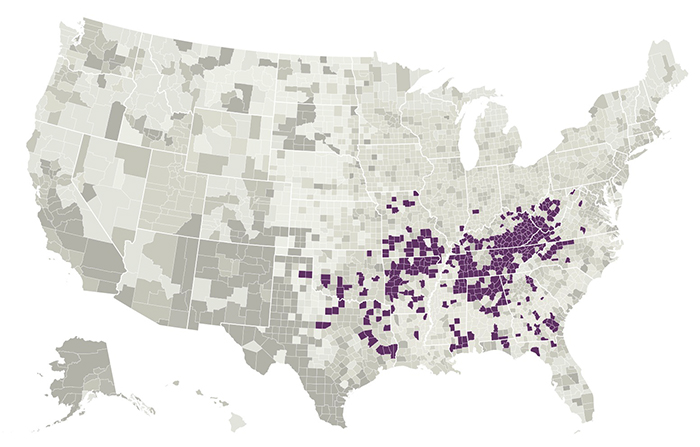
These evangelical hubs, as they are called, have about 10 million people, with about 52% of the residents being evangelicals (compared to 13% nationwide). They are mostly in the South and border states. Donald Trump got 77% of their votes in 2016, 79% in 2020, and 81% in 2024. The more they see of Trump, the more they like him. However at this rate of increase, the Republican presidential candidate won't get 100% of the evangelical vote until the 2060 election. The hubs are about 90% white and have a median income of $47,000. They also have lower educational levels than the country as a whole, with only 17% of adults having a bachelor's degree, half the national average. One area where they lead the nation is in teenage pregnancies, where they have 36 births per 1,000 girls ages 15-19, double the national level.
Only 343 of the 375 evangelical hub counties had a Senate election in 2026 (because Missouri didn't). The data showed the counties still voted Republican, but a lot less lopsidedly and with many fewer voters turning out, despite competitive races in many of the states. The 343 counties' vote was 66% of what it was in the 2024 presidential election. For the surrounding counties in those states, turnout was 78% of what it was in 2024. In other words, large numbers of evangelicals stayed home last week (or maybe they went to church, which would be unusual but not impossible on a Tuesday, but in any case, they didn't go to a polling place). If they had voted in the same numbers as the other counties in their states, that would have produced hundreds of thousands more Republican votes. Most likely, if they had turned out like the non-evangelical counties, Sen. Cindy Hyde-Smith (R-MS) would have kept her job. Their absence also gave the Democrats several U.S. House seats. The Democrats might have won the Texas House no matter what, but it would have been much closer than 82D, 67R.
This study doesn't technically say anything about turnout among evangelicals in other states, but it is probably a good guess that it was depressed elsewhere as well, which could have resulted in Democrats winning tight races they would otherwise have lost. There is some evidence that white evangelicals wanted to send Donald Trump a message that they don't like his war or his enriching himself instead of looking out for them. Since voting for a Democrat is about 20 bridges too far, they just didn't vote this time.
To some extent, this study reinforces something we have said several times here: Democrats didn't win; Republicans lost. Democrats ignore this at their peril in 2028. Then they need to give voters something to vote for, not hope that voters will vote against Trump again. (V)