
Dem
53

Ties
2
GOP
45

Most political punditry and polling is focused on the Senate and House elections, and to a lesser extent, the 35 races for governor. But these aren't the only games in town. There are also many competitive seats in state legislatures up in November, potentially flipping control of them, in some cases creating or ending trifectas. Also, some chambers may cease being veto-proof or may start being veto-proof.
After years of Republican dominance in state races, this year Democrats are on offense. One analysis showed that in the best case, Democrats could get the trifecta in seven states and break Republican trifectas in six states. Getting all of this is unlikely, but getting some of it is realistic in a blue wave. Republicans have a chance to break Democratic trifectas in only two states and could get their own in at most five states. Here is the current trifecta map:
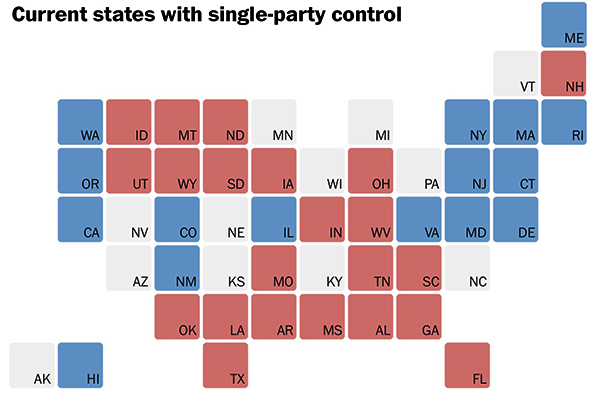
Much of the Democrats' problem began in 2010, when Barack Obama showed roughly zero interest in state legislative races and Republicans netted 700 seats in them and took control of 20 chambers. Now both parties are on the ball. Heather Williams, president of the Democratic Legislative Campaign Committee (DLCC, analogous to the DSCC and DCCC), said: "2026 is proving to be a once-in-a-generation opportunity for Democrats to shift the balance of power away from Republicans." A memo from the Republicans' counterpart, the Republican State Leadership Committee (RSLC), said this year would be a "political environment that is likely to be one of the most challenging for state Republicans in recent years." It also said the Republicans would focus on defense first.
Democrats' top priorities for trifectas are in Nevada, Minnesota and Pennsylvania. To get Nevada, Aaron Ford has to beat Gov. Joe Lombardo (R-NV). In Minnesota, Democrats need to hold their 34D, 33R lead in the Senate and pick up one seat in the state House. In Pennsylvania, they need to flip three seats in the state Senate and hold their 103D, 100R lead in the Assembly. Flipping three seats won't be simple because only half the state Senate seats are up this year. However, Gov. Josh Shapiro (D-PA) is spending as much time campaigning for state Senate seats as he is for his own reelection. If he can pull this off, in 2028 he can talk about his "long coattails," which might get him quite a few endorsements from Democratic officeholders who might want to grab onto them in the next cycle.
The Republicans' best shot at a new trifecta is Kansas, where term-limited Gov. Laura Kelly (D-KS) is likely to be replaced by Ty Masterson (R).
There are four states where either party could conceivably get the trifecta: Alaska, Arizona, Michigan, and Wisconsin. In all four, there is a competitive race for governor, which is essential, of course. In Alaska, the Senate is 9D, 11R and the House is 14D, 21R, 5I. The five independents are a big factor, naturally. In Arizona, the Senate is 13D, 17R, and the House is 27D, 33R. In Michigan, the Senate is 20D, 18R and the House is 52D, 58R. This is probably the easiest of the four for the Democrats, especially since Jocelyn Benson is the strong favorite to be elected governor. In Wisconsin, the Senate is 15D, 18R and the House is 45D, 54R, so the latter chamber will be tough, but not impossible, for the blue team.
Now on to trifectas that could be broken by the election of a Democratic governor. These are Georgia, Iowa, and Ohio, where the Democratic candidate has an excellent chance, and Florida, New Hampshire, and Texas, where the Democratic gubernatorial candidate is in a much weaker position, but one that is not impossible. None of the legislative chambers in any of those states is expected to flip.
There are also two states where the Democrats could lose their trifectas: Maine and Oregon. In Maine, the Republicans could capture the state House if they can flip three seats. In Oregon, Gov. Tina Kotek (D-OR) could lose her reelection bid.
Also of interest are the supermajorities some states have, which allow the majority party to override the governor's vetoes. Democrats are focused on breaking the Republican supermajorities in Iowa, North Carolina, and Ohio, all of which could have a Democratic governor in January (North Carolina for sure, since Josh Stein is not up this year).
Trifectas come and go. Right now, Republicans have more than Democrats and only a handful of states have split government. That wasn't always the case as this chart of trifectas shows:
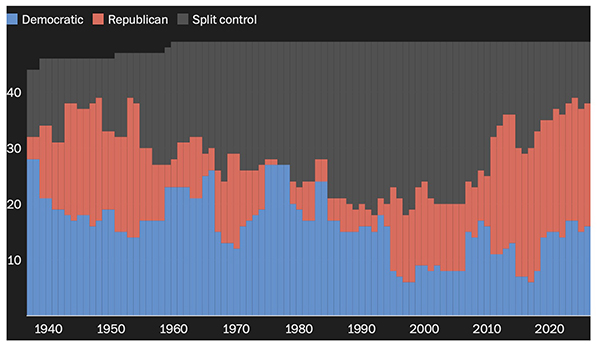
As you can see, until 1996, the Democrats dominated in trifectas. Then it suddenly switched and Republicans have dominated since then. In a sufficiently big blue wave, it could switch again. (V)