
Dem
53

Ties
2
GOP
45

In the past few days, there has been a spate of articles about the potential disaster in the House for Republicans, for example, in Politico, The Hill, Axios and The Cook Political Report. All of the articles are predicting a Democratic takeover of the House, which would be in line with normal results for midterms, where the president's party takes a hit. But this time it could be especially bad in the popular vote, although the extensive gerrymandering could temper the number of seats that flip.
One recurrent fear among Republican politicians and operatives is that white working-class men—the base of the current Republican Party—won't just stay home on Election Day, but will vote for Democrats to show their displeasure with the Republicans. When you can't afford to fill up your tractor with diesel, anger about whether a few players assigned male at birth are playing on girls field hockey teams in Massachusetts fades into the background.
One commonality in all the articles is that Republicans are aware that even some deep-red districts could be in danger. In ANY midterm with a Republican president, R+4 districts are in danger. But this time, even R+10 districts can't be taken for granted. This means that incumbents who were always safe in the past and never really had to raise money or campaign are now frantically trying to defend their seats. This also means that the NRCC and other Republican groups are having to pull money from light-red districts and move it to dark-red districts, which increases the chances of the light-red districts flipping even more. Nevertheless, some Republicans are pooh-poohing the problem. Rep. Barry Loudermilk (R-GA), who is retiring from an R+12 district, said: "I think there's just a lot of things in play, and of course, what do we have three weeks out—that's light years in political time." Actually, it is not. A light year is a measure of distance, not time. That makes as much sense as saying: "The election is 500 miles away."
Besides moving money from pink to scarlet districts, campaign schedules have changed. On Friday, Speaker Mike Johnson (R-LA) went to KY-06, an R+7 district Trump won by 11 points, to campaign for Ralph Alvarado (R). Republican House speakers don't normally campaign in R+7 districts unless internal polling shows a problem there. On Saturday, Trump campaigned in TN-07, the R+11 district Rep. Matt Van Epps (R-TN) is defending. Johnson and Trump are planning to campaign in Montana shortly, again something top Republicans don't normally do unless there is a five-alarm fire there. Top Republicans are also very worried about three of Iowa's four districts and the race to replace the retiring Sen. Joni Ernst (R-IA). Iowa is especially a problem because Rob Sand (D) is crushing Zach Lahn (R) in the gubernatorial race and he could have coattails.
Moving money goes both ways. Republicans redrew the Tennessee map earlier this year so they could win Steve Cohen's TN-09 district. It is now R+9, but Democrats think it is nevertheless in play and have put money into the campaign of Tennessee state Rep. Justin Pearson, who they think has a chance. At least part of the Democrats' motivation is to scare the Republicans into thinking the Democrats have polling showing that TN-09 (and other deep-red districts) are in play, forcing Republicans to divert money to defend races they would normally take for granted. Here is a map of red districts the DCCC is actively targeting. However, Rep. Suzan DelBene (D-WA), chair of the DCCC, says she needs another $17 million to compete effectively:
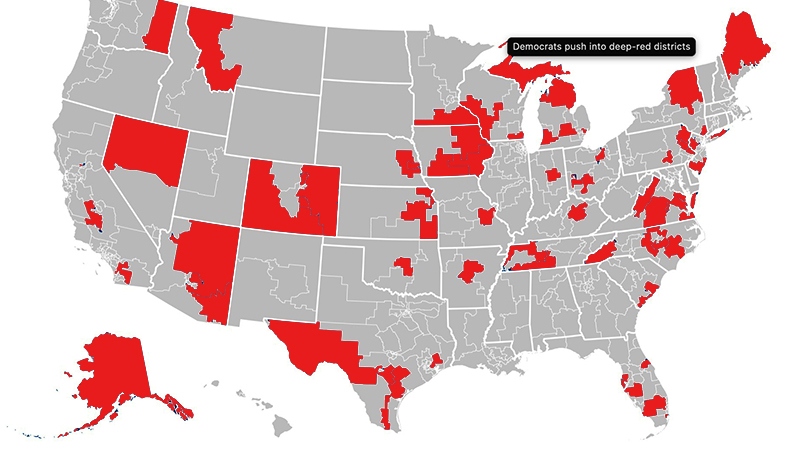
The Cook Political Report changed the ratings on 18 House races last week—all toward the Democrats. Three of the four Iowa seats now lean Democratic, along with PA-07 (Ryan Mackenzie, R+1) and PA-10 (Scott Perry, R+3). Also, some vulnerable Democrats are now seen to be safe and some not-vulnerable Republicans are now thought to be vulnerable. Cook editor Erin Covey expects the Democrats to pick up 9-19 seats. The Republicans' challenge is getting the marginal voters who powered Trump's 2024 victory to vote this year. And if they do, to vote Republican.
At Larry Sabato's Crystal Ball, more than 20 seats have been moved toward the Democrats since September. Over there, managing editor Kyle Kondik said: "High prices can destroy a political coalition." That would seem to be a slightly more clunky version of "It's the economy, stupid." (V)