
Dem
52

Ties
3
GOP
45

Nate Silver has a rule: "Always account for the possibility of systematic polling errors." What he means is that it is possible that the polls could be off by, say, 3 points in all states due to some systematic error (e.g. "shy" Republicans) and all the errors are in the same direction. Pollsters are obviously aware of this problem, but how they deal with it is another matter. Aggregators and model makers (like Silver) also need to address this.
His FLIPR model currently predicts a 54D, 46R Senate. He also tested a model in which the Democrats underperform the polls by 2 points. If that happens, the Iowa and Kansas seats stay Republican but Democrats (barely) flip Maine and Texas, leading to a Senate that is 52D, 48R. Next he assumed the Democrats underperform the polls by 3 points. Under those conditions, Republicans hold Maine and Texas and the Senate is 50-50, giving J.D. Vance some actual work voting in the Senate. This scenario also gives Sen. Lisa Murkowski (R-AK) a lot of power. If Democrats underperform the polls by 4 points, Republicans win Alaska and Michigan, leading to a 48D, 52R Senate.
But there are other factors to consider, including candidate quality. That holds especially for Maine, where Sen. Susan Collins (R-ME) is one tough old bird who can defy national trends, and Texas, where Ken Paxton is personally so toxic that he could lose even if there is no blue wave.
We have done a small stress-test experiment ourselves. Starting with today's map we can look at what happens if the Democrats overperform the polls by 3, 2, or 1 points and also if the Republicans overperform the polls by 1, 2, or 3 points. Here are the results. In each cell, the Democratic score is given first.
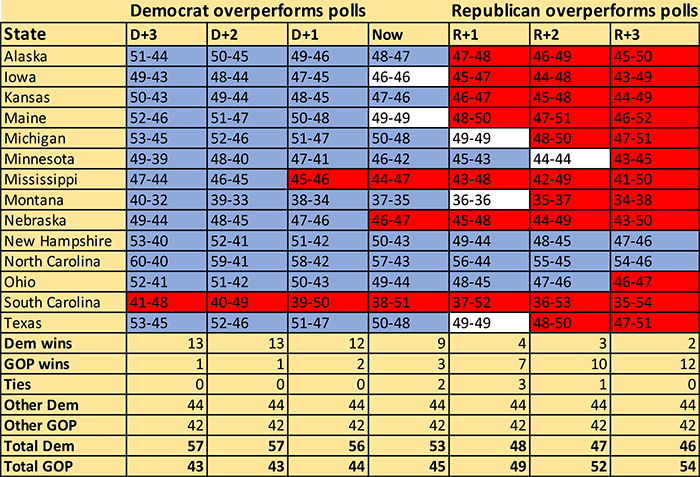
The "Now" column is the current map, except in this experiment we are counting Seth Bodnar (MT) and Dan Osborn (NE) as likely to caucus with the Democrats. So although the map scores Bodnar as a tie (because he hasn't said which party he will caucus with), it is very likely he will caucus with the Democrats, just as Sen. Angus King (I-ME) does.
As you read across the table in any row from left to right, the Democratic score decreases by 1 point in each column and the Republican score increases by 1 in each column. The D+3 column shows what happens if the Democrats overperform the current map by 3 points in every one of the states listed. Then the Democrats get 57 seats. The R+3 column shows the results if the Republicans overperform the map by 3 points. Then the Democrats get 46 seats.
As you read across the table in any row except South Carolina, at D+3, it is blue. Then as you move to the right, Democratic performance drops and the blue becomes white and then red or in some cases, like 46-45 fliiping to 45-46, directly from blue to red. Once it has hit red, moving farther to the right, it never goes blue again. When the "Total Dem" and "Total GOP" numbers in the bottom two rows do not add up to 100, that is due to predicted ties (white cells). Of course there can't be a real tie, but if the polling rounded to integers is 46-46, we have scored it as a tie.
Given a plausible polling error of up to 3 points and the likelihood that all the errors are in the same direction, the Democrats could end up with anywhere from 46 to 57 seats in the Senate. (V)