
Dem
52

Ties
3
GOP
45

Speaking of experiments, the guy who was Nate Silver after Nate Silver stopped being Nate Silver, namely G. Elliott Morris, commissioned a Verasight poll to examine how low-information Trump voters are feeling. He (wisely) did not start off with the question: "Are you a low-information voter?" Instead he started off with two questions:
A respondent who got both right was considered a "high-information voter," and one who missed one or both was labeled a "low-information voter." It's not a high bar, but many respondents failed. In baseball, batting .500 would put Ted Williams to shame, but not here. About 25% of 2024 Trump voters and 22% of 2024 Harris voters got at least one wrong. JVL of The Bulwark constantly comments about the intelligence level of the American public by citing a survey Lay's did of people who buy Lay's potato chips. Forty percent of Lay's actual customers did not know that potato chips are made from—you guessed it—potatoes. The company then redesigned the packaging to show potatoes on it to educate its customers. Anyhow, Morris also asked who they voted for in 2024. He did not ask about potatoes.
Using these three questions, Morris had a known pool of low-information Trump voters and a known pool of high-information Trump voters. He also asked them whether they approved or disapproved of Donald Trump and computed the net score. He then compared the current results with the same poll questions he asked in February. Here are the results, with the low-information voters on the bottom:
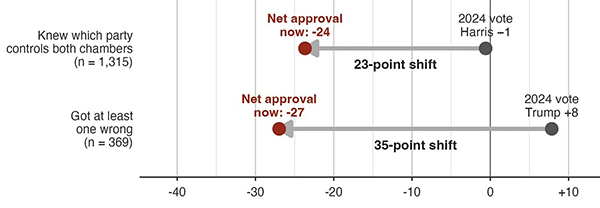
The high-information Trump voters have soured on Trump by 23 points since February, while the low-information ones have soured 50% more, with a shift of 35 points. And remember, it was the low-information voters who powered Trump's victory in 2024. They now dislike Trump even more than the high-information voters do.
Morris also asked the generic House ballot question in both February and October. The high-information voters are now D+7 (a 6-point shift). The low-information voters are now D+12 (a 20-point shift). This means the low-information voters have shifted much more strongly than the high-information voters. Or, more crudely, the less you know about politics, the more likely you are to be a Democrat. It is not intuitive, but did you expect more from people who don't know what potato chips are made from?
The survey asked about 13 policy issues as well. On every one of them, the low-information voters dislike Trump more than the high-information voters. On prices, for example, the low-information voters are net -24 for Trump but the high-information ones are +4 for Trump. The pattern holds for everything else as well. Also, only 35% of the low-information voters say that Trump cares about people like them (vs. 60% of the high-information voters).
Maybe this is just anti-incumbent bias. Hard to say. Morris has a warning for the Democrats, though. If Democrats can't deliver in the next two years, the low-information voters are likely to swing back again. Excuses like: "We passed a whole bunch of bills to lower prices but Trump vetoed them all" won't cut it because these voters don't understand how government works. That's life. (V)