
Dem
52

Ties
3
GOP
45

No two of the 435 House races are identical. Demographics, geography, local issues, candidate quality, and partisan lean always play a role. Nevertheless, there are two groups of voters that could play a decisive role in determining which party controls the House, and by how much. These are Latinos and rural voters. The New York Times has a good article examining which districts are going to be affected by how they vote.
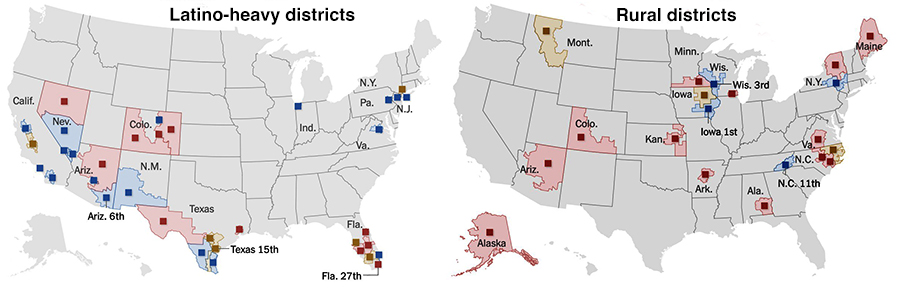
Here are maps showing districts to watch, with competitive Latino-heavy districts on the left and competitive rural districts on the right. In the Times map, the districts are interactive, so mousing over a district pops up an information box about it. Except for CO-03 (Jeff Hurd, R, PVI of R+5), which is on the Western Slope and AZ-02 (Eli Crane, R, PVI of R+7), which covers most of the state, there isn't much overlap between the two demographics.
The situation keeps deteriorating for Republicans. Since the end of September, the Cook Political Report has shifted 63 districts toward the Democrats. Now, 12 of the toss-up districts are held by Republicans and only 5 by Democrats. History shows that swing districts tend to swing the same way, so a split close to 50-50 is an unlikely outcome.
The problem for the Republicans is that Latinos are furious about ICE sweeping Latinos, including some American citizens, off the streets and locking them in gulags for deportation. Farmers are furious about high prices for diesel and fertilizer and the loss of foreign markets due to Trump's trade war. If both groups swing hard toward the Democrats, it could be a bloodbath for the Republicans.
On Election Night, there are seven districts in South Florida to watch to see how Latinos are voting. Although Florida Latinos are Cuban American and South-American American and western ones are Mexican American, a huge shift toward the Democrats in South Florida could be a bellwether for more of the same when results from the West start coming in two hours later. Especially since Cuban Americans tend to lean more Republican than Mexican Americans.
Similarly, the very rural ME-02 and the three rural districts in eastern North Carolina will be closely watched. Democratic wins in NC-03 (R+6) and NC-13 (R+8) will spell big trouble for the Republicans all over the Midwest. Of course, the reverse is also true. If Republicans hold steady in the East they will also probably hold steady in the Midwest. (V)