
Dem
53

Ties
4
GOP
43

There have a large number of polls of specific House races, but all of them effectively take into account characteristics of that specific race, those specific candidates, and other factors that may not apply in other races. One question pollsters have been asking for decades that factors out these specific-to-a-particular-race things is: "Are you going to vote for the Democrat or the Republicans for the House of Representatives?" It doesn't factor out all the local characteristics because some voters know who the local candidates are, especially close to Election Day. Still, the question deemphasizes the local candidates.
Nate Silver took a look at how accurate the House generic poll has been over time, but in an interesting way. Instead of looking at Democrats vs. Republicans, he looked at the president's party vs. the opposition. Here are the results for the midterms since 1994:
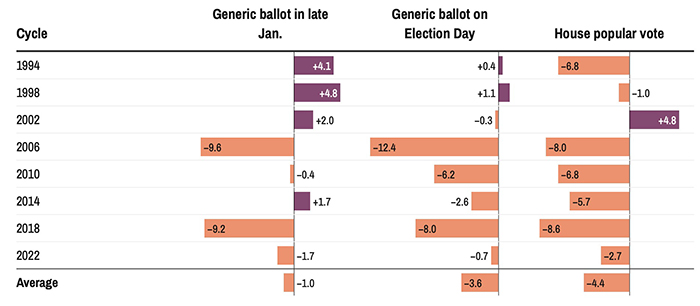
So for example, in 2022, the generic ballot said President Joe Biden's party would lose the House popular vote by 0.7%. The Democrats lost it by 2.7%. In 2018, the generic ballot said that President Donald Trump's party would lose the House popular vote by 8.0%. The Republicans lost it by 8.6%. While in individual years, the generic ballot has been off typically by 3-4 points, averaged over all the midterms since 1994, the mean error is only 0.8%. So the generic ballot is a reasonably good indicator of the House popular vote.
With this as prologue, Reuters has a new House generic poll conducted by Ipsos. The result is D+11. However, when undecided voters were pressed to make a choice, the graph was reduced slightly, to 50% vs. 41%, or D+9. Here is the generic poll since the start of Trump v2.0,with the shaded areas showing the margin of error:
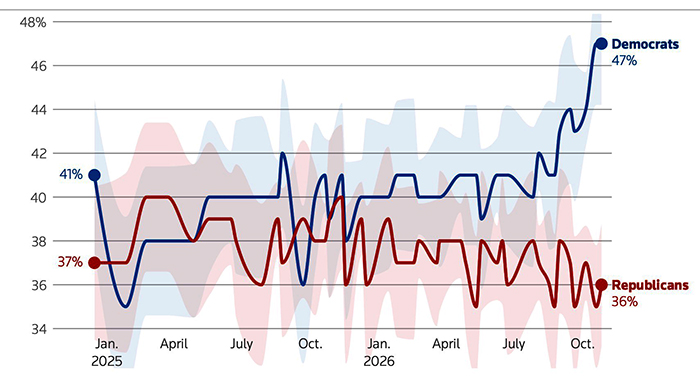
Clearly there has been a strong movement toward the Democrats since about August. If the final House vote is D+11 or even D+9, that will probably translate into a few dozen seats and almost certain Democratic control of the House with enough margin for Speaker Hakeem Jeffries (D-NY) to get his programs through without having to worry about any fringe caucuses blocking him.
The poll also asked about Donald Trump's approval. It is approaching the Bush line—but from the wrong direction. It is now 32%, up from 31% last time. But that variation means nothing. It is just statistical noise. Here is Trump's approval during his second term:
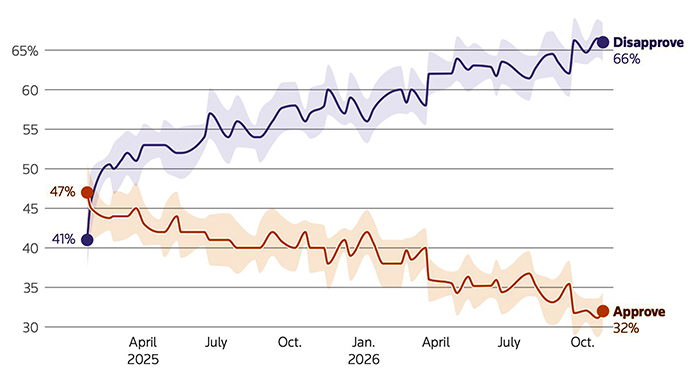
If the generic poll is as accurate as previous ones and Trump's approval is really in the low 30s, that does not bode well for Republicans next week. (V)