
Dem
53

Ties
2
GOP
45

Not a lot of people other than professional bond traders follow the ups and downs of the bond market. But a lot of people sure feel the consequences. Here is the yield of the benchmark 10-year treasury note for the past 20 years:
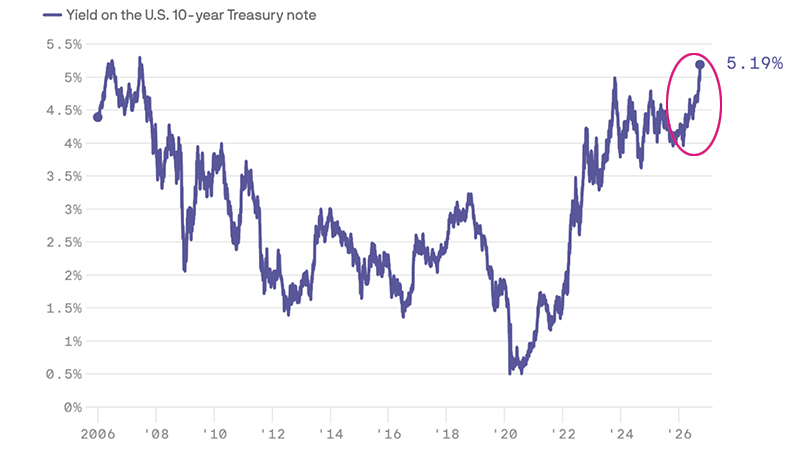
Ten-year treasury bonds pay $1,000 at maturity but are traded on the market, usually for less than $1,000. The discount upon purchase plus the semiannual interest coupons determine the effective interest rate. The effective interest rate has shot straight up this year and is currently at 5.19%, a near-historic high for the past 20 years. Bond prices drop (which makes yields go up) when investors expect more inflation in the future and demand more interest as compensation. Right now, the gas price ($4.50/Gal.) and diesel price ($6.48/Gal.) are making investors nervous and they expect the Fed to raise interest rates later this year.
So, does anyone other than bond traders care about bond yields? Probably not many, but they will soon feel the consequences. The bond market basically sets the interest rate on credit card debt, mortgages, car loans, student loans, personal loans, and other consumer loans, which people most definitely feel. A rising bond yield also puts pressure on the Fed to raise rates again, since fighting the market rarely works, if ever. Fed Chairman Kevin Warsh understands this very well.
All of these data point to more pain for consumers in the coming months, precisely when affordability is the keyword for the midterms. There is no relief in sight, certainly not before Nov. 3 and probably not even next year, which matters for 2028. It is not hard to imagine Democratic candidates for all offices in 2028 repeating in unison: "If you like the current economy, vote a straight Republican ticket. If you don't, vote a straight Democratic ticket." While James Carville is way past his prime, his motto, "It's the economy, stupid," is alive and well.
If the Democrats capture Congress, they could try to pass popular "messaging" bills about affordability that Republicans will fillibuster to death, but which send a signal to the voters. For example, they could pass a bill that reduces taxes on people making less than $100K and makes up for it by raising tax rates and closing thousands of loopholes millionaires and billionaires use to reduce (or escape) taxes. Democrats could attempt to eliminate the cap on FICA contributions (currently $184,500), which would shore up Social Security for decades. They could try to raise the subsidies available on Affordable Health Care ("Obamacare") plans to reduce health care costs. They could try to restore all the cuts to Medicaid that the Republicans passed. They could attempt to make driving cheaper by passing a bill to provide huge subsidies to anyone buying a new American-made electric car. Another bill could provide big subsidies on American-made solar panels, to help reduce electricity bills. Republicans would probably fillibuster all of these things and if they didn't, Trump would veto them. This would send everyone the message that Democrats want to make life more affordable and Republicans are blocking every move. How will that sell in 2028? (V)