
Dem
53

Ties
2
GOP
45

In 2024, an unexpectedly large number of Latinos (but not Latinas) voted Republican. There were endless stories about how this was a permanent realignment and the Democrats were henceforth sunk. There is now increasing evidence that Donald Trump took that huge gain and deported it, never to be seen again (at least, not any time in the foreseeable future).
In an average of high-quality polls in September, Republicans are 35 points underwater with Latinos, with it going 64 to 29 for the Democrats on the generic House ballot. That would be a massive shift since 2024, when the presidential polls were D+7, not D+35.
This huge change could result in the map changes in Texas and Florida becoming dummymanders, particularly in districts where the Republican mapmakers had counted on a massive Latino vote for them. That now seems very unlikely. Here are the changes among Latinos (male + female) in some key Texas and Florida Latino-heavy districts where the mapmakers assumed they would do well in 2026:
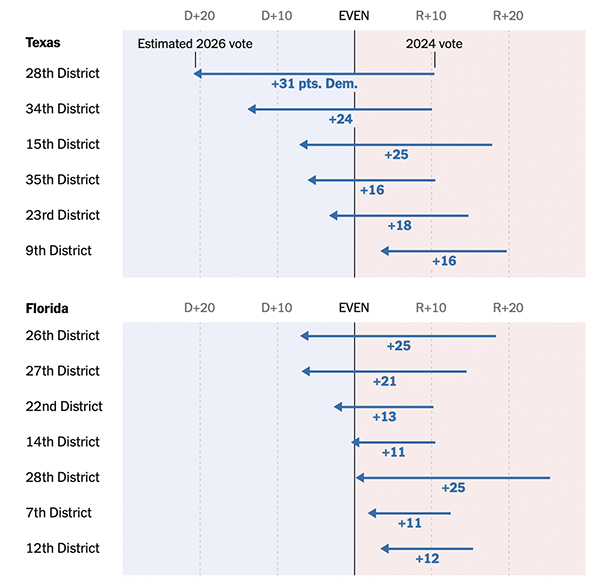
As you can see, the six Latino-heavy districts in Texas have moved toward the Democrats by 16 to 31 points. The seven Latino-heavy districts in Florida have moved 11 to 25 points toward the Democrats. None of these districts have moved toward the Republicans or even stayed roughly the same. Republicans changed TX-35 from D+19 to R+4, making a sure Democratic win now leaning Republican. But that assumption may now be way off and the Democrat has a good chance if Latino turnout is strong, as it is likely to be. Similar booboos may have been made in other districts.
And these are House races. In Senate races, the shift is also likely to be felt. This is very likely to be why Republican Ken Paxton is behind in most polls in Texas and Democrat Angie Nixon is doing surprisingly well in a few polls in Florida, although she is not nearly as consistent as Democrat James Talarico in Texas.
You don't need a focus group to figure this out; Trump has been disparaging Latinos for 2 years now and arresting and deporting hundreds of thousands of them, even some U.S. citizens. It is hardly surprising that Latinos don't want "more of the same." This could cost the Republicans multiple House seats and maybe a Senate seat or two. (V)