Project 2029
The Bulwark's Jonathan V. Last (JVL) often thinks out of the box. One recent idea of his is that Democrats should
stop saying their condition for ending the shutdown is restoring health-care subsidies. Instead, they should say their
only condition is releasing 100% of the Epstein files, unredacted except for blacking out the names of Epstein's
victims. Most Democrats, independents, and even Republicans would probably support this. It would put the Senate
Republicans in the unenviable position of saying: "We would rather shut the government down and cause untold hardship
for millions of people rather than let Americans know who Epstein's accomplices, helpers, and fellow criminals were." We
suspect that would be a tough position for even the hardest-core Trumpists in the Senate to defend.
JVL also has another pet project,
Project 2029.
He even has a
cover photo
ready to go (with a bit of help from
Midjourney's AI program):
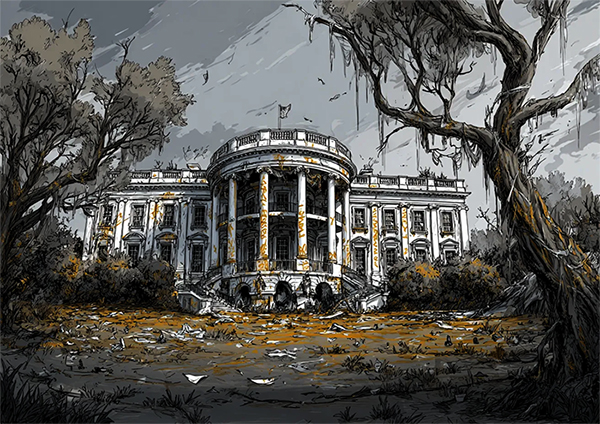
Here are the main items in JVL's Project 2029:
- Make D.C. a state, remove federal control of it, and have it elect its senators as quickly as possible.
- Expand SCOTUS. Is this ideal? No. An Amendment can come later, but action is required now.
- Aggressively prosecute everyone who broke laws during Trump 2.0, from the top down to the lowest ICE agent.
- Eliminate the Dept. of Homeland Security, distributing essential functions to other Depts.
- Pass laws curtailing the president's authority during emergencies.
- Pass laws requiring financial transparency from presidential candidates.
JVL invites readers to add their own items. OK, here are some of ours:
- Clean House. Fire all Trump agency heads then institute new rules for the future.
- Pass the
For the People Act.
- End gerrymandering, possibly by electing representatives statewide with proportional representation.
- Give election administration over to independent civil servants, not partisan politicians.
- Establish a constitutional right to vote for all citizens over 18 except those currently imprisoned for felonies.
- Pass a new and stronger Voting Rights Act.
- Strengthen the Posse Comitatus Act (e.g., no troops doing law enforcement unless the governor also approves).
- Pass a law stating that the president can be indicted after his term for violating federal law while president.
- Allow Congress to punish presidential misbehavior short of impeachment; maybe a short suspension or fine?
- Abolish (super) PACs and make it illegal for corporations to donate to campaigns, even indirectly.
- Public matching of campaign contributions up to $200 for all federal offices at a ratio of 5:1.
- Require all donations to candidates and measures be reported in public and in real time.
- Amendment to allow a president to name a SCOTUS justice after each victory plus mandatory retirement at 65.
- Pass a law making the heads of agencies truly independent (e.g. require Senate approval to fire one).
- Name impounding congressionally appropriated funds as an impeachable offense; ban recissions.
- New antitrust laws. Make controlling >10% of a sector a reason for a forced breakup.
- Ban politicians from owning stock except ETFs in the S&P 500.
- Ban right-to-work-laws nationally and strengthen unions.
- Make social media platforms liable for defamatory postings they publish, same as newspapers.
- Raise the estate tax to 95% for estates above $10 million.
- No more acting (cabinet) officers; No. 2 takes over until the Senate has confirmed a new No. 1.
- Make declaring emergencies require Senate approval and then only for 30 days.
- Repeal all laws giving the president congressional powers (e.g., levying tariffs).
In our view, the main things are strengthening democracy and returning power to where it belongs: Congress. Economic
issues, like the minimum wage, can certainly be included, but first priority is making sure there will never again be an
authoritarian because Congress holds most of the cards. That was the founders' intention, actually (which is why it is
in Art. I of the Constitution and the president is in Art. 2). The three branches are coequal but it was never intended
to make them copowerful.
In particular, the Supreme Court has far too much power that was never intended. It simply took it in Marbury v.
Madison and it stuck. How about a law embedding judicial review in a statute, but with restrictions? For example,
the Court can declare a law passed by Congress unconstitutional, but only by a unanimous vote of all the justices? No
more contentious 5-4 or 6-3 rulings throwing out laws passed by the people's representatives. (V)
This item appeared on www.electoral-vote.com. Read it Monday through Friday for political and election news,
Saturday for answers to reader's questions, and Sunday for letters from readers.
www.electoral-vote.com
State polls
All Senate candidates


