America Is Now Desensitized to High-Profile Killings, Europe Not So Much
Every time there is an incident of political violence, "thoughts and prayers" pop up, then nothing happens and
everyone moves on. The unfortunate reality is that political violence is as American as apple pie. Here are some recent
examples:
- Jan. 8, 2011: Then-Rep. Gabrielle Giffords was shot in Tucson while talking to constituents.
- June 14, 2017: Rep. Steve Scalise (R-LA) was shot while practicing for the congressional baseball game.
- June 14, 2025: Two Minnesota state representatives were shot, and one died.
- Sept. 10, 2025: Charlie Kirk was shot and killed.
These are just recent examples, If we go back to the 1960s, we have John F. Kennedy, Robert F. Kennedy Sr. and Martin
Luther King Jr., too. Further back are William McKinley, James Garfield and Abraham Lincoln. These are only the most
prominent ones. In all, 4 presidents, 11 members of Congress, 4 governors, 29 state legislators, 9 mayors, and a whole
raft of judges and other officials have been assassinated. It's the American way. If you are skeptical, here is a
long list of them.
And the list of failed attempts is also long, including an attempt at Ronald Reagan's life, the attempt on Donald
Trump's life in Butler, PA (resulting in the death of audience member Corey Comperatore), the golf course shooter who
wanted to get Donald Trump, and the arsonist's attempt to burn down the Pennsylvania governor's mansion while Gov. Josh
Shapiro (D-PA) was sleeping in it. And school shootings? We're not even going to start on that. American exceptionalism,
indeed.
One worrying sign is how these events become normalized and fade into the background. Lincoln's assassination is
still important enough that 160 years later, schoolchildren are taught about it. But modern shootings? They usually last a
couple of news cycles—if that much—and are then gone with the wind. The shooting of Gabrielle Giffords was
on the front page of The New York Times for a week. The arson attempt in Pennsylvania didn't even make the front
page of most newspapers. The national attention span can now be measured by looking at Google searches for the topic.
Searches surge on the day of the incident, then quickly die off.
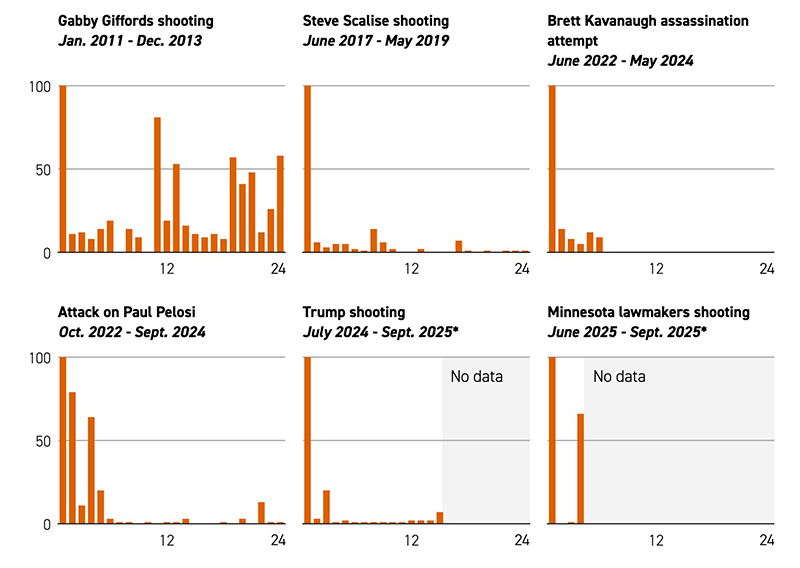
The drop off in searches matches the drop off in newspaper articles about the event. It is as if people are saying:
"Oh, another one. Nothing new here. Time to move on." People are becoming desensitized quickly now because these events
are so common. The Kirk story may go on longer since the search for a motive will dominate the news until the Internet
has decided what the shooter was thinking.
In an attempt to see where we may go from here, Politico Magazine talked to 10 experts on political violence
to see what they had to say. Here is a
brief rundown:
- Pouring Poison in the Public Well (Sean Westwood): The aftermath of a political
assassination tests the strength of a democracy. After the attempts on Donald Trump's life, leaders of both parties
tried to lower the temperature. Now they are trying to raise it. The core problem is not that everyone wants it. Only 2%
of Americans approve of political assassinations. The problem is that each side sees the other as a vast, murderous
faction. Leaders exploit this for attention and money. The long-time result is erosion of democratic stability, but some
leaders are willing to ignore this for short-term gain.
- Political Violence Is Not Random (Barbara Walter): Political violence is more common when
four conditions are met: (1) democracy is declining; (2) society is divided by race, religion, ethnicity, etc.; (3)
leaders encourage or at least tolerate violence and (4) everyone has easy access to guns. The U.S. passes all four
tests. The outlook is bleak. Democrats have no power and Republicans have no incentive to change anything since it works
for them. Most political killings seem to be due to radicalized young men who feed on all the hate on the Internet. The
only lever that might yet be pulled (eventually) is to rein in the tech companies and the pipeline feeding extremism.
One way that would not inhibit free speech is to make Internet platforms subject to the same rules as newspapers. If
The New York Times publishes libelous hate speech, it can be sued for it. Facebook can't be (due to
Sec. 230 of the CDA).
If it were repealed, platforms would have to vet their own content, just as the NYT does. Their own lawyers would
make them very cautious.
- The Norms Inhibiting Such Violence Are Becoming Increasingly Weak (Joel Busher): The
danger here is that the government will call for a crackdown on "the radical left" and that will lead to more violence.
To break the cycle, leaders from all parties and sectors have to strongly condemn all violence, even when it benefits
their side. Also, everyone has to come to realize that the problem is that many people are very unhappy with how things
are and see no way to change them. This will not be easy.
- Individual Attacks Without a Partisan Motivation or Trend (Clionadh Raleigh): The trend
in the U.S. is the lone-actor violence without a partisan trend. Actually, it has been that way for a long time. John
Wilkes Booth was not operating on behalf of some organized group. Neither were Charles Julius Guiteau, Lee Harvey Oswald
or James Earl Ray. The hopeful sign here is that the U.S. is not on the brink of civil war. The only way to stop lone
actors is to make access to guns much more difficult (as is the case in Europe) and provide better mental health
treatment for those in need of it.
- Political Violence Often Begets More Political Violence (Erica Frantz): The killing of
Charlie Kirk shouldn't be seen in isolation. It is part of a broader pattern going back to the Jan. 6 rioters and the
people who egged them on. A key problem is the personalization of politics, where the leader is in it for himself rather
than in it as a representative of what millions of people want. We see that all over the world now. Ending the cycle of
violence begetting violence requires top-down leadership and a shared understanding of the value of democracy.
- More People Will Conclude That Political Violence Can Be Justified (Solveig Hillesund):
No society can insulate itself entirely from crazy people who get some weapon and attack a politician. When a large
group of people come to believe that the political system does not care about their grievances, they are more likely to
opt for violence as the only solution. The cycle of violence will only be broken when aggrieved people believe the
political system can be used to address their issues. If peaceful avenues are seen to be pointless, violence can be
justified. [Ed: The current cycle of midterm gerrymandering so as to get the people out of the loop is just about the
worst way to get people to think that there is hope for the system.]
- We Do Not Have to Accept This Climate as Our New Normal (Shannon Hiller): Her group at
Princeton has tracked 250 threats against politicians in 40 states in the first half of 2025 alone. These threats have led to
politicians hiding and being unwilling to take unpopular stands, without which the problem can't be dealt with. If the
environment doesn't change, the problem won't go away. We don't have to accept this as a given though. There have to be
cross-partisan efforts to reject political violence and especially to avoid playing the blame game and fanning the
flames by blaming whole segments of society for the acts of loners.
- Glorifying These Attacks Threatens to Normalize Them (Dalya Berkowitz): We could be
headed for a cycle of tit-for-tat violence we haven't seen for decades. Violence against people usually comes from the
far right. Violence against property usually comes from the far left. If the left begins to rejoice in Kirk's killing
(depending on what facts come out), then the norm of nonviolence may be gone for decades. Research shows that incendiary
rhetoric directed against certain groups threatens to normalize violence and allows people to justify their actions. The
only way to tamp it down is for political leaders of all stripes to get together to try to lower the temperature and not
use it to attack their favorite enemies. Otherwise, no one will be safe.
- This Is Now the Watershed Moment (Robert Pape): The Kirk killing was not unpredictable.
Pape wrote an op-ed in the NYT in June saying that the country was on the brink of political violence. What is
needed is for every political leader from the president down to local dogcatchers to give a full-on condemnation
of political violence and urge restraint. They must do this on video and make it as convincing as their political ads.
And they need to do it heavily on social media, especially TikTok, and address it to their own bases, which may be out
for more blood.
- Political Leaders Must Condemn Violence Across Party Lines (Eduardo Moncada): In Latin
America, political violence often blends with organized crime. That is not true in the U.S. (yet). But one factor that
is common is the normalization of violence, with people saying it is justified if the "system" doesn't work. Can the
cycle be broken? In the aftermath of Kirk's killing, it has already broken down into the familiar partisan narratives.
That has to stop. Leaders have to be held accountable when they use dehumanizing or menacing rhetoric. We need to
correct the view that the "other side" wants violence so "our side" has to do it, too. That simply reinforces the
cycle.
The murder of Charlie Kirk is also
reverberating
around the world. Within minutes of the shot heard round the world (2025 edition), some world leaders condemned the
assassination. Italian Prime Minister Giorgia Meloni said: "An atrocious murder, a deep wound for democracy and for
those who believe in freedom." The French foreign ministry tweeted: "France expresses its deep emotion following the
assassination of Charlie Kirk." Despite Kirk once calling the U.K. a totalitarian third-world hellhole, British Prime
Minister Keir Starmer said it was "heartbreaking that a young family has been robbed of a father and a husband."
However, these weren't the only reactions. Hungarian Prime Minister Viktor Orbán said: "Charlie Kirk's death
is the result of the international hate campaign waged by the progressive-liberal left." Jordan Bardella, the leader of
the far-right National Rally in France, condemned the "dehumanizing rhetoric of the left and its intolerance." Vigils
for Kirk popped up in London, Berlin, and Rome.
There was also action. On Saturday, a
march
of over 100,000 people in London led by far-right activist Tommy Robinson (the stage name of Stephen Yaxley-Lennon) led
to clashes with the 1,000+ police dispatched there to keep order. Twenty-five people were arrested and 26 officers were
injured. The rival "March against Fascism" drew about 5,000 people. Robinson is the founder of the anti-Islam English
Defense League and a very influential figure on the far right in Britain. Supporters held banners saying "stop the
boats," "send them home," and "enough is enough, save our children."
Populist parties all over Europe are making hay out of Kirk's murder. They are opposed to mass immigration, skeptical
of international institutions, averse to globalism and unabashedly patriotic. They also loathe elites and the expert
class for having made a mess for the past 35 or so years. They are adopting MEGA (Make Europe Great Again) as a motto.
It has been a long time since the American right and European right were so united on their goals. The last time was
before the Berlin Wall fell and they were united by anti-communism. That was before globalism had set in. Also, Ronald
Reagan and Margaret Thatcher were practically in love. It is a bit of a paradox that the trans-Atlantic political groups
cooperating most are the groups that viscerally hate trans-Atlantic cooperation.
So how is Donald Trump taking this all in? He was talking to the architects of his grand new ballroom when he got the
news of Kirk being shot. His reaction was shock, anger, and disbelief because he knew Kirk very well and considered him
a key ally and personal friend (as much as he has friends). He was genuinely upset and sent J.D. Vance to go fetch
Kirk's casket on Air Force Two. Trump also honored Kirk posthumously with the Presidential Medal of Freedom and said he
would attend Kirk's funeral.
Chief of Staff Susie Wiles said that Kirk was the highest profile MAGA person other than those working in the White
House. She also said: "So, I think it shook everybody to their core, and for many of us, it brought back the memories
of last July 13th in Butler with the president."
But Kirk was more than an ally to Trump. Donald Trump Jr. said that Kirk was like another son to his father. He was
also close to Vance and others in the White House, especially young staffers who became conservatives as a result of
being part of Turning Point USA.
Many of the experts on political violence above said that at moments like this, leaders need to come together and
condemn all violence and not call for revenge. How is that playing with Trump? When Ainsley Earhardt asked Trump on Fox
how the country can come together, Trump said: "I'll tell you something that's going to get me in trouble, but I
couldn't care less. The radicals on the right oftentimes are radical because they don't want to see crime. They don't
want to see crime. They're saying we don't want these people coming in, we don't want you burning our shopping centers,
we don't want you shooting our people in the middle of the street. The radicals on the left are the problem. And they're
vicious, and they're horrible, and they're politically savvy." This is not exactly what Berkowitz, Paper, Hiller, and
the others said is needed at this moment. (V)
This item appeared on www.electoral-vote.com. Read it Monday through Friday for political and election news,
Saturday for answers to reader's questions, and Sunday for letters from readers.
www.electoral-vote.com
State polls
All Senate candidates


