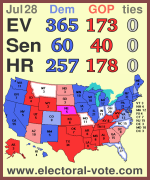
The Senate voted to confirm Sonia Sotomayor for the U.S. Supreme Court yesterday by a vote of 68 to 31. All 59 Democrats and independents who voted said aye (Ted Kennedy, who is being treated for brain cancer, was not present). Nine Republicans voted yes. Here is the list of Republicans who voted yes:
| Senator | State | Voted | Possible Reason |
| Lamar Alexander | Tennessee | Yes | ? |
| Kit Bond | Missouri | Yes | Retiring |
| Susan Collins | Maine | Yes | Very blue state and solidarity with a woman |
| Lindsey Graham | South Carolina | Yes | Service in the Judge Advocate General Corps |
| Judd Gregg | New Hampshire | Yes | Retiring |
| Richard Lugar | Indiana | Yes | Old-style conservative |
| Mel Martinez | Florida | Yes | Retiring |
| Olympia Snowe | Maine | Yes | Very blue state and solidarity with a woman |
| George Voinovich | Ohio | Yes | Retiring |
What can we conclude from the list? First, the two moderate women from Maine voted yes. This was to be expected as they are pro-women's rights and rarely take their marching orders from the party's central command. The two conservative Republican women in the Senate, Kay Bailey Hutchison and Lisa Murkowski, both of whom are facing the voters next year--Murkowski for the Senate and Hutchison for governor--voted no. Four Republican senators who are retiring from politics (Bond, Gregg, Martinez, and Voinovich) were free to vote in the country's interest rather than in the party interest and voted yes. This leaves three senators unaccounted for. Alexander is a mystery. It is not clear why he broke with the leadership although he is not up for reelection in 2010. Graham was formerly in the Judge Advocate General Corps and has a finer tuned feeling for the law than most senators. He might have felt that there was no good legal basis for opposing the President's pick. Finally, there is Lugar, who is more of an old-fashioned small-town conservative than a Bush-Cheney-type conservative. He has something of a tendency to pay attention to the national interest, but usually in matters of foreign policy.
What about the Republicans up for reelection? Here is the list.
| Senator | State | Voted | Possible reason |
| Robert Bennett | Utah | No | Running for reelection |
| Richard Burr | North Carolina | No | Running for reelection |
| Tom Coburn | Oklahoma | No | Running for reelection |
| Mike Crapo | Idaho | No | Running for reelection |
| Jim DeMint | South Carolina | No | Running for reelection |
| Chuck Grassley | Iowa | No | Running for reelection |
| Johnny Isakson | Georgia | No | Running for reelection |
| John McCain | Arizona | No | Running for reelection |
| Lisa Murkowski | Alaska | No | Running for reelection |
| Richard Shelby | Alabama | No | Running for reelection |
| John Thune | South Dakota | No | Running for reelection |
| David Vitter | Louisiana | No | Running for reelection |
Perhaps it is just a coincidence that four of the five retiring Republican senators (all except Jim Bunning) voted yes and every Republican senator running for reelection voted no. More likely, all the Republicans running for reelection felt that angering their own base was a greater danger than angering Latinos. In general, there did not appear to be much of a correlation between the size of the Latino population and the vote. Both senators from Texas--the state with the largest Latino population, about 30%--voted no. More on the vote and partisanship can be found in this article at the National Journal.
So presumably this is just politics as usual. And Sotomayor is about as conservative a justice as one could expect from Obama. Two more retirements are likely during Obama's presidency: John Paul Stevens, who is 89, and Ruth Bader Ginsburg, who had colon cancer and pancreatic cancer. If Obama nominates true liberals for either seat, probably few, if any Republicans, will support him or her as a matter of principle, no matter what the person's qualifications are. Some of the Republicans opposing Sotomayor said the key reason for their opposition was one sentence she said to a Latino group in Berkeley nearly 10 years ago. If the only way to get Republican votes is to find a candidate who has never said or done anything they disagree with in his or her entire life, it is going to be tough. The new motto is: "One strike and you're out."
Politico is reporting that Rahm Emanuel is annoyed at liberal groups (e.g., moveon.org) for running TV ads attacking blue-dog Democrats for impeding health care insurance reform. On the one hand, Emanuel went to a lot of trouble as head of the DSCC to get these folks elected in red districts in the first place, but on the other, he also wants them to support a health-care bill. He doesn't believe the pressure will work, but the mere fact that he is alarmed may mean it is having an effect.
New Research 2000 polls show the Republican candidates for governor in the only major 2009 races--New Jersey and Virginia--are leading. In New Jersey, Chris Christie (R) is beating Jon Corzine (D) 48% to 40% and in Virginia Bob McDonnell (R) is ahead of Creigh Deeds (D) 51% to 43%.
PPP, a polling firm that usually works for Democrats, has polled all the big Senate races except Connecticut, Nevada, and Pennsylvania. Based just on the polling data (and not their intuition), here is the list of the top 10 seats most likely to switch parties in 2010, from most likely to least likely.
| State | Incumbent | Notes |
| Ohio | Open (R), Voinovich | Both Lee Fisher and Jennifer Brunner beat Bush-alum Rob Portman |
| Delaware | Open (D), Kaufman | If Mike Castle (R) runs, he could beat Beau Biden (D) |
| Kentucky | Open (R), Bunning | Jack Conway could beat Trey Grayson but Dan Mongiardo would lose |
| New Hampshire | Open (R), Gregg | Paul Hodes would beat John Sununu; no polls on Kelly Ayotte |
| Colorado | Michael Bennet (D) | Bennet edges out Bob Beauprez if he runs (unlikely) |
| Missouri | Open (R), Bond | Robin Carnahan edges out Roy Blunt |
| Illinois | Open (D), Burris | Alexi Giannoulias ties Mark Kirk at 35% |
| Texas | Open (R), Hutchison | If Hutchison resigns, Greg Abbott could beat Bill White by 6% |
| North Carolina | Richard Burr (R) | Against Elaine Marshall, Burr wins 43% to 35% |
| Arkansas | Blanche Lincoln (D) | Against Gilbert Baker, Lincoln wins 48% to 37% |
These ratings should be taken with a pound or two of salt. Some of the polls are elderly and in some cases (like New Hampshire), PPP guessed one of the candidates wrong. In Kentucky, which is fundamentally a red state, a bitter primary between Attorney General Jack Conway and Lt. Gov. Dan Mongiardo (who lost a squeaker to Bunning in 2004), could hurt the Democrats chances. In Missouri, despite what this poll says, Robin Carnahan is the clear favorite over Roy Blunt. Her family is very well respected in Missouri (Dad was governor, Mom was a senator, and brother is a congressman) and Blunt represents the GOP congressional leadership, which is very unpopular. In Colorado, newbie Bennet may get a free pass as Beauprez is a terrible campaigner and the Republicans can't seem to find anyone else. While the state is trending blue, the Republicans still have a chance--provided they can find a top-tier candidate, something that has eluded them so far. While incumbent Sen. Roland Burris (D-IL) has had plenty of problems, he won't be on the Illinois ballot in 2010 and state Treasurer Alexi Giannoulias has shown he can win statewide office while Rep. Mark Kirk is not well known outside his district. Besides, Illinois is a blue state and President Obama will surely campaign for Giannoulias if he is the nominee. North Carolina should probably be higher on the list as the state is becoming purple. Obama carried it and Kay Hagan beat popular incumbent Elizabeth Dole in 2008. Burr is nowhere near as popular as Dole, so lightning could strike again. While Arkansas made the top 10, in truth Lincoln is not in any trouble. At the state level, Arkansas is a surprisingly blue state (e.g., the Democrats have both Senate seats, 3 of the 4 House seats, the governor's mansion, and 2/3 of each chamber of the state legislature).