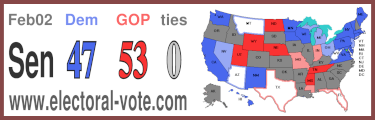
New Senate: DEM 49 GOP 51
New polls:
Dem pickups: (None)
GOP pickups: (None)
Previous | Next
FBI Raids Cohen; Trump Outraged
Another Monday, another dramatic development in TrumpWorld. The newest chapter involves Donald Trump's lawyer Michael Cohen, whose office, home, and hotel room were raided by FBI agents. According to witnesses, they were looking for information related to the payoff of porn star Stormy Daniels (aka Stephanie Clifford) as well as evidence of any other payoffs or shady deals that Cohen may have made on Trump's behalf. Some sources report that the agents were also looking for evidence concerning possible bank fraud and wire fraud.
This is, of course, bad news for both Cohen and Trump. Only they know for sure what the FBI will find, but most communications between lawyers and their clients are protected by attorney-client privilege. The major exception is evidence of a conspiracy between counsel and client to commit a crime. Ergo, that must be what is suspected here, and the preliminary evidence was strong enough that a federal judge agreed to a warrant. This does not prove guilt on the part of Cohen or Trump, but it certainly takes us part of the way down that path. And the warrant was (apparently) based only on the Daniels situation; who knows what else the agents will turn up? Certainly, special counsel Robert Mueller is hoping that some Russia-related dirt will present itself.
And speaking of Mueller, he's a shrewd cookie. Knowing that his mandate probably does not extend to porn star payoffs, he (or Deputy AG Rod Rosenstein) handed the matter off to the office of US Attorney for the Southern District of New York, Geoffrey Berman. Not only is this the "by the book" way to do things, it makes it considerably harder to claim "witch hunt," since the folks who conducted the raid weren't working directly for Mueller. On the other hand, Mueller could have handed the case to New York AG Eric Schneiderman because if Cohen is indicted and convicted on federal charges, Trump can still pardon him. Presidents have no authority to pardon state crimes. Only Mueller knows why he made the choice he did.
One possible reason Mueller preferred Berman to Schneiderman is that Berman is no Democratic lackey, whereas Schneiderman is a partisan and ambitious Democrat. Berman is the former law partner of former New York City Mayor Rudolph Giuliani, and a stong Trump supporter. In 2016, Berman donated $5,400 to Trump's campaign, the legal maximum. He was appointed to his current position on an interim basis in January by AG Jeff Sessions, after being personally interviewed by Trump. Trump was planning to make Berman's appointment permanent, but after yesterday's raid, that appointment may be in danger. The mere fact that Berman would endanger his appointment to one of the most powerful and prestigious jobs in law enforcement suggests that the evidence presented to him was so overwhelming that he felt he had no choice but to carry out the raid.
Unsurprisingly, Trump claimed that the raid was a witch hunt, despite Berman's strong Republican credentials and almost certainly Rosenstein's approval. In fact, he was informed as to what had happened during Monday's cabinet meeting, and he launched into a nine-minute rant that included all the greatest hits, including "fake news," "a real disgrace," and "unfair":
Trump also described the raid as, "an attack on our country in a true sense," and made clear that he is thinking seriously about firing Mueller. An interesting thing, from a body language point of view, is that for much of his monologue Trump crossed his arms tightly and came dangerously close to hugging himself. That is generally regarded as a signal of insecurity and vulnerability. It's certainly not a posture he adopts very often.
Mike Allen of Axios, who is generally well plugged in, is reporting that the raid of Cohen is a giant leap forward and Trump has no one to turn to for help and consolation. That was the job of former communications director Hope Hicks, but she is gone now. According to Allen's source, Trump sees the raid as a personal affront and a crossing of the Rubicon into forbidden territory. He is likely to become completely untethered now since there no one in the White House to control him any more. Allen also notes that the big picture is the president's top lawyer being raided by the FBI, prompting the president to warn of an epic attack on the government and threatening to fire a special counsel investigating him. Books will be written about this and you can tell your grandchildren that you watched it in real time. Still unknown: Will Robert Redford play Mueller in the movie?
Anyhow, at the moment, the $64,000 question us: What will Trump do now? (The $128,000 question is "What did the FBI turn up?" but we won't know the answer to that for a while). Given the President's obvious irritation, and the fact that he values Cohen far more than anyone else who has been targeted with a search warrant, there appear to be a few possibilities:
- Do Nothing: This is almost certainly the correct
response, but don't bet on the President choosing this one. Just about everyone
who will tell Trump "no" has either departed the White House (John Dowd, etc.)
or has fallen out of favor (John Kelly, etc.). What is left is a collection of
yes-men and enablers, many of whom have absolutely terrible political instincts
(Javanka, John Bolton, Kellyanne Conway, etc.). The only person left who might
convince Donald Trump to cool his jets is Donald Trump, and if that happens it
will be a first.
- Fire the FBI Personnel Involved in Monday's Raid:
The problem here is that anyone Trump might bring the hammer down upon—Berman,
FBI Director Christopher Wray—was appointed by Trump. That makes it rather
hard to claim incompetence, or corruption, or a "deep state" conspiracy.
- Fire Mueller: The President is certainly tempted
to do this, as his ad hoc remarks make clear. However, the costs at this point
would be particularly great. Trump would almost certainly have to fire
Rosenstein first, and it's possible that AG Jeff Sessions—though he has
recused himself from the investigation—could become disgusted and throw in
the towel. Whether that happens or not, having a Tuesday Afternoon Massacre
right after your attorney gets raided is a very, very bad look. Further, now
that Mueller has involved other personnel within the FBI, who knows what he has
shared and with whom? Lopping off the Special Counsel's head might do fairly
little to contain the damage at this point.
- Bomb Syria: Theoretically, Trump's decision on Syria should have nothing to do with Monday's raid in New York. But given that he likes to vent, and given that he would love a distraction, and given the type of man he is, it is well within the realm of possibility that the tail could wag the dog here (more below).
Whatever happens, it's likely that Trump will commit to a course of action pretty quickly. So, we could have our answer sometime today or tomorrow. (Z & V)
Trump May Soon Discover Where the Buck Stops
So far, Donald Trump hasn't faced any crises that couldn't be "papered over" with a couple of tweets That phase of his presidency may soon end as a result of the poison gas attacks in Syria, attacks that were possibly triggered by his statements that the U.S. was about to leave the country. Now that he has condemned the attacks, he is on the spot to actually do something. Richard Haass, a long-time diplomat in Republican administrations, has said: "Doing nothing now would be a moral and strategic fiasco." He sees three options for Trump:
- Do something punitive (like a missile strike) but that doesn't actually change anything
- Do something serious, like wiping out part of the Syrian air force
- Forget about leaving Syria and stay in for the long haul
The only one that actually makes a difference is the second one, that is, punishing Syrian President Bashar al-Assad in a way that really hurts. However, that course of action will certainly anger Russian President Vladimir Putin, who may respond militarily. He might also release some kompromat on Trump, if he has any that can be released piecemeal. Entering into a military conflict with Russia at the same time he is talking about a trade war with China and planning to tear up the Iran accord could backfire on Trump in many ways, none of them good for him or the Republicans in the midterms. (V)
Senate Confirmation Battles Loom
The Senate is considering three new cabinet nominations: Mike Pompeo for Secretary of State, Gina Haspel for CIA director, and Adm. Ronny Jackson for Secretary of Veterans Affairs. None of them are going to whiz by with easy hearings followed by a 100 to 0 vote. The Republicans have a narrow 51 to 49 margin in the Senate, and Sen. Rand Paul (R-KY) is already on record in opposition to the first two. If all the Democrats oppose both of them (which is far from certain, since the ones up for reelection in deep red states may decide a "no" vote could be deadly in November), it becomes 50-50, requiring the president of the Senate, Mike Pence, to break the tie. And this assumes that Sen. John McCain (R-AZ) is able to fly to D.C. to vote, despite his illness. Even if he makes it, he might vote against Haspel because she once ran a torture site for the CIA and McCain is not a big fan of torture, having been tortured himself when he was a prisoner in Vietnam. And, of course, if all the Democrats vote "no" and some other Republican defects, the nominee goes down. All in all, there is almost no margin for error.
Jackson is a horse of a different color and has different problems than the other two, both of whom are experienced. The Veterans Administration is the second largest federal department and Jackson has zero experience running a massive bureaucracy, let alone one that is functioning very poorly. Another doctor, Ben Carson, is also running a huge bureaucracy (HUD) despite having no qualifications for the job, but if he fails completely, only poor people will be hurt. Poor people have little say in D.C., so that won't hurt the Republicans. Many Republicans are veterans, though, so if Jackson fails to solve the VA's many problems, the Republicans will absolutely hear about it.
Under current rules, after a cloture vote is taken and cloture is invoked, senators can force 30 hours of debate. Democrats are likely to demand that all 30 hours are used, clogging the Senate up for days for each nominee. Republicans could change the rules and reduce or eliminate post-cloture debate, but Majority Leader Mitch McConnell (R-KY) is generally hesitant to reduce the minority's ability to obstruct, because he can easily envision becoming minority leader in January. (V)
Taxes Will Rise in Many States Despite the Tax Cut
Republicans had hoped to ride the tax cut law to victory in November. But one thing they forgot about is state income taxes, and this could hurt them. To sum up the tax-cut law in a few words, what it did was eliminate many deductions in return for lower rates. The problem is that many states have taxpayers compute their income based on the federal rules, then apply state tax rates. So for state tax purposes, there will be fewer deductions (= more taxable income) and no corresponding reduction in the rates. This will lead to higher state taxes for many people, canceling out (part of) the federal tax cut. As a result, many people may not see much of a pay increase, thus taking away a major Republican argument in November.
States could reduce their tax rates to be revenue neutral, but most will keep the extra money. It is rare for a state to get more revenue without a painful vote in the state legislature, so this is a freebie not to be thrown away lightly. The amount of revenue varies from $30 million in Vermont to over $1 billion in New York. The whole issue has gotten little attention, other than the $10,000 cap on state and local tax deductions. Business groups are trying to get attention on this issue (because it also hits them), but it is not likely to succeed. In Colorado, for example, the Democrats and Republicans are already arguing over how to spend the windfall, not how to eliminate it. Other states haven't even begun dealing with it. Some are barely aware of the issue. If most states decide to keep the money, many people will see less of a tax cut, undercutting the Republicans' best argument in the midterms. (V)
Mueller Investigating $150,000 Payment from Ukrainian to Trump Foundation
Given Monday's FBI raid (see above), this story is likely to fly under the radar (perhaps by design). In any event, the New York Times is reporting that Robert Mueller is taking a close look at a $150,000 payment made to the Trump Foundation by Ukrainian steel magnate Victor Pinchuk in exchange for a brief Trump appearance via videolink during a 2015 conference in Ukraine.
While it's certainly possible that the payment is kosher, there are several aspects to it that undoubtedly piqued Mueller's interest. Namely:
- It's an awful lot of money for such a brief, not-in-person appearance
- It's Ukraine, the same country to which former Trump campaign chair Paul Manafort has ties
- Trump has already come under scrutiny for using his foundation is questionable ways
- Trump appears to have tried to hide the payment, not disclosing it until two weeks after he was elected
- The payment was negotiated by...Michael Cohen
A lot of smoke, then. Maybe there's fire, and maybe there isn't, but if Trump thought that whatever secrets he has were going to remain secret, he should probably be rethinking that position at this point. (Z)
Neither Party Is Ready for Mueller
If special counsel Robert Mueller issues a report before the midterms, it could upend the elections and neither party has a strategy for dealing with it. One Republican strategist said: "It's something on everybody's minds. There's an unknown there. That's certainly a fear." McClatchy has interviewed two dozen strategists and they all basically agree: There are too many scenarios to make any plans. Some strategists are thinking that if Mueller finds that top Republicans, possibly including the President, have committed crimes, their candidates should yell "Fake news!" and pretend Mueller is making it all up. Others will advise their candidates to ignore the national news and pivot to local issues. Here is a road map to how the operatives are thinking about Mueller at the moment, but it only gets real if and when he brings out a report:
- The Combative Conservatives:
Many conservative voters don't believe Trump or top Republicans have done anything wrong, so they aren't wasting any time
thinking about what to do if Mueller finds something because they don't think he will.
If he does come out with a report, their idea is to use it to rally the base, yelling that they have to defend Trump against
all his enemies, including Mueller. Many of them are positively salivating at the prospect of the Democrats running on an
"Impeachment now!" platform, since it will turn out the Republican base like nothing else.
- The Tune-it-out Crowd:
Many strategists have their heads in the sand and have a wait-and-see attitude. They want to see the report before figuring
out how to deal with it. Consequently, they are advising their candidates to ignore Mueller and just campaign as if nothing is
about to happen. Talk about taxes and local issues. If and when Mueller has something to say, that's soon enough to make a plan.
Furthermore, the plan depends on the state or district. If Mueller has bad things to say about Trump, in a deep red state or
district, just ignore him and conduct business as usual. However, in a state or district Clinton won, the only option is to
throw Trump under the bus.
- The Alarm-bell Caucus:
In swing districts, strategists are telling the candidates to consider possible responses already. These could vary from
waffling to full-out saying that Trump must be impeached. Similarly, if Trump fires Mueller, some of the strategists are
recommending to their swing-district candidates that raising impeachment might be the best way to fight off an energized
Democratic base demanding it.
- The Democrats: Most Democratic consultants think the wide range of outcomes makes planning impossible. One of them said: "You can spend all week game-planning all the scenarios. It's just not worth your time." Another Democratic strategist seconded that, saying candidates should focus on health care and taxes, but if Mueller makes his move, reevaluate at that point.
In short, no one is really preparing for Mueller's report because it is not known when it might appear and what it might say, making planning basically hopeless. (V)
Rick Scott Is Running
An epic showdown will occur in Florida in November, with Gov. Rick Scott (R-FL) now officially challenging Sen. Bill Nelson (D-FL) in what is sure to become the mother of all Senate races. Scott has universal name recognition in the state and can spend as much of his own fortune as he needs to, making him a very formidable contender.
A shoo-in he is not, however. He won each of his two gubernatorial elections by 1 point. In contrast, Nelson has won his three Senate elections by 5, 22, and 13 points, respectively, and he is as well known in the Sunshine State as Scott. Also, in three recent bellwether elections in Florida, the Democrats have won, most recently in Florida House district 72 in Sarasota County, in which a Democrat flipped a Republican seat in a largely white district Trump won in 2016. Finally, hundreds of thousands of Puerto Ricans have moved to Florida in the aftermath of Hurricane Maria. Puerto Ricans are American citizens and can register to vote as soon as they have established residency. Most of them are Democrats. In short, Scott is a well-known, well-financed, and popular politician, but he still has a steep climb, especially if there is a blue wave this year. (V)
Older, Educated, White Voters are Moving Away from the Republican Party
We may well be on the cusp of a major party realignment, with non-college voters becoming Republicans and college-educated voters becoming Democrats. A new analysis of Reuters/Ipsos polls taken over the past 3 months shows a 12-point swing toward the Democrats among college-educated white voters over 60 since 2016. Older white voters form the core of the Republican Party and if a sizable chunk of them is switching teams, it will mean big problems ahead for the GOP. The problem is magnified by the fact that older voters (in contrast to younger voters) are very reliable and generally show up to vote. Health care is a big issue for these voters—Republicans' numerous attempts to repeal the ACA don't play well with them, and Speaker Paul Ryan's dream of abolishing Medicare is a complete nonstarter with this group. Democratic ad makers understand this very well and their targeted ads will be brutal. (V)
100,000 Young Californians Have Pre-Registered to Vote
A law passed in 2016 allows young people in California to pre-register to vote when they turn 16, so that they are able to exercise their 26th Amendment rights promptly upon turning 18. California Secretary of State Alex Padilla has reported that the number of pre-registrations has now exceeded 100,000.
Given the age of the folks in question, not to mention their state of residence, it seems fair to assume that most of them will be Democrats. Their participation in the process is not likely to impact the state's presidential preference, since the Golden State always gives its electoral votes to the blue team these days, anyhow. However, they could impact some of the congressional races, which may be squeakers. Further, this would appear to be further evidence that: (1) The "slacktivist generation" stereotype no longer holds, if it ever did; and (2) There is enormous grassroots enthusiasm among young people heading into the 2018 midterms. (Z)
Back to the main page