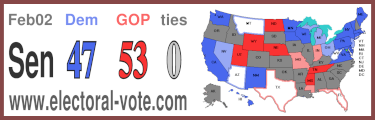
New Senate: DEM 49 GOP 51
New polls:
Dem pickups: (None)
GOP pickups: (None)
Previous | Next
China Threatens Retaliation if Trump Imposes More Tariffs
Earlier this week, Donald Trump said he was considering imposing tariffs on $200 billion worth of Chinese goods. China responded yesterday, saying essentially two can play this tariff game. Only China didn't threaten to match Trump dollar for dollar, saying that it would put tariffs on only $60 billion worth of American products. It is hard for China to match U.S. tariffs dollar for dollar because the U.S. imports much more from China than it exports. Nevertheless, China has other ways of hitting back if it wants to.
One way China could fight back is by devaluing its currency against the dollar, making Chinese exports to the U.S. cheaper and U.S. exports to China more expensive. In fact, it is already doing precisely that, as the renminbi has dropped 9% against the dollar since April.
That said, it's hard to believe Trump will impose more tariffs and rev up the trade war just before an election. Investors certainly don't believe him anymore. It used to be that when Trump threatened a trade war, markets would tank. That's not true anymore. It is not that trade wars are less harmful then they were a few months ago. It's that a lot of people now think Trump's bark is worse than his bite (cue the the ancient Roman boy who cried lupus). Trump threatens all kinds of things but only infrequently follows through and the word has gotten out. (V)
Manafort's Accountants Testify
The trial of former Trump campaign manager Paul Manafort is zipping along, upholding Judge T.S. Ellis III's reputation for running a rocket docket. Yesterday Manafort's accountant, Cindy Laporta, testified, and it wasn't good for Manafort. Laporta was granted immunity because she said she would plead the Fifth Amendment if she didn't get it. Her problem is that she prepared tax returns for Manafort that she knew were false, which is a crime. One specific area that she was concerned about in 2014 and 2015 is the $2.4 million that Manafort's firm received from foreign sources. Manafort told her the money was a loan, but he had no documentation, and the money came from known clients, so Laporta strongly suspected it was income that should have been reported and wasn't.
Remember, Manafort is charged with tax evasion, and testimony from his accountant that she thought he was engaged in, well, tax evasion, is going to be hard for the defense to rebut. So far, the best Manafort's lawyer could come up with was something about him being a busy man and keeping track of every payment of a few million is pretty hard to do. Except two days ago, his bookkeeper said Manafort was a detail guy and kept track of every penny. Oops.
To make it worse, a previous accountant, Philip Ayliff, who did Manafort's taxes for 20 years before Laporta, testified that he specifically asked Manafort about foreign bank accounts, but Manafort never told him about the large number he had. Also noteworthy is Ayliff's testimony that when Manafort bought an expensive townhouse in Manhattan in 2012, he asked Manafort where the money came from, and the answer was it came from his wife's savings account. Prosecutors allege that it was wired in from one of Manafort's Cyprus-based businesses. In short, prosecutors are making a very strong case that Manafort earned millions of dollars overseas, spent it on luxury goods and real estate, and didn't report any of it to IRS. (V)
Democrats Are Hoping for a Blue Wave, But Are Experiencing a Green Wave
All the talk about a possible blue wave may end up being true or not, but the green wave is happening right now. That is, Democrats are raising a lot of money. At the moment, in 73 House races, the Democrat has acquired more of that green stuff than the Republican. That could change, of course, but donors greatly prefer backing winners since the return on investment backing a loser is zero. So, fundraising is a big clue as to which way the wind is blowing.
One measure of enthusiasm in political races is how much money candidates can raise, and according to that metric, the Democrats are doing well. Non-incumbent Democratic candidates raised three times as much in Q2 2018 as they did in Q2 2014. Much of the effect is due to the increasing polarization of politics. In 2016, Donald Trump bragged that he could shoot someone on Fifth Avenue and wouldn't lose any voters. That may well be true, but the hatred for him among Democrats is just as strong as the love for him among his supporters, and that hatred is translating into cold, hard cash for Democratic House candidates. The hatred is so strong that money is rolling in even in districts that neither party thinks the Democrats can win. But of course, if enough money rolls in, a previously unwinnable district could become competitive.
One factor that could affect the election is that Republicans are defending 42 open seats and Democrats have raised more money than Republicans in half of them. And remember, by definition, these are Republican districts because the current (retiring) representative is a Republican. There are very few Democratic-held districts where the Republican has more money.
One new feature of the fundraising this year is how Swing Left is operating. Traditionally, fundraising groups focused on candidates they wanted to support. Swing Left is focusing on districts, rather than candidates, and has raised $5 million, much of it before the Democratic nominee was even chosen. The money has been held in escrow until a nominee is selected, and then, bingo, money suddenly appears.
On the other hand, the RNC has raised $213 million to the DNC's $109 million. That will go a long ways toward leveling the playing field. The activist groups, like Swing Left, collect their money from small donors whereas the party committees get it from very large donors, and there the Republicans are way ahead since they have many more large donors. (V)
Trump to Visit Ohio Today
As we noted yesterday, Ohio will have the last "Can the Democrats flip a Republican district" election before the November midterms. Although OH-12 has a PVI of R+7, and Donald Trump won it by 11 points, polls now have the race between Democrat Danny O'Connor and Republican Troy Balderson as a dead heat. Further, since Balderson had a 10-point lead as recently as a month ago, the momentum seems to be favoring O'Connor. Anyhow, in an attempt to save the seat, Trump will hold a rally in Columbus today.
This is a pretty high-stakes gamble. If Balderson ekes out a narrow win, or even a not-so-narrow win, Trump will claim all the credit. This will give him some extra political capital heading into the midterms, and will likely force some GOP candidates to hug him a little closer. On the other hand, if O'Connor prevails, it will suggest that Trump has no coattails. That's not a good look for him less than 100 days before the midterms, and may cause some swing-district Republicans to back off from the President, not only in the next few months, but also in the next two years. (Z)
Trump Slams LeBron James
When it comes to the kind of athletes that Donald Trump likes to target, NBA star LeBron James checks all the boxes. Namely:
- He is black.
That James is well known, willing to speak his mind, wealthy, and so forth is helpful, but none of those things is essential for an athlete to be targeted by the President.
Anyhow, the attack on James came via Twitter, of course, since Trump rarely attacks people to their face:
Lebron James was just interviewed by the dumbest man on television, Don Lemon. He made Lebron look smart, which isn’t easy to do. I like Mike!
— Donald J. Trump (@realDonaldTrump) August 4, 2018
In theory, what set the President off was James' declaration that Trump is "using sports to kinda divide us." That's pretty mild, and also dangerously close to being a statement of fact rather than an opinion, but it was enough for the Donald, who prefers his basketball players to be seen and not heard (like Michael Jordan, aka "Mike," who is notoriously apolitical).
We only point this out because it's a particularly clear-cut example of how calculated Trump's attacks on athletes (read: uppity blacks) really are. Everyone knows Trump does not watch CNN; if he did, he would have seen the interview when it first aired four days ago. What he knows—or what somebody pointed out to him, more likely—is that James recently departed Ohio (specifically Cleveland) as a free agent for the Los Angeles Lakers. There was a lot of anger the last time James did that (when he left the Cavaliers for the Miami Heat in 2010), and the President clearly thinks that he's got a chance to score some brownie points with Ohio voters (see above). It's something to keep in mind once Trump starts blasting NFL players again, which should happen in a couple of weeks, as training camps are now underway. (Z)
Butina Connected with Trump Campaign
Donald Trump's campaign seems to have had contact with every Russian in the United States who was up to no good. Accused Russian operative Mariia Butina seems to have had contact with just about every prominent Republican and GOP-affiliated organization in the country. And so, it was all-but-inevitable that the two stories would eventually converge. On Friday, courtesy of the Washington Post, they finally did.
The connector is J.D. Gordon, who served for six months as the Trump campaign's director of national security and then worked on his transition team. Characteristic of Butina's alleged playbook, she exchanged a few e-mails with Gordon, batted her eyelashes at him, and all of a sudden she was getting invites to go to rock concerts and to attend his birthday party. It would seem that the security "expert" persuaded himself that an attractive 29-year-old surely must be romantically interested in someone more than two decades her senior, and that she could not possibly have ulterior motives.
Gordon was fairly small potatoes in the overall scheme of the campaign. That said, "small potatoes" is where hostile operatives (and, for that matter, special counsels) begin their work. So, we shall see if we soon learn about contact between Butina and more significant members of the campaign (besides her brief meeting with Donald Trump Jr., which was already known). (Z)
Manhattan Madam Met Mueller
As if the whole Russiagate affair didn't include enough sex, what with porn stars, playmates, and a sexy Russian spy in the mix, it added even more spice yesterday when it came out that special counsel Robert Muller interviewed the "Manhattan Madam," Kristin Davis, on Wednesday. Davis once ran a high-end prostitution ring in New York and went to prison as part of the scandal surrounding then-governor Eliot Spitzer, although Davis was not Spitzer's supplier. As we noted previously, it was suspected that Mueller was planning to have this conversation, but now it's official.
So what is Mueller up to? It turns out Davis is close to Donald Trump's friend and adviser Roger Stone, although it is not clear if their relationship is professional or social, and if professional, whose profession. However, in 2010, Davis ran for governor of New York on a platform of legalizing prostitution (and marijuana). Stone was her strategic campaign adviser. In 2016, she was on Stone's payroll, performing various tasks. Two sources told CNN that one of the things Mueller was curious about is whether any of those tasks resulted in Stone fathering Davis' son. How that relates to Russia is a mystery, but Mueller is looking closely at whether Stone committed any crimes and talking to people who know him well does make a certain amount of sense. Of course, Mueller may have specific knowledge of things that are not public that may make his interview of Davis fit in better. (V)
FBI Can't Keep Top Computer Security People from Leaving
Just as the FBI is expected to start taking serious action to prevent Russia from hacking another election, it is facing a difficult problem: Top cybersecurity managers are leaving the Bureau for better-paying jobs in the private sector. Almost 20 top cybersecurity leaders have left the bureau in the past five years and the pace is quickening as private companies are realizing that they also need cybersecurity experts. Companies can pay much more than the government can, so it is hard for the FBI to stop the brain drain.
Just recently, four top FBI managers, each with more than 20 years' experience with the bureau, departed for the private sector. Their departures coincided with Donald Trump attacking the FBI as the "deep state," but his attacks probably didn't play much of a role. College tuition bills probably were a bigger factor. Austin Berglas, who ran the New York cyber branch for years, said the Bureau needs to "reassess its compensation and incentives." But for any government agency, especially one the president hates, that isn't so easy absent a lot more money. The base pay for an FBI assistant director isn't bad ($185,767), but large banks in New York pay between $450,000 and $950,000 for cyber executives. One can easily envision the temptation to jump ship.
One former FBI official said that a potential problem is that since the FBI is under a lot of pressure to fill top cybersecurity jobs, it might pick people who are not really trained in cybersecurity, which could hurt morale down the chain, as well as lead to bad management decisions. (V)
Back to the main page