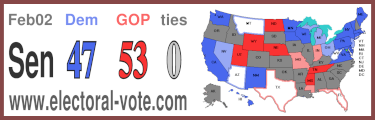
New Senate: DEM 49 GOP 51
New polls:
Dem pickups: (None)
GOP pickups: (None)
Previous | Next
Giuliani: Trump Could Pardon Himself but He Probably Won't
Donald Trump's lawyer Rudy Giuliani has argued that the president can do just about anything he wants to and, echoing Richard Nixon, believes that if the president does it, then by definition it is legal. Yesterday, Giuliani told NBC's Chuck Todd that if Donald Trump tried to pardon himself, it would lead to immediate impeachment. Giuliani didn't discuss what would happen if Trump saw the handwriting on the wall, didn't like what it said, and then issued himself a pardon followed by resigning 5 minutes later.
Whether Trump would really be impeached if he pardoned himself and decided to stay in office is not at all clear. So far, Trump has done half a dozen things that would have gotten a Democratic president impeached but there is no talk of impeachment at all in the House, although House Majority Leader Kevin McCarthy (R-CA) and Rep. Will Hurd (R-TX), among others, suggested on Sunday they would not be happy if the President tried to pardon himself.
Further, it is not clear if a self-pardon would even be constitutional. Prof. Ethan Leib of the Fordham Law School has said that the Constitution mandates that the president take care that the laws are faithfully executed, and this prohibits self-dealing. In practice, ultimately, if he were to pardon himself and some prosecutor indicted him anyway, it would probably be up to Anthony Kennedy to make the call, as usual. (V)
Team Trump Seems to Be in Full-Blown Panic Mode
The weekend began with the leaking of a January letter from Donald Trump's then-attorneys John Dowd and Jay Sekulow to Special Counsel Robert Mueller. The letter says many things, but its primary argument is that as president (and head of the Dept. of Justice), Trump cannot possibly commit obstruction of justice. This is an argument that nearly all lawyers, and even some of the President's closest allies, find preposterous. After the letter was leaked, Trump responded with outrage, accusing someone working for Mueller of being the leaker. This is a bit hard to swallow, since the only person who benefits from the publication of a letter laying out a bunch of pro-Trump arguments is Donald Trump. Subsequent events have made it look even less likely that Mueller's team was the culprit, and that instead, someone in the Trump camp planned a weekend-long, highly public push-back against the Russiagate investigation.
Assuming this theory is correct, then the promulgation of the letter—followed by a lot of bloviating from Rudy Giuliani and from Trump—was just the first step. The second step was Giuliani's interview with NBC (see above), in which he went even further than the letter, floating the notion that the President could decide to pardon himself. This is a considerably more aggressive, and an even more tenuous, assertion than the notion that a president cannot commit obstruction.
In step three of the weekend's machinations, meanwhile, Team Trump shifted gears. Nearly everything we heard on Saturday and for the first half of Sunday had to do with the powers and privileges of the presidency. Eventually, though, the focus shifted to excusing any blame Trump may have for his circumstances. Giuliani, for his part, made the remarkable argument that Trump should not be compelled to testify before a grand jury because, "our recollection keeps changing." Here, actually, is the counselor's whole quote, which certainly does not help dispel the theory that Giuliani's cheese is slipping off his cracker:
I mean, this is—this is the reason you don't let the President testify. If, you know, every, our recollection keeps changing, or we're not even asked a question, and somebody makes an assumption, in my case, I made an assumption and then I, then, then we corrected, and I got it right out as soon as, as soon as, as soon as it happened. I think that's what happened here.
In terms of being rambling and nearly incomprehensible, Giuliani is giving the President a run for his money, which is saying something. And in any case, it's remarkable that he could make that argument with a straight face—that Trump can't be asked to testify because, in effect, he can't keep his story straight (actually, nobody on Team Trump seems to be able to do so, including Giuliani). On some level, it's actually a refreshingly honest assessment—Giuliani is, in so many words, admitting that Trump is 100% guaranteed to perjure himself. The problem for the President is that there is no judge (or special counsel) in the land that would excuse a witness for this reason.
Trump himself also got into the act, getting onto Twitter to point fingers in many different directions:
As only one of two people left who could become President, why wouldn’t the FBI or Department of “Justice” have told me that they were secretly investigating Paul Manafort (on charges that were 10 years old and had been previously dropped) during my campaign? Should have told me!
— Donald J. Trump (@realDonaldTrump) June 3, 2018
....Paul Manafort came into the campaign very late and was with us for a short period of time (he represented Ronald Reagan, Bob Dole & many others over the years), but we should have been told that Comey and the boys were doing a number on him, and he wouldn’t have been hired!
— Donald J. Trump (@realDonaldTrump) June 3, 2018
Mark Penn “Why are there people from the Clinton Foundation on the Mueller Staff? Why is there an Independent Counsel? To go after people and their families for unrelated offenses...Constitution was set up to prevent this...Stormtrooper tactics almost.” A disgrace!
— Donald J. Trump (@realDonaldTrump) June 3, 2018
There are really three different arguments here; let's take them one by one:
- The FBI Should Have Warned Me!: When a candidate
runs for office, there is only one person whose responsibility it is to vet his or her
underlings: The candidate. This is not the FBI's job, and furthermore, it is
neither smart nor appropriate to advise outsiders about ongoing investigations. If
the target is innocent, then their name will have been unfairly slurred. And if
the target is guilty, they could be tipped off about the investigation and could
destroy evidence or otherwise cover their tracks. In the specific case of
Manafort, his ties to Ukraine, Russia, etc. were hardly a secret. Trump likely
knew, and if he didn't, he could have asked just about anyone: Mike Pence, Jeff
Sessions, Sam Clovis, the valet at any decent Washington restaurant. Everyone
knew.
- Manafort Wasn't that Big a Part of the Campaign!:
Manafort was a part of the campaign for six months, and was its chair for two of those,
from June 21 to August 17, 2016. A week is a lifetime in politics, and two months is an
eternity. Especially those two months, since that period included the Republican
convention and Trump's formal nomination.
- Aaargh! The Clintons!: In the third tweet, Trump is basically quoting Penn, who was on Fox News on Sunday, and who hasn't had a direct association with the Clintons since Hillary's 2008 presidential campaign, during which there was a serious falling out. However, the Donald makes a slight but important error, either willfully or due to poor memory. What Penn actually said is that there is a lawyer who represented the Clinton Foundation on Mueller's staff. That is true; Jeannie Rhee once represented the foundation against a (frivolous) racketeering charge when she worked for WilmerHale. However, working as counsel for the Clinton Foundation is far from the same thing as being part of the Clinton Foundation. If so, well, Ty Cobb has frequently represented the king of Saudi Arabia. Does that mean that Trump had members of the Saudi royal family on his legal staff up until the point that Cobb resigned? It's also worth noting that WilmerHale is currently representing Ivanka Trump, Jared Kushner, and Manafort, among others.
In short, as we said yesterday, it was a "throw everything at the wall and see what sticks" kind of weekend for Team Trump. This is a strategy that has Rudy Giuliani's fingerprints all over it, though the exact purpose is unclear. There is no chance that Mueller's team is going to be influenced by any of it. Those folks learned long ago to ignore political pressure and spurious legal arguments. That leaves us with three plausible possibilities, any or all of which might be on the mark:
- Trump demanded that his legal team do something, and this is something.
- This is all for the benefit of Deputy AG Rod Rosenstein, for whatever reason.
- This is all for the benefit of the base, in the hopes that it will get them to the polls in support of "Trump is above the law" members of Congress.
We may never learn which it is. On the other hand, given how leaky the Trump White house is, we might know the truth by the time the sun sets tonight. (Z)
Republicans Are Getting More Optimistic about Holding the Senate
After a few months where it looked like the Democrats might be able to take control of the Senate, things are looking up for the GOP now. In principle, Republicans should have a good year because 10 incumbent Democrats are up in states Donald Trump won, in some cases by double digits. Only three Republican seats (Nevada, Arizona, and Tennessee) are in any danger. Nevertheless, midterms have historically been bad news for the president's party, almost without exception. So looking at the Senate from a macro perspective, Democrats should be happy, but looking at it race by race, Republicans should be happy. Still, five changes in recent weeks are all good news for the GOP. These changes are as follows.
- Trump's approval: A number of polls have shown Donald Trump's approval now just above 40%. While that is
not a good place to be, it is better than being in the high 30s, where it was a few months ago. Presidential
approval always plays a role in the midterms. An unpopular president always hurts his party and the less
popular he is, the bigger the hit. Of course, it is now June, not November, and a lot can happen between
now and then (economy, trade, North Korea, Mueller, etc.)
- Missouri: The resignation of former governor Eric Greitens is a godsend to the Republicans. He threatened
to bring down the whole Missouri party. Now he is history and Republican Senate candidate Josh Hawley
can talk about something else. This makes Sen. Claire McCaskill (D-MO) one of the three most endangered
Democrats. That said, Greitens is threatening to do everything he can to bring Hawley down with him, so
the Missouri GOP might not be done with him quite yet.
- Arizona: To the relief of all Senate Republicans, Sen. John McCain (R-AZ) is still alive. It is not that
they like him so much—he can be a thorn in their side sometimes—but the filing deadline for
Arizona passed last week. If McCain had died in May, there would have been a second Senate race in Arizona.
Currently, two far-right candidates, Kelli Ward and Joe Arpaio, are beating each other's brains out and
will split the far-right vote, likely allowing establishment candidate Rep. Martha McSally (R-AZ) to squeak
through and get the nomination. She would be the favorite to hold the seat of retiring Sen. Jeff Flake (R-AZ).
If McCain had died in May, either Ward or Arpaio would have switched to the special election for McCain's
seat, giving the Democrats a shot at picking up two seats in Arizona. Now if McCain dies or (likely)
resigns, Gov. Doug Ducey (R-AZ) will appoint a senator who will serve until Jan. 2021. No matter what
McCain does, there will be no special election in Arizona this year. This is a massive relief to
Senate Majority Leader Mitch McConnell (R-KY), even though he doesn't especially care for McCain.
- West Virginia: McConnell's super PAC spent a ton of money trying to make sure coal baron and former felon
Don Blankenship wasn't the Republican candidate for the Senate in West Virginia. It worked;
West Virginia Attorney General Patrick Morrisey won the primary, and he is far more electable than
Blankenship. Nevertheless, before the GOP can break out the champagne, they have to beat Sen. Joe Manchin (D-WV),
who has won five statewide elections in West Virginia and is still popular. He is no pushover.
In addition, Blankenship wants to run against Morrisey and Manchin on the Constitution Party ticket. The main problem
is that West Virginia has a "sore loser" law that says a candidate who lost a primary running for
one party's nomination can't run in the general election as the candidate of another party. Blankenship is going
to sue the state on this one. If he wins, he can run, otherwise, he is finished.
- The economy: Unemployment is down and the economy just keeps humming along. In every election, when jobs are plentiful, inflation is way down, and there don't appear to be any clouds on the horizon, the president always claims credit, as Donald Trump is doing now. If the economy keeps improving until November, the Republicans will have a strong argument with the voters.
On the other hand, the Democrats are doing well in Nevada and Tennessee, so they could possibly pick up two seats. But in order to control the Senate, they can't lose any of their own seats. Also, there is an outside chance that Mike Espy could pull off an upset (a la Doug Jones) and win a special election in Mississippi for the seat of former senator Thad Cochran. For the past 100 or so years, predicting that a black man could win a Senate seat in the deep South was incredibly stupid, but Mississippi is about a third black, so if Espy can get all the black voters in the state to show up and vote for him, plus most of the well-educated white suburban voters, he has a small chance. (V)
Charlie Cook: Tax Cuts Won't Save the House
Widely respected election guru Charlie Cook spoke to House Republicans 2 weeks ago in Maryland. His message was that the tax bill will not save the House for the GOP. He said polling shows that it helps a little with Republicans, but the effect is already lost on independents. It did nothing to get more Democrats in the mood to vote Republican. He doesn't think the Republicans will be able to hold the House, but he does think they can hold the Senate.
If Republicans had to choose which chamber they would prefer holding, it would be a tough call. If Democrats take the House and Republicans hold the Senate, Donald Trump is likely to be impeached and a very messy trial will ensue. On the other hand, a Republican-controlled Senate can keep confirming Trump's judicial picks, including Supreme Court picks if any vacancies arise. A Republican House would avoid impeachment, but a Democratic Senate would probably refuse to confirm many judges and other appointments. This is not merely idle speculation. Republicans have only so much money available to spend on the election and the RNC has to decide if it wants to give priority to Senate races or House races. If it is split 50-50, they could end up losing both chambers. (V)
Russians Are Already Hard at Work on the Midterms
A new Website, usareally.com, suddenly appeared about 2 weeks ago. Cybersecurity company FireEye, located in Milpitas, CA, says that its operators once worked in the same St. Petersburg building in which the notorious Internet Research Agency operates. The website's goals seem to be to foment racial divisions, undermine social cohesion, and harden feelings over hot-button issues like immigration, police brutality, and gun control. The site also has a Facebook page and a Twitter account.
FireEye's Lee Foster said that multiple indicators suggest that the St. Petersburg troll farm is behind the site. It posts about nine new news articles a day, some of them in poor English. It also plans to emphasize news that the major media won't touch (like crazy conspiracy theories). Foster also said the website may be part of a larger campaign by the Russians to influence the election. So far, Congress has appropriated some money for more secure voting machines, but it will be years before they are purchased and operational. Meanwhile, the Russians will once again be running a mutlipronged attack on democracy with almost no pushback from the federal or state governments. (V)
Jungle Primaries Make Strange Bedfellows in California
In 2010, California joined Louisiana in adopting, for most state offices, the "jungle primary." Under this system, the two candidates with the most votes advance to the general election, regardless of party affiliation. This change was prompted by a budget standoff in 2009, during which Republicans and Democrats both held the state budget hostage for 100 days as neither would give ground In theory, jungle primaries are supposed to fix these kinds of problems by steering votes toward more moderate candidates. It hasn't worked out that way.
As we've pointed out numerous times, the jungle primary has some serious weaknesses baked into it. To start, they actually tend to encourage fringe candidates to hang around, since first place may be out of reach, but second is viable. The result is often more polarization, not less. More moderate Democrats get pulled leftward, and more moderate Republicans get pulled rightward, as they can spend the entire primary season getting attacked from the fringe. Further, jungle primaries leave almost no room for independent candidates, as only two candidates advance to the final round of voting. Finally, the system assumes a roughly equal number of viable candidates, ideally two or three, from each major party. It does not work as well when one party has far more viable candidates than the other.
With tomorrow's primaries in the Golden State almost upon us, the downsides to the jungle primary system are coming into particularly sharp focus:
- Case Study 1—The Congressional Races: The
Democrats badly need to flip some Republican seats in California if they wish to
take the House back. Their problem is that enthusiasm in some key districts is
high on their side, inspiring many strong candidates to throw their hats into
the ring, and fairly low on the GOP side, sometimes inspiring only two or three strong
candidates to sign up (or even fewer). In CA-39,
for example,
the blue team drew two well-funded challengers, while incumbent Ed Royce (R)
decided to retire. Those should both be good things for the blue team, but they
have actually proven to be serious problems. As Royce is out of the race, there
is no one Republican to suck up most of the red vote, with the result that two
GOP candidates are in line to split it pretty evenly. Meanwhile, the two
millionaire Democrats have torn each other to shreds, depressing enthusiasm on
that side of the race, particularly among younger voters. Based on early voting,
it is possible that neither of the leading Democrats will advance, despite
expenditures of nearly $10 million. At this point, many of the left-leaning voters
who are going to the polls are not concerning themselves with which candidate
they want the most, but which Democrat has the best chance of surviving to the
next round.
A similar drama is playing out in CA-48. There, incumbent Dana Rohrabacher (R) is trying to hold his seat, but he's somewhat unpopular due to his close relationship with the Russian government and with Donald Trump. Meanwhile, GOP challenger Scott Baugh has run a solid campaign, with the result that the two men are also likely to split the Republican vote pretty evenly. At the same time, there are three viable Democrats, and they too are likely to split the blue vote pretty evenly. Needless to say, 1/2 of roughly 1/2 is more than 1/3 of roughly 1/2. The result is that the fairly purple district (PVI of R+4) could end up with two Republican candidates in the final round. The DCCC and other party organs are trying very hard to avoid taking sides, for fear of alienating voters. This means getting involved on the Republican side, a practice whose name references a particular type of rodent engaging in a particular type of intimate contact. For a while, the Democratic pooh-bahs were propping up Baugh, in hopes that he would steal votes from Rohrabacher and allow two Democrats to advance. Now that it is clear that isn't likely to happen, they are dumping money on the #3 Republican, an unknown named John Gabbard who hates Democrats and doesn't want their money ($137,000 of it). He's accused the DNC of, "bringing its classic unethical tricks from the swamp in Washington to the shores of Orange County." - Case Study 2—The Governor's Race: Tactical
voting is nothing new in American politics, but—as the case of CA-39
illustrates—the jungle primary can take things to extremes. When it comes
to the governor's mansion, there is little question that Lt. Gov. Gavin Newsom
(D) is going to advance to the second round. However, voters on both sides of
the aisle have a tough choice to make. The leading Republican is John Cox, who
has no political experience, and no chance of beating Newsom in November.
However, he has money and the backing of Donald Trump. So, those GOP voters who
are worried that a "headless" ticket could depress Republican turnout in
November will vote Cox. Those GOP voters who want a more viable general election
candidate, and one with actual political experience, will vote Assemblyman
Travis Allen. On the Democratic side, meanwhile, many voters will be working in
the opposite direction. Since the blue team would benefit enormously from a
double-Democrat general election race, a lot of folks who actually like Newsom
will end up voting for one of his two Democratic rivals—former L.A. mayor
Antonio Villaraigosa or state treasurer John Chiang (D)—in hopes of getting
one of them to round two.
- Case Study 3—The Senate Race: Dianne Feinstein (D) is nearly certain to be reelected, so much so that she's drawn very mediocre GOP opposition. This also creates an interesting dynamic for voters on both sides of the aisle. Democrats, for their part, could invest their votes in Democrat #2, state Sen. Kevin de León, in hopes of guaranteeing the seat remains in Democratic hands. On the other hand, Feinstein is so strong, and the GOP field so weak, that they could choose to invest their votes in the leading Republican, in hopes of embarrassing the party. You see, the Republican who appears to be atop the polls (there haven't been many) is Patrick Little. Maybe he's leading because he's got a generic, recognizable-sounding name, or maybe it's because he's a neo-Nazi and an avowed anti-Semite. Nobody knows, though the state and national GOP have both denounced him and begged people not to vote for him. Meanwhile, Republican voters could vote for de León, so as to keep Little off the ballot, or they could vote for Little in hopes of getting some Republican to the second round, or they could throw a Hail Mary pass and vote for one of the other GOP candidates in hope that person somehow advances. The problem there is that there are almost a dozen minor candidates to choose from, and the one with the most name recognition among them, which he has purchased with his personal fortune, appears to be Roque "Rocky" De La Fuente. The good news is that De La Fuente is not a neo-Nazi. The bad news is that if he makes it to the next round, he may be a bit busy. You see, he's also running for the Senate in Washington, Minnesota, Wyoming, and Florida. He might also enter the races in Hawaii, Delaware, and Vermont, too.
In short, whatever problems the jungle primary was meant to solve, it doesn't seem to be solving them. Meanwhile, it is enabling kooky candidates, forcing voters to support candidates they don't like (and may even loathe), and potentially shutting entire segments of the voting public out of the general election. California loves to be different; perhaps they can take a look at instant-runoff voting, which more effectively addresses the issues the Golden State was trying to address in the first place, and without most of the nasty side effects. (Z)
Trump's Tariffs Are Not Popular
Donald Trump has imposed various tariffs because he genuinely believes America is the world's sucker when it comes to trade. Politically, the tariffs are not winners. A new Politico/Morning Consult poll shows that 70% of voters want Trump to focus on opening new markets for American-made products abroad rather than engaging in trade wars. Only 14% disagree. So, if Trump really imposes tariffs—and other countries impose their own tariffs—the result is not going to be a win politically. Various groups have estimated that a trade war could cost upwards of 2 million U.S. jobs, something that would immediately become a major campaign issue in the fall. (V)
Back to the main page