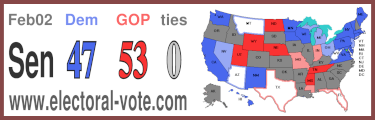
New Senate: DEM 49 GOP 51
New polls:
Dem pickups: (None)
GOP pickups: (None)
Previous | Next
Cohen Plot Just Keeps Thickening
AT&T is under enormous pressure to provide answers as to exactly what they were buying with the $600,000 they paid to Trump fixer Michael Cohen. On Wednesday, the company declared that the payment was for his advice on "specific long-term planning initiatives as well as the immediate issue of corporate tax reform and the acquisition of Time Warner." A lot of observers wonder exactly what advice could possibly be worth $600,000, while noting that the timing of the contract—three days after Donald Trump was sworn in, and while the telecom giant had major business before the Dept. of Justice and the FCC—is a bit fishy.
AT&T and the other companies that paid Cohen—Switzerland's Novartis and Korea Aerospace Industries—could be in big trouble here. The United States has laws against bribery, of course, while Switzerland and South Korea have laws against a corporation trying to purchase favors from a foreign government. The Swiss, in particular, tend to be very aggressive about looking into these things. Of course, there are also other ways that these corporations could have tried to curry favor with Trump, like hosting events at Trump-owned properties, or donating to his inaugural committee. Since the Trump-branded property in Washington has been doing a land-office business and the inaugural committee collected over $100 million, those kinds of influence peddling are possibly on the table, too.
Cohen could also be in big trouble. A U.S. court could decide these payments were bribes, or that they were bank fraud, or both. If that's not enough for him to worry about, news also broke on Wednesday that Columbus Nova—which also gave money to Cohen, and which counts Russian oligarch Viktor Vekselberg as its most important client—was also dabbling in URL speculation, buying up nearly a dozen alt-right themed web addresses like alternate-right.com and alt-rights.com.
It's possible that everyone involved in this story will be able to persuade the world that nothing untoward has taken place. But it is also the case that Essential Consultants L.L.C—a shell corporation of the sort that is often set up to hide bad behavior—now connects Donald Trump, his lawyer/fixer, a porn star with whom Trump allegedly had an affair, several deep-pocketed domestic and foreign corporations with an interest in gaining Trump's favor, a prominent Russian friend of Vlad Putin, and the alt-right. This could all be a big coincidence, but that's certainly not the answer that Occam's Razor favors. (Z)
McCain Ignored, Insulted
Sen. John McCain (R-AZ) has made very clear that he does not want to see Gina Haspel confirmed as Director of the CIA. She has overseen torture programs, something that McCain, himself a former POW and torture victim, finds reprehensible. The Senator's colleagues listened respectfully to his opinion, and now appear to be planning to pay him no heed. Sen. Lindsey Graham (R-SC), McCain's closest friend in the Senate, has already said he's voting for Haspel. Sens. Jeff Flake (R-AZ) and Bob Corker (R-TN) appear to have fallen in line, too, which raises the question of exactly what the pair think it means to be "anti-Trump," since they vote the way the President wants nearly 100% of the time.
It's not just that McCain's words appear to have fallen on deaf ears, though. His reward for his troubles has been to see himself publicly attacked in an absolutely disgraceful manner. We already knew that "POW and war hero" does not make one off limits to the Trump White House. We now know that adding "dying" to the list doesn't change anything. In fact, when White House aide Kelly Sadler was asked about the Senator's opposition to Haspel, Sadler said it did not matter because "he's dying anyway." Hours later, outspoken Trump supporter and former Fox military analyst Thomas McInerney appeared on the Fox Business Channel to defend torture as an information-gathering technique, declaring that, "The fact is, is John McCain, it worked on John. That's why they call him 'Songbird John.'" McInerney offered no proof of this, and there is zero evidence that McCain ever gave up any intelligence to the enemy. Nor has he been called "Songbird John" in public prior to yesterday. But such is the state of political discourse in the Age of Trump. (Z)
Nielsen Almost Resigned
Some have suggested that Donald Trump is ill-tempered and prone to fits of rage. Others have suggested that he's verbally abusive toward his female underlings. Both of these things would appear to have been substantiated by the news on Thursday that Secretary of Homeland Security Kirstjen Nielsen, who was already rumored to be miserable in her job, nearly resigned after being screamed at in front of the entire cabinet for her alleged failure to secure the border. According to inside sources, the letter is still sitting on her desk, and while she may decide to shove it in a drawer, she might also still give it to the President, and tell him to shove it.
Trump's anger has two specific sources. The first is that after a sharp dip in border crossings last year, things are back up this year. That means he's no longer able to brag about being the most successful president ever when it comes to keeping immigrants away. The second is the caravan of Central Americans that is slowly making its way to the U.S. border, which has become a near-obsession for the Donald (more below). Now, if we are to hold Trump to his own verbiage, the border cannot be secured without a wall. That wall has not, as yet, been built. The question that one might ask is: Is that Nielsen's fault? She does not prepare the budget, nor is it in her purview to persuade Congress to spend money. If the situation is not to Trump's liking, perhaps he should be looking elsewhere. Like, in any mirror. (Z)
Trump's Tweets Return to Haunt Him...Again
You know what one of the easiest kinds of cases to win is? Undocumented immigration. It's illegal, and it's easy to adjudicate—either the person has proof of citizenship, or they don't. And one of the hardest kinds of cases to win? Discrimination. Although it is a violation of the Civil Rights Act of 1964 to discriminate on the basis of race, color, national origin, sex, or religion, most people who might be guilty of this particular misdeed are also clever enough not to leave proof of what they are doing lying around.
Donald Trump is not most people, though. And when it comes to the caravan of 1,000 or so Central American immigrants that are fleeing persecution and trying to escape to America, the President is laser-focused on keeping them away and on signaling to his base that he's taking a STRONG stand on the matter. To that end, he and AG Jeff Sessions cooked up a scheme wherein they hauled about a dozen of the new arrivals before a criminal court, as opposed to the usual civil deportation system. At the same time, Trump—as he is wont to do—has spoken rather freely about the subject on Twitter.
As a consequence, Trump and Sessions have flipped the usual script. The Central Americans are fighting back, and—now that it's a criminal prosecution—they're doing so with lawyers paid for by the government. The lawyers (and their clients) have a solid chance of winning a usually unwinnable case, because they've got an excellent argument: Trump is discriminating on the basis of national origin, which is illegal. Again, this is usually a hard charge to prove, but the President has done the defendants the favor of leaving evidence in plain view, where it can be seen by any of the 262 million Twitter users in the United States who decide to take a gander. Thus, Trump has managed to put himself in a situation where he could well lose a case that's generally a winner, while his opponents could win a case that's generally a loser. Our guess is that this will not be getting a chapter in the next revision of "The Art of the Deal." (Z)
Trump's Preparations for Mueller Interview Going Poorly
One of Donald Trump's lawyers—and these days, you can never know which lawyer is making the decisions—thought it would be a good idea to begin prepping the President for his likely interview with special counsel Robert Mueller, who appears to be ready to secure the President's cooperation by hook or by grand jury summons. Since Trump will eventually need to get ready anyhow, there's no time like the present. And if things had gone well, it may have persuaded Team Trump to cooperate with Mueller, rather than dig their heels in and force him to go to the grand jury (and, likely the Supreme Court).
Things did not go well, of course. Trump sat for four hours of prep time and, between the interruptions that come with being president, along with the Donald's tendency to bloviate, he managed to make his way through a grand total of...two questions. Needless to say, there are a hundred ways that Trump could hurt himself with this kind of meandering inefficiency. His lawyers must be having nightmares now (if they weren't already), and the chances that they allow Trump to be interviewed before exhausting all possible delays and routes of escape are rapidly approaching 0%. (Z)
Time Running Short for NAFTA Changes
Government negotiators are working furiously to try to hammer out a replacement for NAFTA, which Donald Trump does not like, and has frequently criticized. They are making little progress, and U.S. Trade Representative Robert Lighthizer knows he's up against the wall. On Thursday, he learned exactly how against the wall he is, as Speaker Paul Ryan (R-WI) set a deadline of May 17 for a vote. Once that date passes, Ryan says it will not be possible for the House to approve a new trade pact in time for the start of the new year.
Deadlines have a wonderful way of driving things forward, as the current Congress has demonstrated more than once. That said, the issues here are so complicated that negotiators have tried half a dozen times to hammer something out, and have gotten nowhere. So, Lighthizer will likely need a miracle (or an extension). If this matter gets tabled for now, there's a good chance that it remains tabled for the rest of Trump's term. Mexico is about to have a presidential election, and looks set to elect Andrés Manuel López Obrador (aka AMLO), who loathes Trump and is loath to work with him. Not long thereafter the Democrats may take control of the House, and they don't want to work with Trump, either. So, unlike the Iran nuclear deal, NAFTA probably still has life left in it. (Z)
Grassley Pushes Supreme Court Justices to Retire
Senate Judiciary Committee Chairman Chuck Grassley (R-IA) appeared on Hugh Hewitt's radio show on Thursday, and he had some thoughts about the immediate future of the Supreme Court:
I just hope that if there is going to be a nominee, I hope it's now or within two or three weeks, because we've got to get this done before the election. So my message to any one of the nine Supreme Court justices, if you're thinking about quitting this year, do it yesterday.
Grassley knows that with recesses, and election season, and the time it takes to get a justice approved, there is actually fairly little time left between now and November 6.
Although the Senator addressed himself to "any one of the nine" justices, he does not seriously believe that Justices Ginsburg, Sotomayor, Kagan, and Breyer are interested in his advice. And Grassley has no particular interest in seeing Justices Roberts, Alito, Gorsuch, or Thomas leave. This means that he was really speaking to one person: Swing justice Anthony Kennedy, who is nominally a conservative, and whom Grassley would very much like to replace with someone who is more than nominal is his conservatism.
Grassley is not going to get his wish; Kennedy presumably enjoys being one of the three or four most powerful people in the country, and has hired clerks for the next two SCOTUS terms. So, he's not going anywhere, particularly in the next two or three weeks. And if and when Kennedy does go, assuming he's next, Grassley is still at serious risk of being disappointed, because John Roberts may well slide into Kennedy's role as the swing vote.
For a very long time, the members of Congress on both sides of the aisle placed value on the independence of the judiciary, and would have been mortified to presume to tell a Supreme Court justice what to do. Clearly, the separation between branches has seriously eroded, with the Judiciary Committee Chairman happy to lead the charge. (Z)
Back to the main page